Peru Count Puts Mendoza on 30.9% in Cusco Governor Race

POLITICS · PERU
Key Facts
- —The country Peru is the world’s third-largest copper producer (BNamericas, February 2026). Its southern Andean regions of Cusco, Apurímac, Arequipa and Moquegua hold much of that copper belt.
- —Why it matters Big mines are licensed in Lima, but regional governors run budgets fed by mining revenue. They also shape the community talks that keep mines working or stop them.
- —Why now Peru elected 25 regional governors on Sunday 4 October. A ticket needs 30% of valid votes to win outright; otherwise a runoff follows on 29 November.
- —What happened At 89.680% counted on 5 October, ONPE had Verónika Mendoza’s Venceremos alliance on 30.873% in Cusco. PRIN had 16.588%, RPP reported.
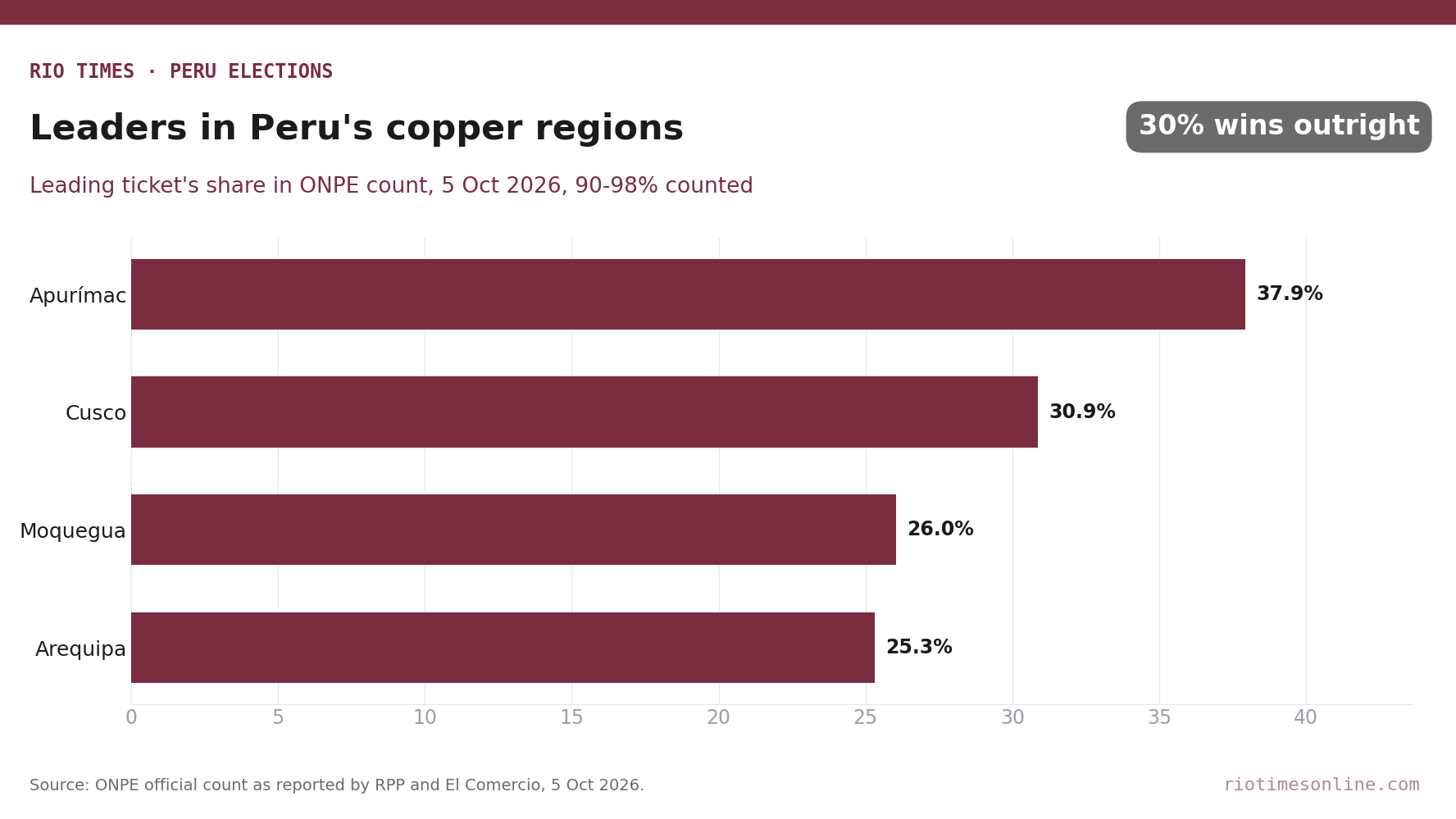
- —The numbers ONPE counts on 5 October: Apurímac leader 37.923% (96.7% counted); Arequipa leader 25.301% (98.0% counted); Moquegua 26.028% against 25.185% (98.1% counted).
- —What it means for you Freeport-McMoRan runs Cerro Verde and Arizona-based Southern Copper is developing Tía María, both in Arequipa. Washington and Lima signed a critical-minerals memorandum on 4 February 2026.
- —Still open Whether Mendoza stays above 30% as rural tally sheets arrive, and what each new governor will do about specific mines. Arequipa and Moquegua look headed for runoffs.
Verónika Mendoza, a left-wing critic of how big mines operate, leads the Cusco governor count in southern Peru. With 89.680% of tally sheets counted on Monday morning, the national electoral office (ONPE) had her Venceremos alliance on 30.873%, just above the 30% needed to avoid a runoff, RPP reported. For foreign investors and copper buyers it matters because Peru is one of the world’s largest copper producers, and Washington signed a critical-minerals memorandum with Lima in February.
Mendoza, a former congresswoman and presidential candidate who has led the Nuevo Perú party, has spent more than a decade challenging how mining is regulated. Venceremos, the left-wing alliance she is running for, fielded Ronald Atencio for president in April.
The Cusco Governor Count and the 30 Percent Line
Peruvian law lets a regional ticket win in the first round only with at least 30% of valid votes. Below that, the top two meet again on 29 November.
Mendoza sits just above the line. Her nearest rival, Iván Aparicio of PRIN, a national party that ran Walter Chirinos for president in April, had 16.588% in the same ONPE count.
Earlier signals pointed the same way. The exit poll by Datum, a Lima polling firm, for América Multimedia gave her 33.7%, and Datum’s quick count, published by El Comercio, put her on 31.2%.
On Sunday night Mendoza asked supporters for “caution, patience, responsibility” until official results arrive, Infobae reported. She told RPP that the count “has to be very responsible”.
What Mendoza Says About Mining
Mendoza, a Quechua-speaking anthropologist, represented Cusco in Congress from 2011 to 2016. In 2012, by her own account, she observed dialogue talks in Espinar after deadly protests near the Tintaya copper mine, then run by Xstrata, which later merged into Glencore.
In 2019 she told Canal N that “the way mining has been done in the country no longer works” and needs new rules. She also argued that putting “order in our house” first would give investors security that projects proceed in harmony.
Her 2021 presidential programme went further. It proposed royalties on sales rather than profits, a windfall tax in boom years, and exploration permits in place of mining concessions.
For Cusco itself, Infobae’s summary of her regional plan lists measures against illegal mining among its environmental proposals. It also stresses irrigation, water harvesting and a wastewater plant in southern Cusco.
Glencore’s Expansion Is the First Test
Cusco’s largest mine is Antapaccay in Espinar province, owned by Swiss-based Glencore. The company plans to invest US$1.8 billion in the nearby Coroccohuayco deposit, Gestión reported in March.
Glencore aims to roughly double the complex’s copper output, an executive said in March, according to Gestión. The trade site Dipromin reported an approval from Senace, Peru’s environmental certification agency, on 20 May 2026 and production from 2028.
Local opposition is reported but not independently confirmed. The advocacy site Biodiversidad en América Latina says nine communities demand prior consultation and two face resettlement.
There is also a stabiliser. Large-mine permits remain a national matter, so a governor cannot cancel the project alone.
Apurímac, Arequipa and Moquegua
In Apurímac, home to the Las Bambas copper mine, two tickets cleared 30%. With 96.705% counted, Ahora Nación, the left-wing party of former university rector Alfonso López Chau, had 37.923%. Progresemos, the national party led by Paul Jaimes, its April presidential candidate, had 34.958%, El Comercio reported from ONPE data.
That reverses the Datum exit poll, which had Progresemos’ Guido Chahuaylla on 40.2% against 38.4% for Ahora Nación’s Elvyn Díaz. Under the 30% rule, the leading ticket would win without a runoff.
Arequipa, site of Cerro Verde and the long-disputed Tía María project, looks headed for a runoff. Alfredo Zegarra, a former Arequipa city mayor running for the regional movement Fuerza Arequipeña, led with 25.301% at 97.973% counted, ahead of the Ahora Nación ticket on 14.4%.
In Moquegua, ONPE had Acción Popular, the party founded by former president Fernando Belaúnde, on 26.028%. Somos Perú, which ran George Forsyth for president in April, had 25.185% at 98.077% counted. Both are short of 30%, pointing to a second round.
Earlier coverage: Peru Exit Poll Points to Up to 14 Regional Runoffs and Peru Sets Regional Election Runoff for November.
What It Means for You
For investors, the count touches companies traded in New York. Freeport-McMoRan runs Cerro Verde in Arequipa, and Southern Copper, controlled by Grupo México, is developing Tía María there. A governor cannot revoke national mine permits, but local unrest can stop output, as road blockades around Las Bambas, run by China’s MMG, did in 2022 and 2023.
For US policy, copper is on the critical minerals list, and Peru signed a memorandum on critical minerals cooperation with Washington in February.
For travellers, Cusco is the gateway to Machu Picchu. The vote changes no entry rules, but past protests in the region have blocked roads and halted trains, so check local news around the regional runoffs, currently set for 29 November.
What Is Not Known
The Cusco governor result is not final. Remote rural tally sheets are often counted last, and a small shift could push Mendoza below 30%.
ONPE’s count is also not the proclamation. Peru’s National Elections Jury (JNE), the top electoral court, must still resolve any challenges and formally declare winners in each region.
None of the four leaders has yet set out a post-election position on a named mine. Statements on Coroccohuayco, Las Bambas or Tía María would be the clearest signal for investors.
New governors take office in January 2027. Until then, sitting regional authorities and the national government keep handling mining disputes.
Who is leading the Cusco governor race?
Verónika Mendoza of the Venceremos alliance. At 89.680% counted on 5 October, ONPE had her on 30.873%, according to RPP. The PRIN ticket was second with 16.588%.
Does Mendoza oppose mining?
She has long called for stricter environmental rules, prior consultation and higher mining taxes, rather than an end to mining. In 2019 she said putting order first would give investors security.
Why does a regional election in Peru matter for US copper buyers?
Peru is a top-three copper producer and US firms operate there, including Freeport-McMoRan at Cerro Verde. Copper is on the US critical minerals list, and the two countries signed a minerals memorandum in February 2026.
Sources: ONPE official count via RPP and El Comercio (Apurímac, Arequipa, Moquegua), 5 October 2026; Andina; La República (Datum); Infobae; RPP; Expreso (Datum exit poll); Peru Foreign Ministry; BNamericas; Gestión; Dipromin; La Mula.
Editorial responsibility: Matthias Camenzind, Editor-in-Chief · Editorial standards · Report an error
Read More from The Rio Times