Mogadishu Demolished a Neighbourhood at Midnight
Eastern Africa · Society
Key Facts
—What happened: Federal security forces began demolishing homes in the Tookiyo neighbourhood of Mogadishu’s Yaqshiid district around midnight on Sunday 23 August 2026.
—The injuries: Nearly ten people were hurt in clashes between residents and security forces, according to local reports.
—No death toll: No official casualty figure has been released, and reports of deaths have not been independently verified.
—The dispute: The federal government says the land is state-owned. Residents say they have lived there for decades and want the legal basis published.
—Who objected: Former presidents Mohamed Abdullahi Mohamed, known as Farmaajo, and Sharif Sheikh Ahmed both condemned the operation.
—Official silence: Neither the federal government nor the Banadir Regional Administration — the authority that runs Mogadishu, and which ordered a temporary halt to all demolitions and evictions in May 2026 — had issued a detailed statement by Sunday evening.
Mogadishu demolitions in the Tookiyo neighbourhood began around midnight on Sunday and left nearly ten people injured in clashes with federal security forces. The government says the land belongs to the state, and residents say they have lived on it for decades.
What the Mogadishu demolitions involved
Federal security forces moved into Tookiyo, a neighbourhood of Mogadishu’s Yaqshiid district, at around midnight on Sunday 23 August. Demolitions were still under way through the day.
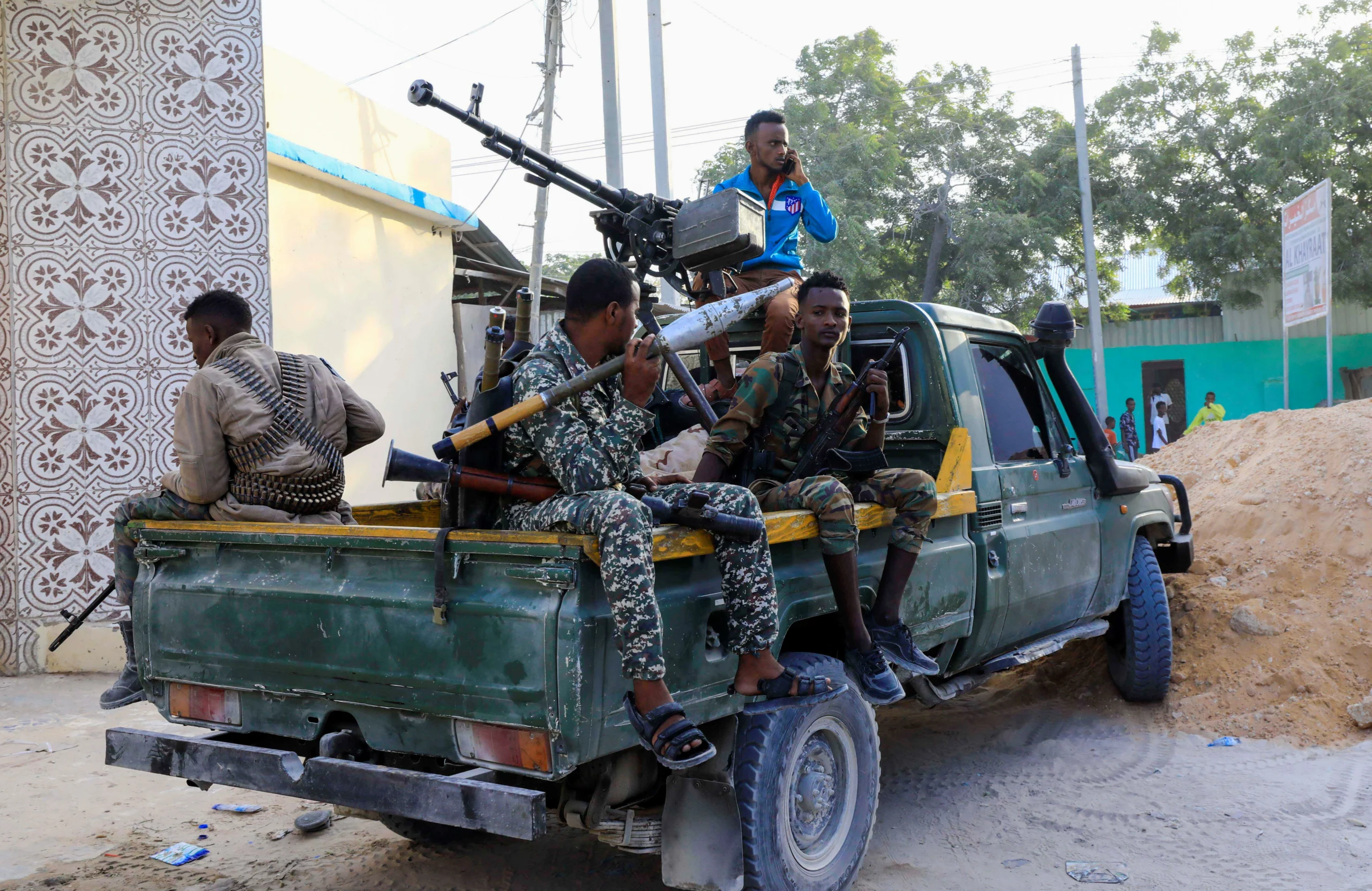
Local outlets reported nearly ten people injured in clashes between residents and the forces, including civilians. Residents told Garowe Online that federal forces used heavy weapons, including DShK heavy machine guns.
We are not printing a death toll. Reports of fatalities have circulated — Kaab TV reported one young man shot dead near Laanta Heegan, Shabelle Media reported several killed, and former president Sharif Sheikh Ahmed referred to deaths without giving a figure — but no number has been independently verified and no official casualty figure has been released.
Turkish air force F-16s flew low over Mogadishu during the operation, including over the affected areas. Turkey stationed the aircraft at Aden Adde International Airport earlier this year for operations against al-Shabaab, the insurgent group that has fought the Somali state for close to two decades. Neither Ankara nor Mogadishu linked Sunday’s flights to the eviction.
The federal government had made no statement. That silence is doing a lot of work in a story where the central question is legal authority.
The argument underneath
The government’s position is that the land is state-owned. On that reading the buildings are encroachments and their removal is an administrative act.
Residents say they have lived there for decades and are demanding that the authorities publish the legal basis for the demolitions. That is a narrower and more answerable demand than it sounds.
Somalia’s land records were largely destroyed in the collapse of the state after 1991. Establishing who owns what in Mogadishu is genuinely difficult, and that difficulty is exactly what makes unilateral clearance so contested.
Where documentation is thin, possession over decades is the only claim most families have. A demolition order that does not engage with that is, in practice, a decision that the claim does not count.
Two former presidents on the record
Mohamed Abdullahi Mohamed, universally known as Farmaajo, and Sharif Sheikh Ahmed both condemned the operation over the forced displacement of families. Both are former heads of state and current opposition figures.
Reports put the number of displaced families in the hundreds, though that figure is not official either.
Land clearance in Mogadishu has been a live political issue through 2026, and opposition-backed protests over alleged land seizures took place in May. This is a continuing argument rather than a new one.
Their intervention converts a district-level dispute into a national political one, which raises the cost to the government of proceeding without an explanation.
Why a market is the next question
Residents fear the operation will extend toward Suuq Bacaad, one of Mogadishu’s largest markets and the food distribution hub for the capital’s northern districts.
If that happened the consequences would stop being confined to one neighbourhood. Wholesale food distribution in a city of several million runs through a small number of physical sites.
Nothing has been announced about Suuq Bacaad and the fear may prove unfounded. It is worth recording because it is what people in the area are actually worried about.
For anyone with commercial property or logistics exposure in Mogadishu, the operative risk is not the demolition itself but the absence of a published legal process around it.
The wider context for outsiders
Mogadishu has been rebuilding for more than a decade, with diaspora money financing much of the construction. Rising land values in a city without reliable title records are a predictable source of conflict.
That combination has produced repeated clearance operations, and each one tests whether the federal government can demonstrate authority through process rather than force.
Somalia is simultaneously courting foreign investment, expanding its port and airport concessions and negotiating offshore exploration. Investors reading those files should read this one alongside them.
The immediate thing to watch is whether the government publishes the legal basis it has so far withheld.
There is also a humanitarian dimension that will outlast the news cycle. Families cleared from an urban neighbourhood rarely find equivalent housing, and Somalia already hosts one of the largest internally displaced populations in the world.
Aid agencies working in Mogadishu have spent years trying to move people out of informal settlements and into secure tenure. An overnight clearance runs directly against that effort.
The city has absorbed waves of arrivals from the countryside, driven by drought, conflict and the collapse of rural livelihoods. Most of them landed in exactly the kind of settlement now being cleared.
Frequently Asked Questions
What are the Mogadishu demolitions?
Federal security forces began demolishing homes in the Tookiyo neighbourhood of Yaqshiid district around midnight on Sunday 23 August 2026, according to Radio Dalsan, in an operation that was still under way through the day.
How many people were hurt?
Local reports put the number at nearly ten, including civilians. No official casualty figure has been released.
Were people killed?
Reports of fatalities have circulated but have not been independently verified, and no official figure exists.
Why is the land disputed?
The federal government says it is state-owned. Residents say they have lived there for decades and want the legal basis for the demolitions published.
Who has criticised the operation?
Former presidents Mohamed Abdullahi Mohamed, known as Farmaajo, and Sharif Sheikh Ahmed, who directed their criticism at President Hassan Sheikh Mohamud over the forced displacement of families.
Connected Coverage
Our Horn of Africa coverage includes the return of piracy off the Somali coast, South Sudan’s unpaid public workers, and more from our Eastern Africa hub.
This article was produced by The Rio Times’ automated newsroom system. How we use AI · Report an error · Editorial responsibility: Matthias Camenzind, Editor-in-Chief