Mexico Ruling Party Defends 200-Seat Formula
The fight is about arithmetic, not ballots: whether the cap on over-representation is counted for each party or for each alliance decides who holds two thirds of the chamber.

Politics: Mexico
Mexico’s ruling Morena party said on Tuesday 24 November 2026 that neither it, the government nor the National Electoral Institute (INE), the independent body that runs elections, decides how the Chamber of Deputies’ proportional seats are shared out. The statement answers a news report of 23 November that the INE was set to keep the 2024 formula, which gave Morena and its allies about 73% of the seats on nearly 55% of the vote.
The formula decides whether Morena keeps the two-thirds majority it needs in this chamber to pass constitutional changes on its own, before the midterm vote of 6 June 2027, held midway through the president’s term. A majority of that size helped it pass a constitutional overhaul of Mexico’s courts in September 2024, the kind of change US companies with business in Mexico follow closely.
Key Facts
- What. Morena, the ruling party, denies that election authority INE is keeping a formula favouring it.
- Next. The INE has published no decision; the midterm vote is on 6 June 2027.
- Prediction markets. Polymarket, a prediction market, gives Morena 89.5% to win the 2027 legislative election (25 November, 02:47 ET).
- Power Index. Mexico ranks 2nd of 14 in The Rio Times Latin America Power Index, with 70.8 points (November 2026 edition).
- As of. 25 November 2026, 08:00 GMT
The fight is about arithmetic, not ballots: whether the cap on over-representation is counted for each party or for each alliance decides who holds two thirds of the chamber.
Mexico’s 500-member Chamber of Deputies is filled in two ways: 300 seats are won in local districts, and 200 “plurinominal” seats are handed out from party lists to match each party’s national vote. Article 54 of the constitution says no party may hold more than 300 seats, and none may exceed its share of the national vote by more than eight percentage points, unless its district wins alone put it above that line.
In 2024 Morena and its allies, the Green Party (PVEM) and the Labor Party (PT), ran as one coalition and won nearly 55% of the vote and 364 of 500 seats, or 72.8%, a gap of about 18 points between votes and seats. The INE applied the eight-point cap to each party separately, and the Federal Electoral Tribunal (TEPJF), the country’s top electoral court, confirmed the allocation.
Morena took 236 of those seats, the Green Party 77 and the Labor Party 51, according to the INE-approved figures. That put the coalition above the 334 seats, two thirds of 500, needed to amend the constitution.
Critics, whom Morena describes as opposition parties and specialists, want the cap counted for the whole coalition, which would trim that majority. On 24 November Morena’s national executive committee replied that “there is nothing more false” than the idea that the INE is moving to keep the formula.
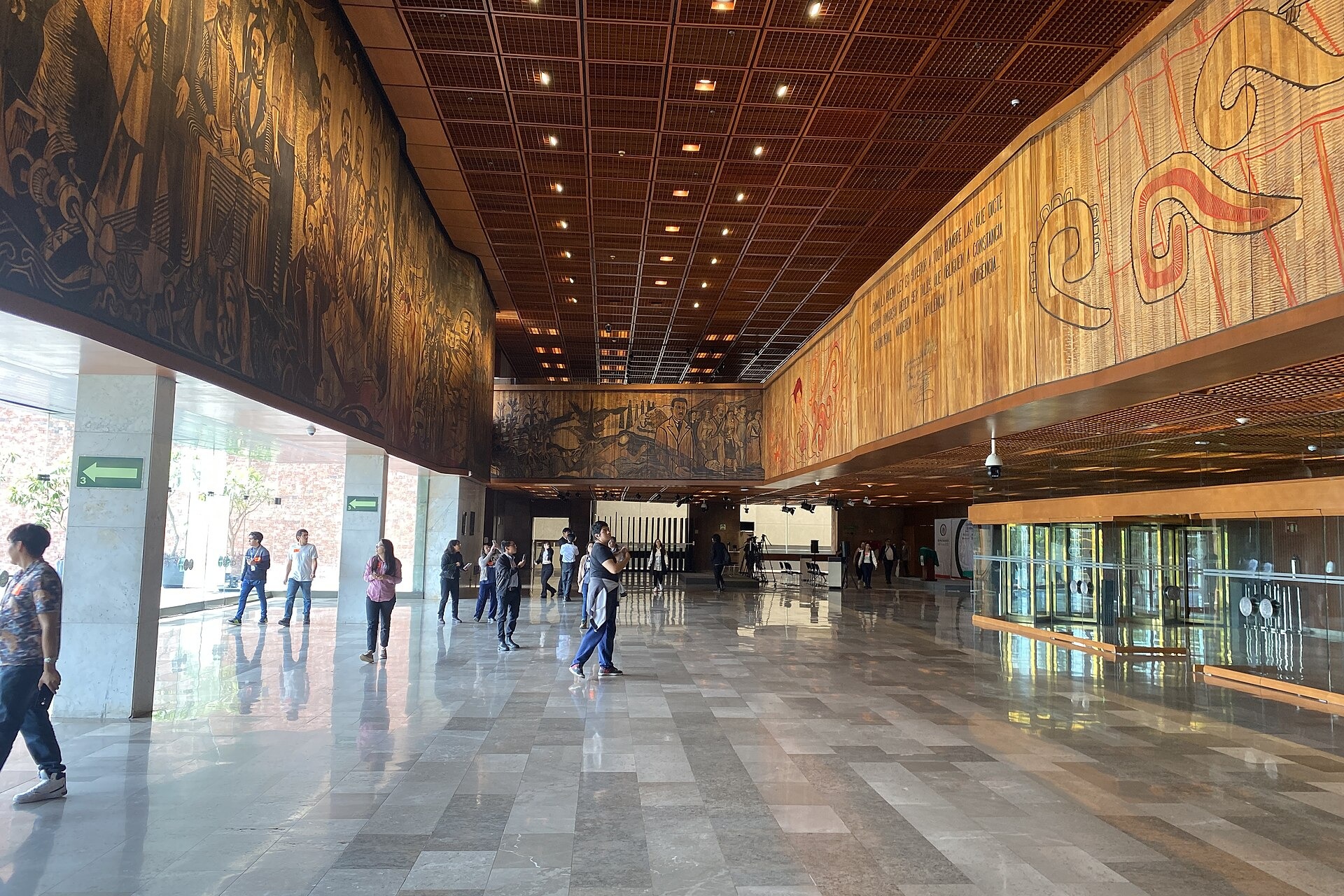
The party said it is the electoral tribunal, not Morena, the government or the INE, that decides the allocation. It added that the same method was used in 2012, 2015, 2018, 2021 and 2024 and “was endorsed at each of those moments by those who now no longer want it applied, because they used to benefit from it” (our translation).
The party’s argument is that the opposition raises the point only now that the rule no longer favours it. It calls that illogical, since the same critics did not object when they benefited.
INE councillors Arturo Castillo and Uuc-kib Espadas said in September that, under today’s constitutional text, over-representation could happen again in 2027, and that changing the rule is a matter for the constitution rather than the electoral authority. Castillo also questioned why the constitutional rule has not been changed since 1997.
The INE’s published agenda for its next regular General Council session, on Monday 30 November, has seven items and none on seat allocation. The institute is led on a provisional basis by Blanca Yassahara Cruz García, who the General Council named on 27 October, while the Chamber of Deputies works on choosing a permanent president.
The opposition National Action Party (PAN) has asked the electoral tribunal to force the chamber to issue the call for candidates for that post. The chamber’s coordinating committee is led by Ricardo Monreal, Morena’s floor leader in the chamber.
Until a formula is published, the only firm date is election day, Sunday 6 June 2027. Whatever rule applies will decide whether Morena can keep amending the constitution on its own.
What Prediction Markets Say
Polymarket, a prediction market, prices Morena at 89.5% to win Mexico’s 2027 legislative election, with US$118,485 traded across the event as of 2:47 a.m. ET on 25 November 2026. These prices are bets, not polls.
Why we show this: prediction markets turn real-money bets into a live probability that moves within minutes of the news, which is why investors, campaigns and newsrooms in the United States now follow them closely. We show them next to polls and official results, never instead of them.
Frequently Asked Questions
What are plurinominal seats?
They are the 200 seats in Mexico’s lower house filled from party lists rather than local races. They are meant to make the chamber match the national vote.
Does the INE decide who gets the seats?
The INE applies the rule and the electoral tribunal rules on challenges, which is the point Morena is making. Both are bound by the constitution’s wording.
Sources
Constitution of Mexico, articles 52 and 54 (Chamber of Deputies) · National Electoral Institute (INE): General Council sessions · Morena: statement of 24 November 2026 · Federal Electoral Tribunal (TEPJF)
Connected Coverage
Mexico news · Mexico Ruling Party Rejects Vote Chief Terms · Mexico Political Parties Explained, Who Stands for What
This article was produced by The Rio Times’ automated AI newsroom. Editorial responsibility: Matthias Camenzind, Publisher and Editor-in-Chief. The Rio Times also runs Ask Rio Times, which answers from 100,000+ of our own articles, the daily Latin America Power Map, and prediction-market odds on elections and markets.. How we use AI · Report an error