Mexico Says No Proof Its Lettuce and Jalapeños Caused Two Large US Outbreaks

HEALTH · MEXICO
Key Facts
- —The country Mexico. Its health regulator, Cofepris (the Federal Commission for Protection against Sanitary Risks), answers to the Health Ministry and joined US inspections of Mexican farms and plants.
- —What happened On 3 October 2026 Cofepris said evidence does not prove Mexican products caused two US outbreaks. The US Food and Drug Administration (FDA) closed both investigations on 2 October.
- —The numbers Cyclospora parasite, linked to lettuce: 12,883 ill, 570 hospitalised, two deaths. Salmonella, linked to jalapeños: 488 ill, 65 hospitalised, no deaths (FDA, 2 October 2026).
- —What it means for you The FDA says recalled lettuce and fresh jalapeños are off the market. The dispute concerns blame and future controls on Mexican produce, not food on shelves today.
- —Still open The FDA is still matching two Cyclospora-positive samples from Mexico with patient specimens. Neither government has announced trade measures as of 4 October.
Mexico’s health regulator Cofepris said on Saturday 3 October that evidence does not show Mexican produce caused two large US outbreaks. It was answering the US Food and Drug Administration (FDA), which closed both investigations a day earlier.
The FDA had tied a parasite outbreak to iceberg lettuce from Taylor Farms de Mexico, and Salmonella to Sinaloa jalapeños. Together they made more than 13,000 people ill in the United States, according to FDA case counts.
What the FDA reported on 2 October
The larger case was Cyclospora, a microscopic parasite that causes watery diarrhoea. The FDA counted 12,883 illnesses, 570 hospitalisations and two deaths across 21 states.
Its inspectors sampled lettuce growers and a processing plant in Mexico, working with Mexican officials. Two samples tested positive: one from a wastewater tank at the Taylor Farms plant, one from a grower’s drainage ditch.
The agency said there is “not enough evidence to conclusively determine how contamination occurred.” It added that the positive samples back “the strong epidemiological data and traceback convergence” linking the outbreak to the recalled lettuce.
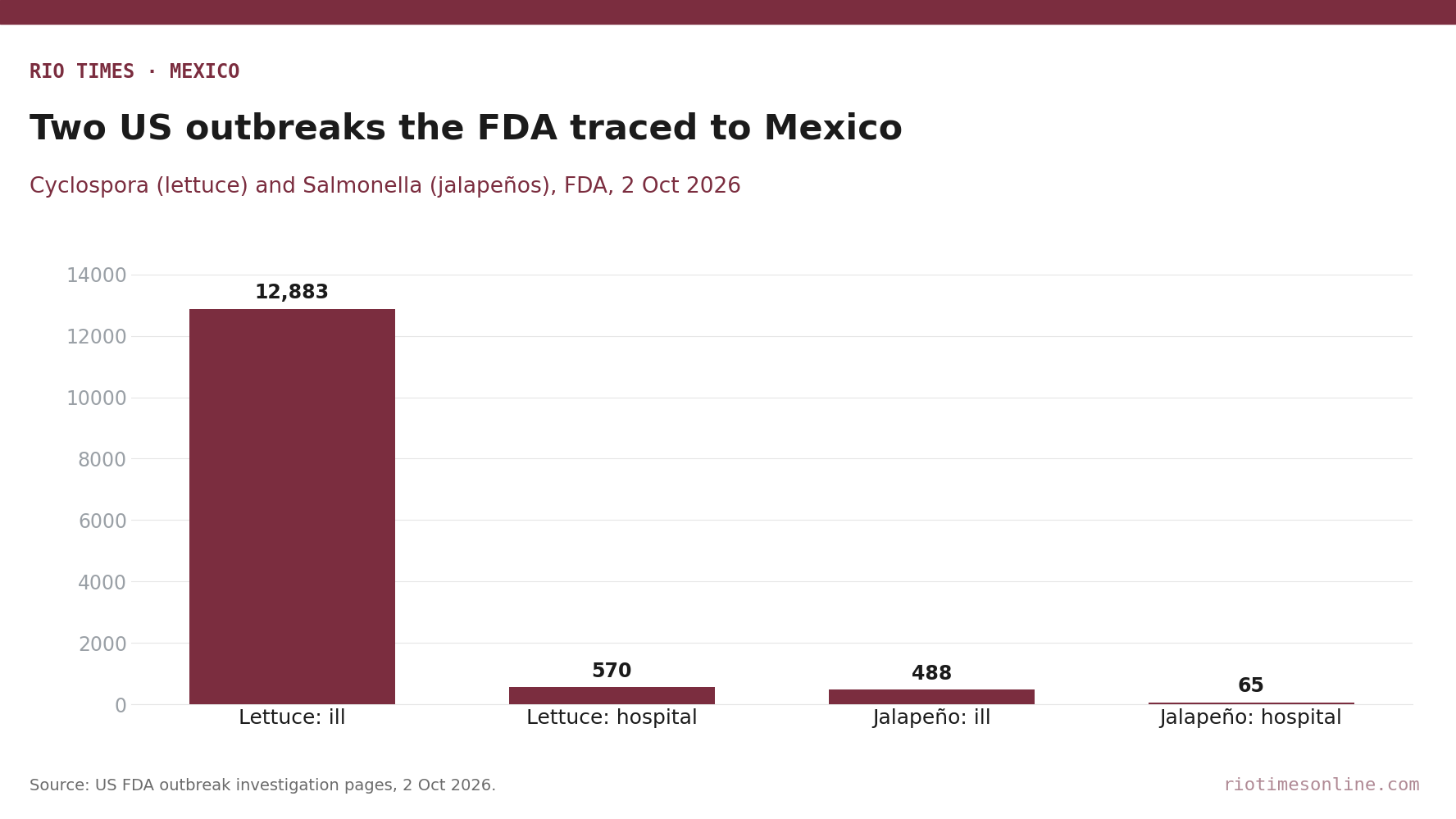
The second case involved Salmonella Javiana. The FDA counted 488 illnesses in 34 states and 65 hospitalisations, with illnesses starting between 16 June and 26 August.
Tracing pointed to a common grower in Sinaloa supplying Coast Citrus Distributors, which recalled its jalapeños. Yet every environmental sample was negative, and the FDA “was unable to determine a route or source of contamination.”
What Cofepris said
Its information note of 3 October said available data do not establish Mexican products as the origin “through conclusive analytical evidence.” It stressed that the FDA itself concedes the contamination route is unproven.
On the parasite, it argued that “environmental findings do not, by themselves, constitute conclusive evidence” that the crops were the source. Its national reference laboratory had earlier tested raw material, finished product and plant water, all negative.
The note ended on a principle: conclusions on the origin of a health risk “must rest on verifiable and conclusive scientific evidence.” It also pledged continued cooperation with the FDA and the US Centers for Disease Control and Prevention (CDC).
Where the two sides actually differ
The disagreement is narrower than the headlines suggest. Both agencies accept that no one has shown exactly how the lettuce or jalapeños were contaminated.
The FDA reads patient interviews and supply-chain tracing as a strong link to Mexican produce. Cofepris treats only laboratory proof on the food itself as decisive.
In a statement reported by the Guardian, Taylor Farms blamed an independent grower it has since dropped. It said its central Mexico facility remains closed.
The Guardian also reported that the FDA’s summer visit to the farm in Guanajuato was its first in more than seven years. US food inspections abroad fell steeply after the pandemic.
Why it matters beyond the clinic
Outbreak findings shape how US buyers and inspectors treat Mexican growers, so the regulator is defending an export reputation. Mexico’s exporters remain closely tied to the US market, as a recent survey on stalled export diversification showed.
For consumers the risk has passed, according to the FDA. Some processed foods made with recalled jalapeños keep longer, so it advises checking home stocks.
What Is Not Yet Known
The FDA is still comparing the genotypes of the two positive Cyclospora samples with patient specimens. A match would strengthen the US case; no match would support Mexico’s reading.
Neither government had announced trade measures as of 4 October. The FDA plans Cyclospora prevention steps before the 2027 season, and Mexico pledges tighter food-safety surveillance.
Sources: US FDA, Cyclospora outbreak investigation, iceberg lettuce and Salmonella outbreak investigation, jalapeños, both updated 2 October 2026; Cofepris, information note, 3 October 2026; El Financiero, 3 October 2026; El Economista, 3 October 2026; The Guardian, 2 October 2026.
This article was produced by The Rio Times’ automated newsroom system. How we use AI · Report an error · Editorial responsibility: Matthias Camenzind, Editor-in-Chief
In depth
LatAm Markets: Live Signals → — real-time movers, turnover leaders and FX across Latin America.