Mexico Export Diversification Stalls, Survey Shows

ECONOMY · MEXICO
Key Facts
- —The country Mexico, Latin America’s biggest exporter, sold 84.69% of its non-oil exports to the United States from January to August 2026, official INEGI data show.
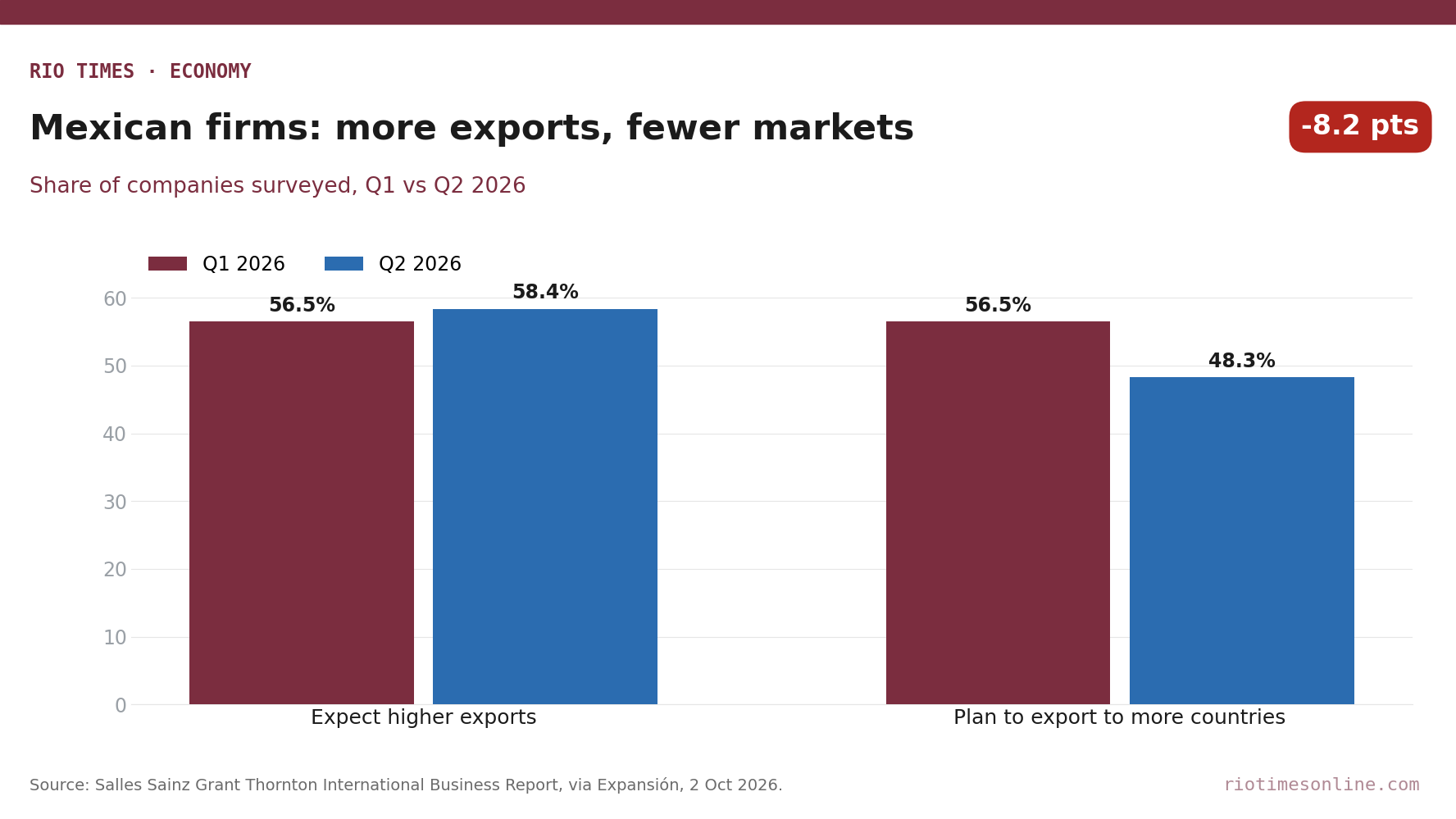
- —What happened In the second quarter of 2026, 48.3% of Mexican firms planned to export to more countries, down from 56.5%, a Salles Sainz Grant Thornton survey found (Expansión, 2 October).
- —The numbers In the same survey, 58.4% expected higher exports, up from 56.5%. Shipping costs and input costs each restrained 55.1% of firms.
- —What it means for you Mexico’s trade remains tied to US demand and US tariff policy, so shifts in Washington still move Mexican output, jobs and the peso.
- —Still open Whether the modernised EU agreement and closer ties with Canada turn into new sales, and how the USMCA review ends.
Mexico export diversification is losing momentum even as companies expect to sell more abroad. Fewer firms now plan to reach new countries, according to a business survey reported by Expansión on 2 October.
The finding sits beside surging trade with the United States. The US took 84.69% of Mexico’s non-oil exports from January to August 2026, according to INEGI, the national statistics office.
More Exports, Fewer New Markets
The International Business Report by Salles Sainz Grant Thornton, an audit and advisory firm, polls Mexican companies every quarter. In the second quarter of 2026, 58.4% expected their exports to rise, against 56.5% three months earlier.
The share planning to export to more countries fell from 56.5% to 48.3%. That is a drop of 8.2 percentage points in one quarter.
Expansión noted that the survey does not show firms abandoning markets. It shows that plans to spread sales more widely are weakening.
The US remained the main opportunity for higher revenue among the companies surveyed. Outside the US, they named Canada, Spain and China, in that order, as the leading new opportunities.
Why the US Pull Stays Strong
Proximity, known buyers and shared supply chains make growth inside North America easier than finding a distributor overseas. In August alone, non-oil exports to the US rose 45.2% from a year earlier, INEGI reported.
Sales to the rest of the world grew 23.5% in the same month. Both figures come from the trade release covered in our report on Mexico Exports Rise 40.4% in August 2026 as Electronics Sales Double.
Costs also hold firms back. In the survey, 55.1% named shipping and delivery costs as a restriction, and the same share pointed to the cost and availability of inputs.
“Diversifying markets is not only a commercial decision, it is an operational and compliance decision,” said Rafael Rubí Carrizoza, partner in charge of the firm’s Tijuana office.
Trade Deals Open Doors, Logistics Must Follow
Kenneth Smith heads the bilateral business committee of COMCE, the Mexican foreign trade business council. He warned that Washington’s tariff-based trade policy may outlast President Donald Trump.
Smith sees room to grow with Canada and through the modernised agreement with the European Union. He said southern farm exporters would need cold chains and better links to Gulf ports.
“We can diversify, even within North America,” Smith told Expansión. That route keeps firms inside regional supply chains while reducing reliance on a single buyer.
Limits Set by the USMCA
Mexico export diversification also meets limits inside the USMCA, the trade pact with the US and Canada. Article 32.10 lets partners exit if one signs a free trade deal with a “non-market” economy.
The clause does not stop sales to China, but it puts a cost on seeking preferential access there. Former economy secretary Ildefonso Guajardo said Washington also wants Mexico to drop some EU commitments on geographic indications.
“That would be totally unacceptable,” Guajardo said, arguing Mexico cannot give up the independence of its trade policy. Our explainer on Mexico Nearshoring Explained: Record FDI, the USMCA Review and What Could Stop It sets out the wider stakes.
What Is Not Yet Known
Expansión did not report how many companies the survey covered, and the full report was not independently reviewed. One quarter of falling intentions does not yet prove a lasting trend.
It is also unclear how the USMCA review will end. Its outcome will shape whether Mexican firms see new markets as insurance or as an unnecessary cost.
Sources: Expansión (Salles Sainz Grant Thornton International Business Report, Q2 2026) · INEGI, Balanza Comercial de Mercancías de México, August 2026, via T21
This article was produced by The Rio Times’ automated newsroom system. How we use AI · Report an error · Editorial responsibility: Matthias Camenzind, Editor-in-Chief
In depth
LatAm Markets: Live Signals → — real-time movers, turnover leaders and FX across Latin America.