Cities of Brazil’s São Paulo state rely on technology, innovation and management to attract investment
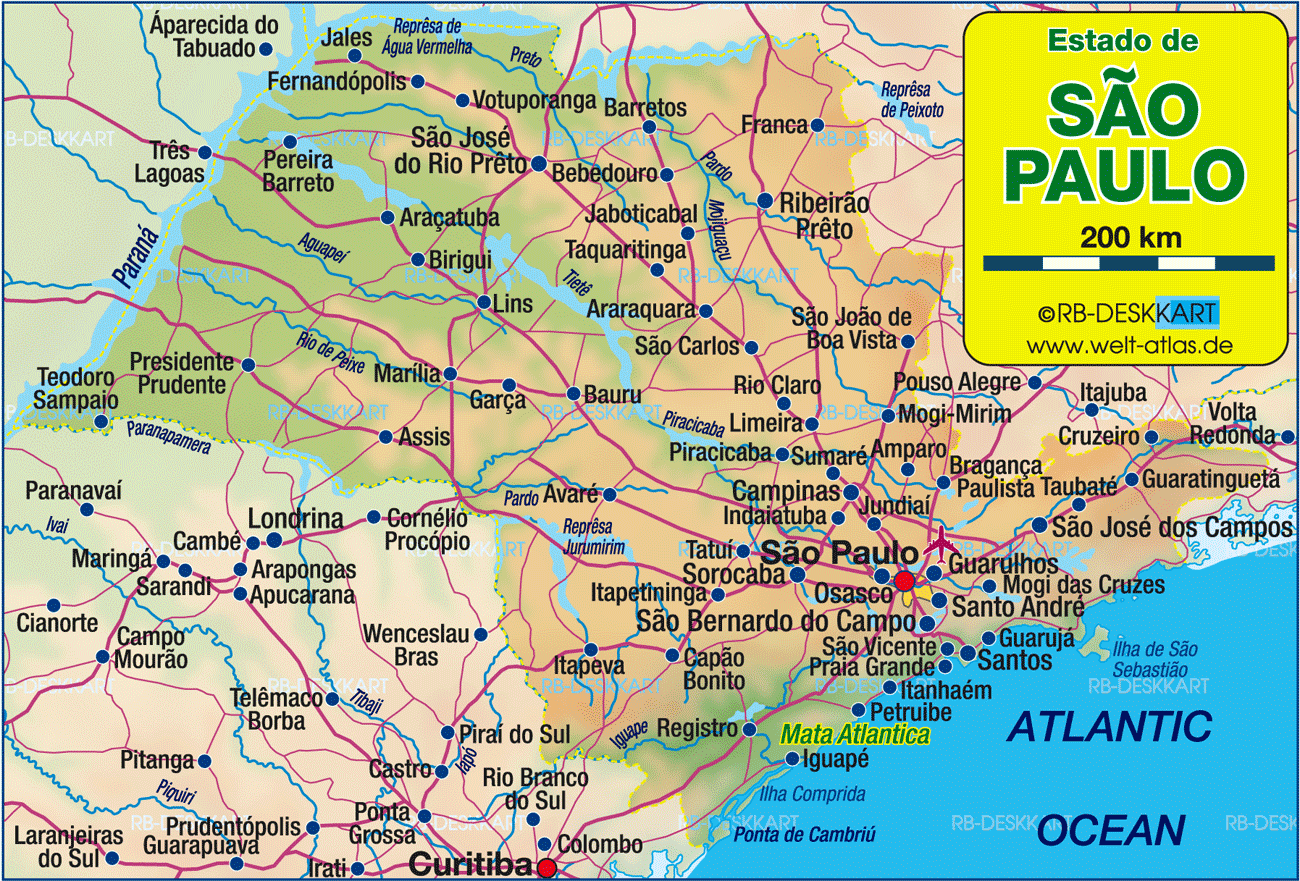
RIO DE JANEIRO, BRAZIL – These cities are among those that have grown the most in the state of São Paulo in recent years, achieving significant successes in various sectors.
However, these advances have required a significant effort to adjust municipal finances. For example, the mayor of Ribeirão Preto, Duarte Nogueira (PSDB), says he has managed to reduce his debt from 32% to 23% of net revenues from 2017 to 2020.
Mayor Gustavo Henric Costa (PSD), who is already in his second term for the PSD in Guarulhos, reported that he started with a public debt equal to 105% of net revenues and reduced it to 31% without increasing the IPTU since 2017.
According to Costa, during that time, he negotiated a billion-dollar debt with Sabesp in the water supply sector. He raised the necessary funds for the expected works against flooding and for creating a linear park along the river that cuts through the city, among other things.
]Now, he wants to create a new industrial park with tax incentives. “There are 200 thousand square meters for a condominium of companies that can locate without paying for the land or IPTU to invest, build and create jobs in Guarulhos,” he said.
In the city government, the need to develop new real estate and build more low-income housing must be balanced with environmental regulations and operational safety requirements of São Paulo International Airport.
Reducing taxes to boost economic sectors has also been one of the alternatives for Osasco and Campinas in recent years. Dário Saadi, elected by the Republicans for his first term in Campinas, explained that the municipality has become more competitive by creating the Economic and Social Activation Program (PAES), with 20 laws to improve the business environment.
These include tax incentives to encourage businesses with lower investment capacity than before; laws to promote startups and innovative entrepreneurship; reduction of the IPTU for industrial and logistics warehouses, an appeal to the Campinas region; low-interest loans for micro and small entrepreneurs; new incentives for culture and new rules for the use of land in the municipality.
“We are keen to consolidate Campinas as one of the country’s high-tech poles. We have an area of 17 million square meters where Unicamp, PUC, and the Sincroton Accelerator Research Center are located. We are about to present to the City Council a project for innovative urbanism, a new way of using and occupying this space for mixed-use,” said the mayor, informing that the plan is endorsed by the two universities and the research center.
The mayor of Osasco, Rogério Lins (Podemos), stressed that he is committed to innovation, technology, and connectivity. When re-elected in 2020, he said he wanted to offset the municipality’s deindustrialization in the last 15 years by attracting technology and service companies.
According to him, with success, following measures such as the reduction of ISS from 5% to 2%, work against flooding, and investment in road infrastructure and digital connectivity.
“Currently, the city has the largest number of tech companies in the country and concentrates 25% of the unicorn startups in the country.” He adds, “As a percentage of the population, Osasco created the most jobs in the state in 2021, with more than 100 thousand jobs signed.”
More: Brazil news in English, every day from The Rio Times.
This article was produced by The Rio Times’ automated newsroom system. How we use AI · Report an error · Editorial responsibility: Matthias Camenzind, Editor-in-Chief