
HUMAN RIGHTS · BURUNDI
Key Facts
- —The country Burundi is a small, landlocked state of central Africa on Lake Tanganyika, bordering Rwanda, Tanzania and the Democratic Republic of the Congo.
- —Why it matters The only UN expert assigned to watch Burundi keeps his job through the run-up to a 2027 presidential election.
- —Why now The vote came at the session that closed in Geneva on Wednesday 7 October, and Burundian reactions are now in.
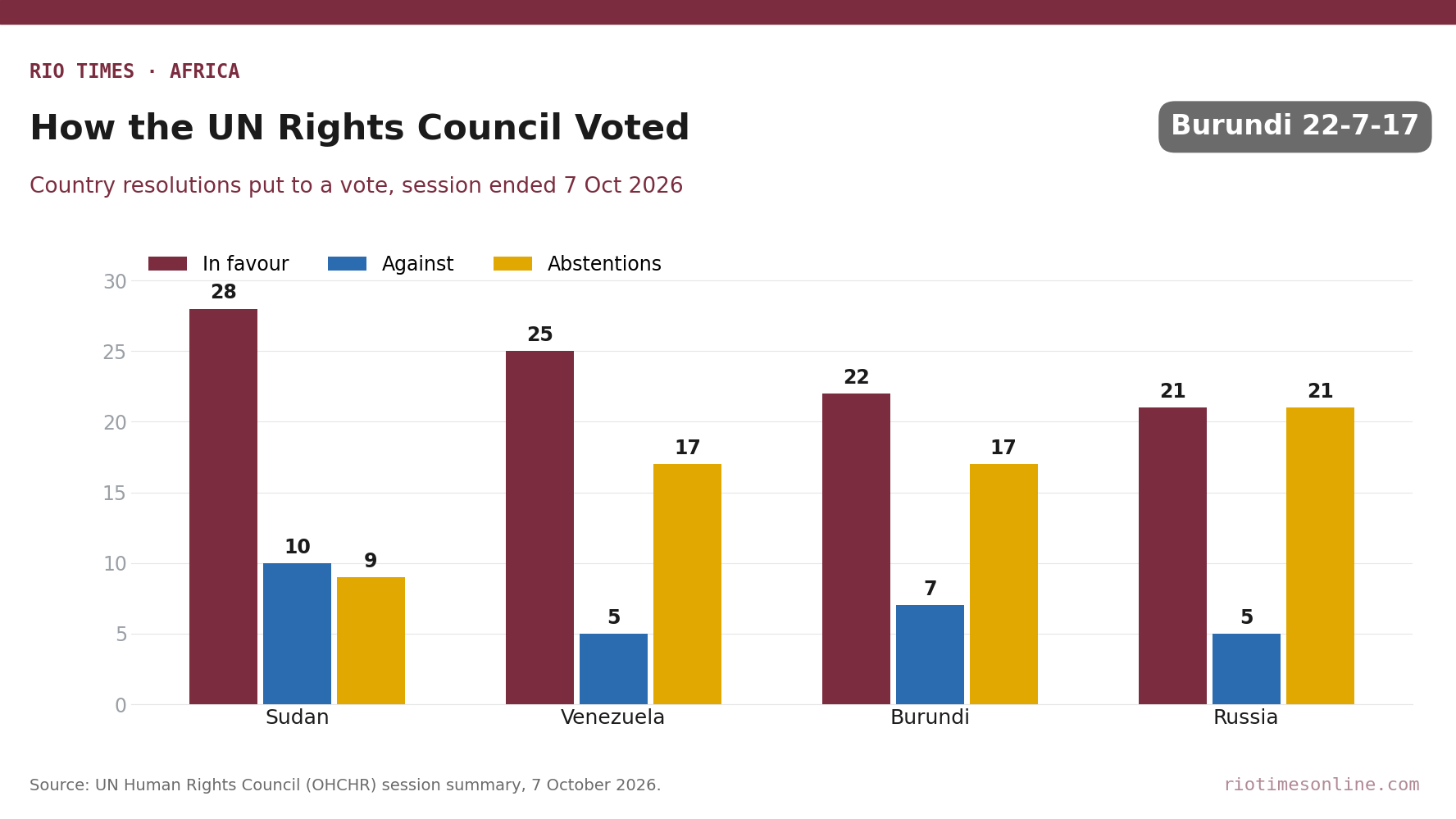
- —What happened The UN Human Rights Council extended the Special Rapporteur’s mandate on Burundi for one year by 22 votes to 7.
- —The numbers 22 in favour, 7 against, 17 abstentions on resolution A/HRC/63/L.13, one of 34 resolutions adopted at the session.
- —What it means for US readers Washington sat out the vote, yet Burundi has agreed to take third-country deportees from the United States.
- —Still open Whether Burundi will ever let the rapporteur in, or set a date to reopen the UN human rights office.
The United Nations will keep a Burundi UN rapporteur in place for another year. The UN Human Rights Council in Geneva renewed the mandate by 22 votes to 7, with 17 abstentions, at the session that closed on Wednesday 7 October. For foreign readers, the main outside check on Burundi’s rights record stays active through an election. It also covers a country that has agreed to receive people deported from the United States.
The resolution, numbered A/HRC/63/L.13, asks the government to create the conditions for a credible presidential election in 2027. It also encourages Burundi to present a timeline for reopening the country office of the UN High Commissioner for Human Rights. The Council’s own session summary confirms the vote count and the one-year extension.
The rapporteur is Fortuné Gaëtan Zongo, an independent expert from Burkina Faso. He reports to the Council but is not a UN staff member, and Burundi has never let him into the country.
How the Vote Split in Geneva
The Council has 47 member states. Its 63rd regular session ran from 7 September to 7 October 2026. It adopted 34 resolutions, ten of them by recorded vote, according to the UN human rights office (OHCHR).
Burundi drew the narrowest margin of the country resolutions put to a vote. Seven states voted against. The independent Burundian outlet Iwacu listed them as Burundi itself, Benin, China, Cuba, Ethiopia, Pakistan and the Democratic Republic of the Congo.
The block of 17 abstentions shows how many governments chose not to take sides. Burundi’s President Évariste Ndayishimiye, of the ruling CNDD-FDD party, attacked what he called the politicisation of the Council. He did so in his September speech to the UN General Assembly, Iwacu reported. He spoke there also as current chair of the African Union.
The mandate was created in October 2021. It replaced a Commission of Inquiry set up in 2016 to document abuses after the crisis of May 2015. That year, a disputed third term for the late President Pierre Nkurunziza triggered protests and a failed coup.
What the Rapporteur Warned About
On 18 September, Zongo told the Council he saw early warning signs of an electoral crisis before the 2027 vote, Iwacu reported. He cited reports of summary or extrajudicial executions, enforced disappearances, torture and ill-treatment.
He also gave credit where it was due. Zongo acknowledged that the 2025 elections took place without major violence. His concern was the lack of conditions for an inclusive, transparent and credible vote. He also noted shrinking space for media and civil society.
His report pointed to the border with the Democratic Republic of the Congo. Arms and fighters circulate there. They include M23, a rebel movement in eastern Congo, and RED-Tabara, a Burundian armed group based on the Congolese side. He added that the Ebola outbreak in Congo poses a risk to Burundi’s weak health system.
Burundi rejects the mechanism outright. Its ambassador in Geneva, Elisa Nkerabirori, called it a propaganda tool that had “lost credibility and legitimacy”, according to Iwacu.
Reactions in Burundi
Lawyer Lambert Nigarura, president of the Burundian Coalition for the International Criminal Court, welcomed the renewal. He described the mandate as an early warning system and told Iwacu that “serious violations continue” and impunity is widespread.
On the other side, Hamza Venant Burikukiye, head of the civic association Capes+, called the renewal a flagrant breach of national sovereignty. He told Iwacu that peace and security reign across the country and accused the rapporteur of wanting to sabotage the next election. He also conceded: “we cannot say we are in paradise.”
Both views will matter as campaigning begins. Iwacu reports that the presidential vote is due in May 2027.
What It Means for US Readers
The United States did not vote. President Donald Trump signed an executive order on 4 February 2025. It says the country “will not participate” in the Council and will not seek election to it.
Washington’s ties with Gitega have nonetheless grown closer. Burundi has agreed to accept foreign nationals deported from the United States. Presidential spokesperson Nancy Ninette Mutoni said it would take only people not accused of crimes or linked to terrorism, South Africa’s TimesLIVE reported. Burundi’s foreign ministry said the details were not yet available, and no legal text has been published.
That is where the rapporteur’s mandate touches American policy. The one UN expert charged with monitoring human rights in Burundi, including the treatment of anyone transferred there, cannot enter the country. The deal is covered in our earlier report, Burundi Agrees to Accept US Third-Country Deportees. Burundi’s wider push for a louder African voice at the UN is set out in Burundi UN Reform Demand Speaks for the African Union.
What Is Not Known
It is not known whether Burundi will engage with the Burundi UN rapporteur at all in the coming year. The government has refused him access since the mandate began. Iwacu reports that a renewed European Union call for access was rejected outright.
There is no timeline for reopening the OHCHR office, which the Council only “encourages”. Nor is it public how many people, if any, the United States has transferred to Burundi so far.
Zongo’s next comprehensive report is due at the Council’s 66th session and at the UN General Assembly’s 82nd session. Both fall in the second half of 2027, after the vote Iwacu expects in May.
Frequently Asked Questions
What did the UN Human Rights Council decide on Burundi?
It extended the mandate of the Special Rapporteur on the situation of human rights in Burundi for one year, by 22 votes to 7 with 17 abstentions, at the session that closed on 7 October 2026.
Who is the Burundi UN rapporteur?
Fortuné Gaëtan Zongo, an independent expert from Burkina Faso. He reports to the Council and the UN General Assembly but has not been allowed into Burundi.
Did the United States vote?
No. A February 2025 executive order says the United States will not participate in the Human Rights Council or seek election to it.
Why does this matter for US deportations?
Burundi has agreed to receive third-country nationals deported from the United States, but has published no terms. The UN rapporteur is the main outside voice on how people are treated there.
When is Burundi’s next presidential election?
It is due in 2027; Iwacu reports May 2027. The Council asked the government to create the conditions for a credible vote.
Sources: OHCHR, Human Rights Council concludes sixty-third regular session, 7 October 2026; Iwacu, Le mandat du Rapporteur spécial sur les droits de l’homme au Burundi renouvelé; The White House, executive order of 4 February 2025; TimesLIVE, Burundi to receive US deportees under new deal, 1 October 2026.
This article was produced by The Rio Times’ automated newsroom system. How we use AI · Report an error · Editorial responsibility: Matthias Camenzind, Editor-in-Chief
Part of our ongoing coverage
Africa: The New Scramble — the great-power contest over the continent.