China and Philippines Seek to Ease Tensions in South China Sea
China and the Philippines agreed to “de-escalate tensions” in the South China Sea after several naval confrontations.
These discussions, held in Manila, revealed significant differences but lacked specific actions to ease tensions. China claims most of the South China Sea as its territory.
Recently, Chinese Coast Guard vessels used water cannons and military-grade lasers against Philippine Navy ships guarding disputed reefs.
These incidents injured Philippine naval personnel and damaged their vessels. Experts warn that these actions bring the region close to an armed conflict.
In response, the Philippines is strengthening alliances with the United States, Japan, and Australia.
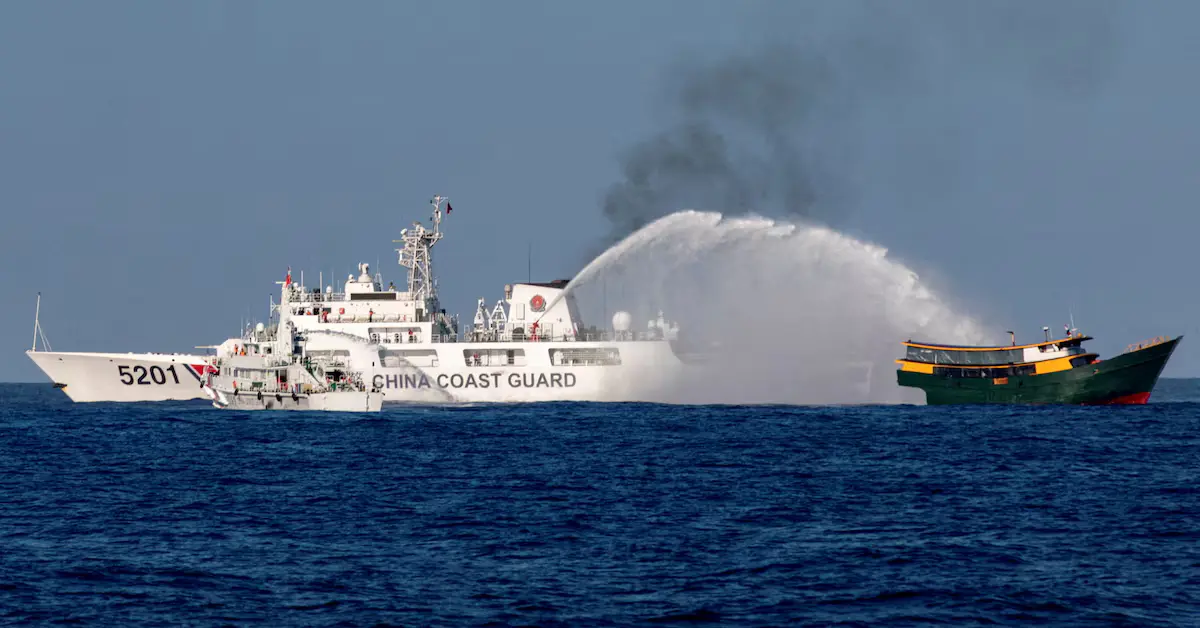
Recent joint maritime activities aimed to bolster regional security and deter further Chinese aggression.
President Ferdinand Marcos Jr. emphasized the need for continued dialogue with China to prevent further incidents and maintain peace.
South China Sea Tensions
The international community condemned China’s actions. The U.S. State Department criticized China’s “dangerous and deliberate use of water cannons” and other aggressive maneuvers.
These actions violate international law and threaten Filipinos’ safety. Canada and Australia also expressed concerns about China’s destabilizing actions.
The tensions arise at a critical time for regional security. The Philippines’ efforts to de-escalate are crucial for peace and testing U.S. commitments under the Mutual Defense Treaty.
This situation underscores the broader geopolitical struggle in the Asia-Pacific region, where power balances and maritime laws face continuous challenges.
China’s aggressive actions, including ramming vessels and boarding boats, heightened the conflict. Manila’s foreign partners have condemned these incidents, highlighting the risk of escalation.
The U.S., Japan, and Australia conducted joint maritime activities to signal their support for the Philippines and to deter further aggression.
President Marcos Jr. called for more talks with China to prevent future incidents. He hopes that continued dialogue and international support will reduce the risk of conflict.
The upcoming summit between the leaders of Japan, the United States, and the Philippines in Washington will discuss these issues further.
The ongoing dialogue and international scrutiny emphasize the importance of diplomatic efforts to resolve such high-stakes conflicts peacefully.
The outcome of these discussions will significantly impact regional stability and international relations in the South China Sea.
This article was produced by The Rio Times’ automated newsroom system. How we use AI · Report an error · Editorial responsibility: Matthias Camenzind, Editor-in-Chief
Read More from The Rio Times