Key Facts
- Gerdau’s New York shares sank 5.44% to US$4.69 the steepest single-session drop among the region’s major steelmakers, as a broad Brazil sell-off punished the sector.
- CSN’s ADR slid 3.71% to US$0.8666 continuing a painful run for the Brazilian mill dragged down by a sluggish domestic construction cycle and rising Chinese imports.
- Ternium held firm, slipping just 0.20% to US$54.69 as the Mexico-based producer’s US-centric auto exposure and protected North American supply chains cushioned it from the sell-off.
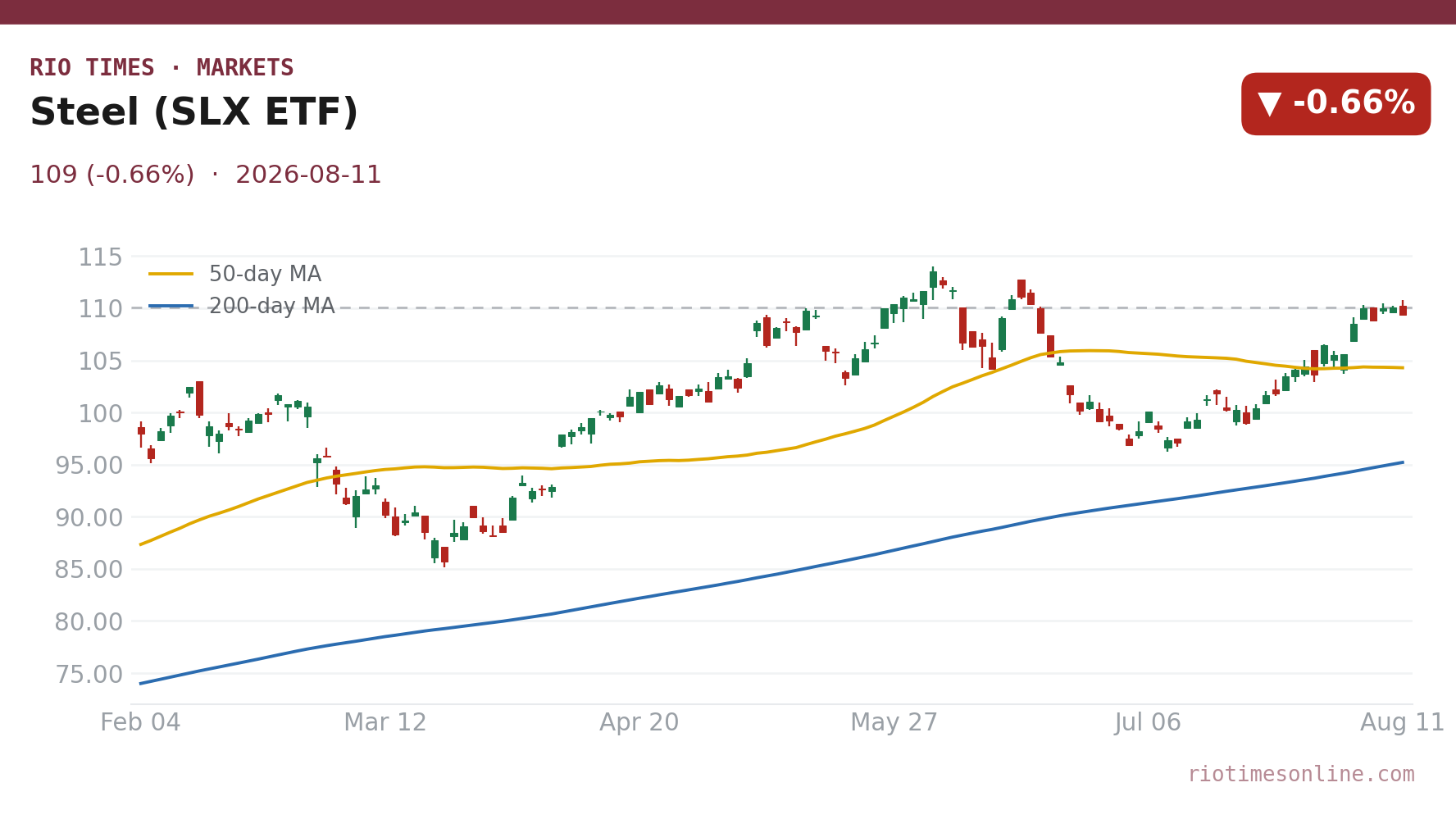
- The steel-producers ETF SLX fell 0.66% to US$109.34 reflecting a global risk-off tilt that hit Latin American industrial metals harder than their US and Asian peers.
- Brazil’s benchmark Ibovespa sank 2.50% to 167,875 with the Basic Materials sector sliding 2.72%, confirming that macroeconomic fears, not just metals weakness, drove the rout.
- The gold price stayed above US$4,400 as escalating Iran tensions and a Strait of Hormuz oil spike drove a flight to haven assets, draining speculative capital from base-metal equities.
Today’s Focus
Latin American steel equities suffered a sharp, lopsided sell-off on Tuesday, August 11, 2026, with Brazilian names bearing the brunt of a broader emerging-market retreat. Gerdau’s New York-listed shares crashed 5.44% to US$4.69 while CSN’s ADR dropped 3.71% to US$0.8666, far outpacing the 0.66% dip in the specialist steel-producers ETF SLX, which settled at US$109.34. The wreckage was not evenly distributed: Mexico’s Ternium gave up barely a fifth of a percentage point to US$54.69, proving almost immune to the panic that swept through Rio and São Paulo.
A triple threat of cheap Chinese steel imports, tentative US tariff rhetoric, and soggy Brazilian construction demand conspired to make the country’s mills the region’s weakest links. The domestic equity backdrop made things worse: the Ibovespa fell 2.50% to 167,875, with the Basic Materials segment down 2.72% and financials shedding 3.47%, indicating that a broad liquidation of Brazilian risk, rather than a metals-specific shock, was the main motor. By contrast, Ternium’s heavy US auto-orientated order book insulated it, while Gerdau and CSN had no such shield against a global flight to safety triggered by an escalation near the Strait of Hormuz that pushed gold comfortably above US$4,400.
What matters today. Tuesday was less about steel fundamentals and more about a flight from Brazilian equities amplified by geopolitics; for the trade to stabilise, investors need clarity on the new US administration’s tariff posture towards Chinese transshipments.
01 The session in one read
Tuesday, August 11, 2026 was a day when being a Latin American steelmaker exposed to the spot iron ore and flat-steel trade felt like a liability. While the global steel ETF SLX drifted just 0.66% lower to US$109.34, Brazilian stocks were hammered: Gerdau collapsed 5.44% to US$4.69 and CSN’s ADR fell 3.71% to US$0.8666, bookending one of the worst sessions for the sector since mid-year.
The exception was Mexico’s Ternium, which barely budged, slipping 0.20% to US$54.69. Its stability was a live demonstration of the market’s single biggest conviction in the sector right now: that mills with North American contract structures and automotive-grade product lines are a completely different asset class from Brazilian blast-furnace operators facing a rising tide of Chinese export plate.
The 0.66% easing in the SLX ETF confirms that global steel sentiment did not collapse on Tuesday; the story was a localised panic that repriced Brazilian beta. With the Ibovespa Basic Materials down 2.72% and financials down 3.47%, the selling was indiscriminate and likely driven by cross-asset liquidations as oil spiked on Hormuz fears and gold held firm above US$4,400, starving emerging-market cyclicals of speculative capital. Ternium’s resilience at US$54.69 reinforces the read: the market is differentiating sharply between producers with US-linked, tariff-shielded revenue and those, like Gerdau and CSN, seen as defenceless against a fresh wave of subsidised Chinese steel looking for a home outside blocked Western markets. The variable to watch is the weekly China steel export data and any move by Brasília to mirror the US in tightening rules-of-origin enforcement—without such a policy response, Brazilian names will remain the preferred punching bag during risk-off episodes.
02 The board
The price screen told a brutally asymmetrical story. The SLX ETF printed US$109.34, confirming this was not a global steel event but an emerging-market clearance sale. Gerdau’s US$4.69 close represented a 5.44% daily plunge that sliced through several weeks of tight trading, while CSN’s crumbling ADR fell to US$0.8666, a level that signals deep investor scepticism about Brazil’s ability to manage a structural shift in seaborne steel flows.
Ternium’s US$54.69 close, down only 0.20%, was the session’s most telling data point. It showed that the market continues to award a scarcity premium to Latin American producers that supply just-in-time coated steels to US auto transplants—a trade that, for now, looks impervious to the political and demand-side tremors shaking Brazil.
| Asset | Level | Change |
|---|---|---|
| Steel (SLX ETF) | US$109.34 | -0.66% |
| Gerdau | US$4.69 | -5.44% |
| CSN (ADR) | US$0.8666 | -3.71% |
| Ternium | US$54.69 | -0.20% |
Source: RT close, 2026-08-11. Where a commodity has no spot feed, an exchange-traded tracker or leading producer is shown as a labelled proxy.
Live Market IntelligenceThe live market board
Rio Times · Live Market Intelligence
Latin America — Cross-Market Board
| Instrument | Last | Change | YoY | Prev. | High | Low | Volume |
|---|---|---|---|---|---|---|---|
| IBOV | 183,476.86 | -0.27% | +21.85% | 183,965.91 | 168,310 | 167,142 | — |
| IPSA | 11,255.90 | -0.39% | — | 11,299.82 | 11,210 | 10,984 | 1,513,213,483 |
| IPC MEX | 64,992.23 | +1.13% | +12.17% | 64,264.16 | 66,121 | 65,405 | 108,886,187 |
| MERVAL | 2,893,751 | -1.57% | +30.51% | 3,022,485 | 3,042,365 | 2,991,150 | — |
| COLCAP | 2,584.72 | -0.95% | — | 9.04 | 9.05 | 9.02 | 4,133 |
| BVL PERÚ | 59,934.37 | +1.27% | — | — | — | — | — |
| USD/BRL | 5.16 | +0.01% | -5.13% | 5.16 | 5.18 | 5.14 | — |
| EUR/BRL | 5.95 | +1.01% | -5.83% | 5.89 | 5.98 | 5.94 | — |
| USD/MXN | 17.06 | -0.24% | -8.58% | 17.10 | 17.08 | 17.01 | — |
| USD/CLP | 913.98 | +0.04% | -5.67% | 913.65 | 915.11 | 906.68 | — |
| USD/COP | 3,140 | +0.03% | -22.04% | 3,139 | 3,141 | 3,105 | — |
| USD/PEN | 3.36 | -0.66% | -4.82% | 3.38 | 3.38 | 3.35 | — |
| USD/ARS | 1,493 | +0.10% | +12.96% | 1,491 | 1,494 | 1,480 | — |
| USD/UYU | 40.27 | +1.24% | +1.80% | 39.77 | 40.27 | 40.23 | — |
| USD/PYG | 5,939 | +1.68% | -19.54% | 5,841 | 5,939 | 5,925 | — |
| USD/BOB | 11.64 | -0.76% | +72.04% | 11.73 | 11.72 | 11.64 | — |
| USD/DOP | 58.34 | +1.25% | -3.44% | 57.62 | 58.34 | 58.04 | — |
| USD/CRC | 445.92 | +0.89% | -9.71% | 441.97 | 448.50 | 445.92 | — |
Live Company IntelligenceGerdau S.A — the full investor dossier
Valuation & profitability
Price & risk
$16.1152-wk high
$26.44
Revenue trend · 6y
Ownership
Dividend
03 What moved it
A toxic cocktail of geopolitics and domestic macroeconomics lit the fuse early in the São Paulo morning. Escalation around Iran and the Strait of Hormuz sent crude prices jumping and spiked haven gold above US$4,400, triggering an immediate exodus from Brazilian risk assets. The benchmark Ibovespa sank 2.50% to 167,875 on the Investing.com Brazil market page, with cyclicals bearing the brunt—Basic Materials slid 2.72% and financials dropped 3.47%, confirming a wholesale repatriation of liquidity rather than a targeted sector rotation.
For steel specifically, the bogeyman remains Chinese overcapacity. Traders continued to price the risk that floundering domestic demand inside China and fresh tariff barriers in Europe and the US will divert a flood of cheap flat and long steel into Latin America. With Brazilian construction demand still well below pre-pandemic vigour and auto output plateauing, mills like Gerdau and CSN are seen as the region’s most price-taker-like producers, lacking the captive US contract base that gave Ternium its 0.20% anchor.
04 The Latin American read
For foreign investors, Tuesday drove home a rule of thumb that had been softening in recent months but re-hardened violently: buying Brazilian steel is a leveraged play on the local real and the domestic credit cycle, not a pure metals wager. When the Ibovespa tanked 2.50% and financials shed 3.47%, the selling cascaded into Gerdau and CSN precisely because those names are held in the same baskets of Brazil risk being unwound by macro traders.
Mexico’s story is self-consciously different. Ternium’s minute 0.20% retreat to US$54.69 underscores that its customer base—US Midwest auto and white goods—operates under the USMCA rules-of-origin umbrella, which deters transshipment of tariff-hopping Chinese steel. Until Beijing directs its surplus there in volume, Ternium’s premium over the Brazilian ADRs will likely widen further, and it already commands a valuation multiple that treats CSN’s US$0.8666 ADR as a completely different industry.
05 The names to watch
Gerdau (US$4.69, -5.44%) remains the highest-beta proxy for Brazilian construction. The steep drop shows the market believes a robust infrastructure recovery is months away at best, and that any near-term US tariffs on transshipped Chinese longs could create a two-tier pain: higher home-market competition and a risk that North American merchant bar markets grow more defensive.
CSN (ADR US$0.8666, -3.71%) is the canary in the flat-steel coal mine. With Brazil’s auto market steady but not accelerating and its domestic cold-rolled prices under constant threat from Chinese reroutes, the ADR has become a battleground for investors trying to assess whether Brasília will finally impose tighter origin-enforcement. Ternium (US$54.69, -0.20%) is the relative safety trade; its main vulnerability is not Chinese imports but a potential softening in US light-vehicle assemblies, which has not yet appeared in the data.
06 The outlook
The steel trade across Latin America is entering a period of extreme divergence that has little to do with tonnes melted and everything to do with tariff geography. US policy crosswinds and the still-unanswered question of whether Brazil will respond to Chinese import pressure with safeguard duties or a rules-of-origin overhaul are set to dominate boardroom discussions for the rest of the quarter. With Gerdau nursing a 5.44% single-session loss and Ternium virtually flat, the message from Tuesday’s tape is that the market has already picked its winners and losers for the next act; the only variable left is timing.
07 What to watch
- China weekly steel export volumes: Any uptick above the recent elevated run-rate will be taken as confirmation that surplus flat steel is tilting towards Latin American ports, hitting Gerdau and CSN first.
- Brazil’s commerce ministry origin-enforcement: A formal announcement of tighter anti-circumvention probes on Chinese-origin coated steels could reverse Tuesday’s 5.44% Gerdau rout by restoring confidence in domestic pricing power.
- US auto assembly schedules: Ternium’s 0.20% resilience hangs on steady just-in-time sheet demand; any downward revision by Detroit OEMs would crack the one steel name that held firm on Tuesday.
- Strait of Hormuz / Iran risk premium: Further escalation that holds gold above US$4,400 and oil elevated will continue to starve emerging-market cyclicals of capital, making Brazilian steel ADRs unownable for momentum funds.
Frequently Asked Questions
Why did Gerdau drop 5.44% while Ternium barely moved?
Gerdau’s Brazil-exposed longs business is seen as vulnerable to cheap Chinese imports and a weak local construction cycle, whereas Ternium’s North American auto contracts are shielded by USMCA rules-of-origin and thus repelled Tuesday’s emerging-market sell-off.
What does the SLX ETF’s 0.66% decline tell me?
The SLX settled at US$109.34, down far less than the Brazilian steel ADRs, confirming that this was a localised Brazil risk event—not a global steel crisis—driven by a 2.50% plunge in the Ibovespa and a flight to gold above US$4,400.
How do Chinese imports hurt Brazilian steelmakers?
When Chinese domestic demand stalls, state-subsidised mills push surplus plate and longs into Latin America at prices local blast-furnace operators cannot match, crushing margins for price-takers such as CSN’s flat-steel division and Gerdau’s merchant-bar units.
Is Ternium really immune to this selling?
Not immune, but highly resistant. Its Tuesday close of US$54.69, just 0.20% lower, shows that the market treats its US-centric, tariff-protected auto business as a different risk category from the Brazilian ADRs; its fragility lies instead in any sudden drop in US car production.
This article was produced by The Rio Times’ automated newsroom system. How we use AI · Report an error
LatAm Markets: Live Signals → — real-time movers, turnover leaders and FX across Latin America.
Read More from The Rio Times