Santos Port Chief Warns Red Tape Takes Years
The head of the operator behind Brazil's biggest port says the plan to add capacity by the end of the decade depends as much on official approvals as on money.

Brazil · Ports
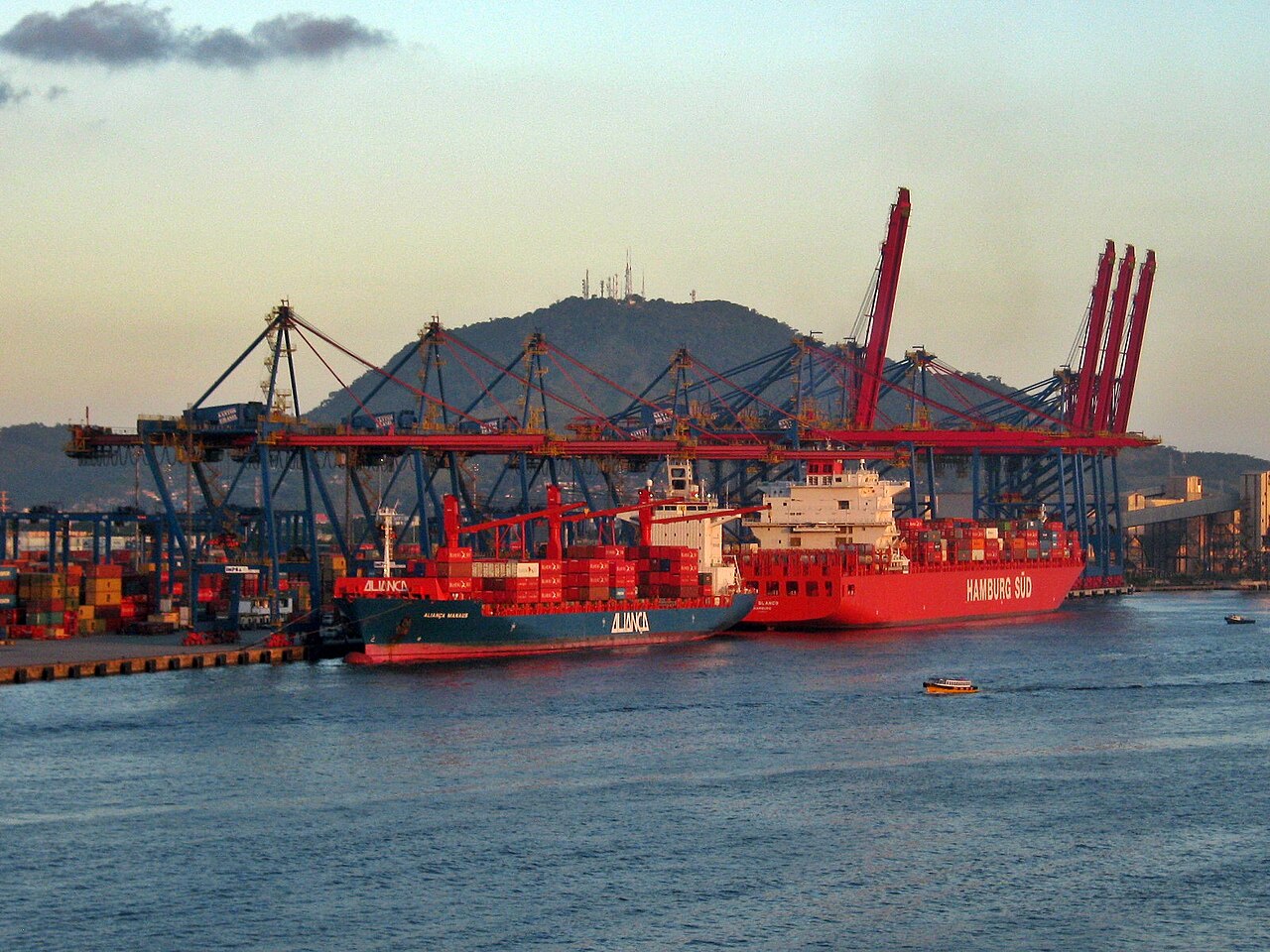
Antonio Carlos Sepúlveda, chief executive of Santos Brasil, which runs the Tecon Santos container terminal and the TEV vehicle terminal at Brazil’s largest port, said in a video interview published on Thursday 26 November 2026 that slow approvals are holding back port expansion. In the interview he said the Port of Santos “is reaching its limit” (translated from Portuguese).
Santos Brasil plans to invest R$3.5 billion (about US$620 million, at R$5.65 per US$, the market close of 26 November) over four years to expand capacity at Santos, with completion expected by 2030. The project is already with the Santos Port Authority, the body that runs the harbour, and covers the container terminal and the vehicle terminal.
Key Facts
- Who. Antonio Carlos Sepúlveda, chief executive of Santos Brasil, a port terminal operator
- What. Says changing an investment plan can take years and the Santos port is nearing its limit
- When. Video interview published Thursday 26 November 2026
- Power Index Brazil ranks 1st of 14 in The Rio Times Latin America Power Index, with 74.2 points (November 2026 edition).
- As of 27 November 2026, 06:00 GMT
The head of the operator behind Brazil’s biggest port says the plan to add capacity by the end of the decade depends as much on official approvals as on money.
The company submitted its plan to the authority on 9 November 2026. A TEU is a standard 20-foot container, and the plan would add one million TEU a year of container capacity, mainly at the Tecon Santos container terminal.
Santos Brasil holds eight port concessions, the most important at Santos, Sepúlveda said in the interview. The company is ending one investment cycle and has proposed a new one.
The Santos Port Authority reported 538,200 TEU handled in August 2026, up 3.9% on August 2025, and 4.0 million TEU from January to August, a record for those eight months. Total cargo reached 125.9 million tonnes in that period, up 3.1% from 122.2 million a year earlier, the authority said in a communiqué published in September 2026.
In the same authority data, soybeans were 49.5% of solid bulk cargo and sugar 19.9%, so farm exports dominate the port’s bulk traffic. A slower expansion limits how fast container volume can rise, which touches importers and exporters alike.
“Sometimes, to change an investment plan, you need two, three, even four years,” Sepúlveda said, in a translation from Portuguese, and he cited cases that took five years. “When we put a very large bureaucracy, a very large hindrance on these projects, the queue becomes endless,” he added.
He said an investment must pass through the port authority, the ministry in charge of ports, the waterway regulator Antaq and the federal audit court TCU, the Tribunal de Contas da União. Capacity growth depends not only on new projects but on expanding existing ones, he said, and the number of requests is very large.
When it presented the plan, the company said it needs early renewal of the TEV vehicle-terminal contract and approval from the port authority, Antaq and the TCU. Bruno Stupello, a Santos Brasil director, said that rail sidings would grow from 400 metres to more than 1,000 metres each, which the company expects to cut container unloading from 12 hours to three.
The work would take about two years, and the company has not put a cost on it. Sepúlveda asked for a review of current processes rather than a radical transformation, and he pointed to a ports bill in the Chamber of Deputies, the lower house of Congress, that he said would bring more speed.
He did not name the bill. One bill of that kind is bill 733/2025 by deputy Leur Lomanto Júnior of Bahia state, which would replace the 2013 ports law (Law 12,815) with a 151-article framework, according to the Chamber’s page updated on 28 May 2025.
The Chamber’s bill record lists it as awaiting the rapporteur’s opinion in a special committee, with its last recorded step on 26 November 2025, and Sepúlveda did not say it is the one he meant. In June 2026 the TCU faulted Antaq over how it corrected a R$758 million (about US$134 million) error in the cash-flow study behind the early renewal of the Tecon Santos contract, which Santos Brasil runs, and over a second case at the port of Itaguaí, in Rio de Janeiro state.
Antaq’s directors were spared personal punishment, and Santos Brasil said in a statement that, as the court itself recorded, its performance under the contract beat the original projections. No date is known for any decision by the port authority, Antaq or the TCU.
Santos Brasil gives 2030 as its completion date, while Sepúlveda says plan changes at ports can take two to five years to approve. Our earlier report on the proposal itself is Santos Brasil’s port expansion plan, and the purchase of control of the operator by the French shipping group CMA CGM is in our report on CMA CGM’s acquisition of Santos Brasil.
More Brazil business news is in our Brazil section.
Frequently Asked Questions
Why does a Brazilian port bottleneck matter abroad?
Soybeans and sugar lead the solid bulk cargo that the port authority lists for Santos, so delays there touch farm exports. Slow approvals are therefore a trade issue as well as a local one.
Who has to approve the Santos expansion?
In the executive’s account, the port authority, the ministry in charge of ports, the regulator Antaq and the federal audit court must all review it. Each has a legal role in reviewing port contracts and investments.
Will the ports bill speed things up?
That is unclear, because the stage of the main bill is not confirmed and Sepúlveda did not name the one he meant. He asks for faster review of existing processes rather than a radical overhaul.
Sources: Santos Brasil, plan statements of November 2026 and interview of 26 November (chief executive Antonio Carlos Sepúlveda); Santos Port Authority (APS), cargo statistics for August 2026, communiqué of September 2026: https://www.portodesantos.com.br/; Chamber of Deputies, bill 733/2025, bill record and news page of 26 March 2025 (updated 28 May 2025): https://www.camara.leg.br/noticias/1144098-projeto-estabelece-novo-marco-regulatorio-para-setor-portuario-brasileiro; Federal audit court (TCU), decision of 17 June 2026 on early port contract renewals: https://portal.tcu.gov.br/; Exchange rate: R$5.65 per US$, market close of 26 November 2026
This article was produced by The Rio Times’ automated AI newsroom. Editorial responsibility: Matthias Camenzind, Publisher and Editor-in-Chief. The Rio Times also runs Ask Rio Times, which answers from 100,000+ of our own articles, the daily Latin America Power Map, and prediction-market odds on elections and markets.. How we use AI · Report an error
Brazil runoff, Sunday, October 25: When is the Brazil runoff election. Latest: Brazil runoff polls, Flávio 51%, Lula 49%.