Number of Indigenous Candidacies Increases 28 Percent over 2016 Elections
RIO DE JANEIRO, BRAZIL – Increased deforestation, invasions by illegal prospectors into their territories, the suspension of demarcations under the Bolsonaro government, and the spread of Covid-19 in the original communities are the backdrop to a boom of indigenous candidacies in Brazil in this year’s municipal elections.
The number of candidacies of those who declare themselves indigenous grew by 28 percent compared to the 2016 elections. At the time, there were 1,715. Now, there are 2,194, or 0.40 percent of the total, according to the Superior Electoral Court (TSE). With these numbers, indigenous candidates outnumber those who declare themselves Asian (1,959, or 0.35 percent of the total) and are no longer the least represented race in the dispute for elective positions.
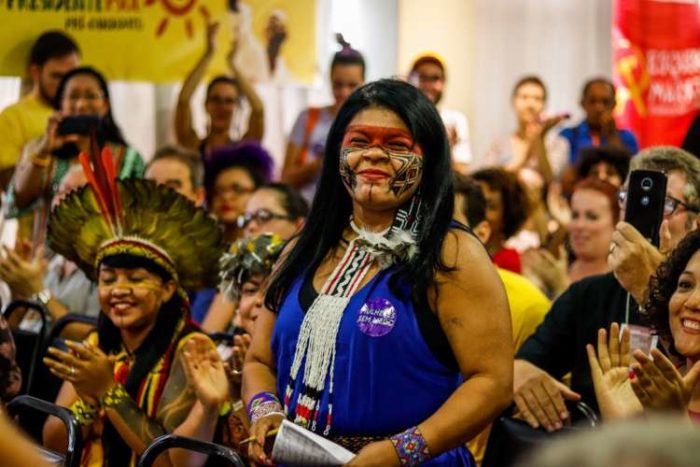
The Articulation of Indigenous Peoples of Brazil (APIB) credits part of this result to the work accomplished in recent years to promote political training in the villages. In 2017, the organization published the letter-manifesto ‘For an increasingly indigenous parliament’ and, in 2018, the movement of native peoples succeeded in electing federal deputy Joenia Wapichana, the first indigenous woman to conquer a seat in the National Congress.

“The removal of fundamental rights of our peoples occurs from articulations in Congress, so our presence in these places is important. But if we want to get there or even to the Presidency, we have to increase the base in the municipal sphere,” said Sônia Guajajara, president of the APIB, who ran for Vice-president in 2018, alongside Guilherme Boulos. In 2016, 167 indigenous people were elected city councilors. For Sônia, “it is very little”. This year, of the 545,437 candidates registered with the TSE, 0.40 percent are indigenous, a rate close to the demographic scale of native peoples in Brazil: they are at least 900,000, about 0.43 percent of a population of 209 million.
“Our strategy is to reduce the number of candidates to concentrate the votes, because the truth is that we cannot rely on the votes of non-indigenous people. And we are not a priority within the parties either. No party, no matter how aligned it is with our agendas, fully understands our demands,” Sônia says.
This is why chief Ramón Tupinambá, 35, who is running for city councilor in the far south of Bahia for the PSOL party, says the ideal would be to have an indigenous party at the national level. “Then we could put into play our approach to participatory government, something common in the management of our villages, for instance,” he says, having already run for city council in 2016 and for state deputy in 2018, unsuccessfully on both occasions.
A descendant of the first peoples to face the violence of colonization in Brazil, Ramón intends to operate in the municipal sphere by demarcating the Tupinambá territories in the region of Ilhéus, authorized since 2009 by the Federal Supreme Court (STF), but barred by the ex-Minister of Justice, Sérgio Moro, who in January this year returned to FUNAI (National Indian Foundation) 17 demarcation proceedings. “We live in constant conflict with big real estate companies that build resorts and condominiums near our villages,” laments Ramón.
Although agreeing with him that the existing parties do not address the demands of the original peoples, Sônia Guajajara is doubtful about the foundation of a national indigenous party. “I am not convinced that this would solve the problem. After all, there are 305 different peoples throughout Brazil, so it’s possible that it would ultimately follow the logic of traditional parties,” she argues.
More women
The 2020 municipal elections will also have a record number of women candidates among the indigenous: they rose from 27.5 percent in 2016 to 32.4 percent of the total, according to TSE data. One of them is Kandara Pataxó, 39, a candidate for city councilor in Santa Cruz Cabrália (BA), for the PSD. The daughter of two indigenous leaders – her mother was the first female chief of her village – Kandara has been active in the community since she was 16 years old as an advocate for women’s rights, calling for more of them to take up decision-making positions within the tribes. Despite this trajectory, she says the invitation to run was unexpected.
“I have been seeking public policies, but I do not come from public life. I hesitated when they proposed the candidacy. I thought: They will have me killed. I don’t want to be another Marielle,” says Kandara, who, after perceiving her people’s support, decided to take up the challenge. “Most of us don’t know much about party politics. Our fight is not partisan, it’s for space. We’ve always been used by the parties to support non-indigenous candidates who promise to defend our agendas, but once there, we’re the first to be forgotten,” she adds.
It was this struggle for space that prompted Ariene Susui, a member of the Wapichana people, only 23 years old, to run for city councilor in Boa Vista (RR) for the Rede party. The city, despite having about 20,000 indigenous people, was never represented by its original peoples in its city council. Ariene says that her community began to hold meetings to discuss party politics in 2017, at a time when the Wapichana people were preparing for the candidacy of MP Joenia. “After she was elected, we didn’t stop. It was a needed spark.”
Ariene says that party politics has never been a priority of the indigenous people because they have always had to fight for the most basic thing: their territories. The setback in these peoples’ rights in recent years, however, has encouraged her to enter politics. “For me, the fuse was to see that miners and loggers are no longer afraid and are invading our territories more and more, exactly because they feel shielded by the Federal Government’s rhetoric,” she says.
For Val Eloy, 39, who has been campaigning for the Taunay-Ipegue (MS) Terena people since the age of 11, standing for election is a way to be part of a government plan in one of the capitals where the rural caucus is strongest. She is a candidate for deputy mayor of Campo Grande, Mato Grosso do Sul, running under PSOL, alongside Cris Duarte. “Here, politicians are not intimidated and are not ashamed to say that they really don’t like the indigenous people,” she says.
From a political lineage – her grandparents founded her village and her brother, attorney Eloy Terena, who succeeded in securing a decision at the STF that forced the Bolsonaro government to implement measures to protect the indigenous peoples from Covid-19 – Val did not hesitate to embrace the candidacy. In her region, she was one of the leaders who coordinated the building of health barriers in the villages, given the lack of government assistance. “We lost many lives, but if they thought it would make us bow down, they only encouraged us to show that we will no longer wait for a white policy that speaks for us,” she said.
Sources
- El País
More: Brazil news in English, every day from The Rio Times.
In depth
This article was produced by The Rio Times’ automated AI newsroom. Editorial responsibility: Matthias Camenzind, Publisher and Editor-in-Chief. The Rio Times also runs Ask Rio Times, which answers from 100,000+ of our own articles, the daily Latin America Power Map, and prediction-market odds on elections and markets.. How we use AI · Report an error
Brazil runoff, Sunday, October 25: Brazil runoff: date, poll closing times and when results start. Latest: Brazil runoff polls, Flávio 51%, Lula 49%.