Equatorial Guinea Explained 2026: Oil, Obiang and a New Capital

EQUATORIAL GUINEA · COUNTRY PROFILE · PILLAR
Key Facts
- —What it is A small Central African state made of a mainland region, Río Muni, and islands including Bioko and Annobón. It covers about 28,050 square kilometres, a little smaller than Maryland, and has about 1.9 million people.
- —Who runs it President Teodoro Obiang Nguema Mbasogo, in power since 1979. His son Teodoro Nguema Obiang Mangue is Vice-President, and Manuel Osa Nsue Nsua was reappointed prime minister on 19 June 2026.
- —The economy Oil and gas, in decline. The World Bank estimates the economy shrank 5.4% in 2025 and projects a further contraction of 3.5% over 2026 and 2027.
- —The capital Ciudad de la Paz, an inland city on the mainland, was declared the official capital in January 2026. Ministries still work from Malabo and Bata.
- —For Americans The United States has fully suspended entry of Equatorial Guinea’s nationals since 9 June 2025. ConocoPhillips and Vaalco Energy, both US-listed, hold major gas and oil stakes there.
- —Currency The Central African CFA franc (XAF), pegged at 655.957 to the euro. One US dollar bought XAF 567.01 at the close on Tuesday, 6 October 2026.
Equatorial Guinea is a small, oil-rich country in the Gulf of Guinea that has been ruled by one man, Teodoro Obiang Nguema Mbasogo, since 1979, and whose economy is now shrinking as its oil and gas fields run down. For Americans it matters because US companies still run much of its gas business, because Washington has barred its nationals from entering the United States since June 2025, and because the president’s son, now Vice-President, once gave up a Malibu mansion to settle a US Justice Department case.
This guide explains how the country works in October 2026: who holds power, why the capital is moving into the rainforest, what the decline in oil means, and what a foreign investor, traveler or newcomer should check first.
What Kind of Country Equatorial Guinea Is
Equatorial Guinea comes in pieces. The mainland region, Río Muni, borders Cameroon to the north and Gabon to the east and south. Offshore lie the islands, above all Bioko, home to Malabo, and far to the south Annobón, along with Corisco and the Elobey islets, as the World Bank describes it.
The whole country covers about 28,050 square kilometres, according to the World Bank, a little smaller than Maryland. World Bank data put the population at about 1.9 million in 2025. The World Bank classifies it as an upper-middle-income country, a label that reflects oil wealth rather than how most people live: it estimates that 61% of the population lived below the poverty line in 2025, that 24% had no electricity and that 32.4% had no piped water.
A former Spanish colony, it became independent on Saturday, 12 October 1968. Article 4 of the constitution makes Spanish and French the official languages and lets the law add others. For a foreign visitor, Spanish is the working language of government and business.

Who Holds Power
Power sits with the president and his family. Teodoro Obiang Nguema Mbasogo has been in office since 1979. The World Bank notes that he was re-elected in November 2022 with 94.9% of the vote, and that his ruling Democratic Party of Equatorial Guinea (PDGE) holds nearly all seats in the Chamber of Deputies, the Senate and local councils.
His son, Teodoro Nguema Obiang Mangue, is Vice-President of the Republic and has addressed the UN General Assembly on the country’s behalf. Americans may know the name from a US case: on Friday, 10 October 2014, the Justice Department announced that he, then Second Vice President, had agreed to give up more than US$30 million in assets, including a Malibu mansion, a Ferrari and Michael Jackson memorabilia. Court papers said he had acquired more than US$300 million in assets while earning an official salary of less than US$100,000.
Day-to-day government is run by a prime minister. Manuel Osa Nsue Nsua, a former head of the National Bank of Equatorial Guinea, was appointed on Saturday, 17 August 2024, according to the World Bank. On Friday, 19 June 2026, the president kept him in the post for a new government after the previous team met only about 10% of its targets, the African business agency Ecofin reported.
The foreign minister, Simeón Oyono Esono Angue, signed the July 2026 agreement with Gabon on behalf of the country, according to the African Union.
A New Capital in the Rainforest
In the first days of January 2026, President Obiang declared Ciudad de la Paz the country’s official capital by presidential decree. The city, a planned government town on the mainland’s central plateau, sits about 140 kilometres from Bata near Mengomeyén airport, the Pan-African news site Afrik reported, and public bodies were given a year to transfer their services.
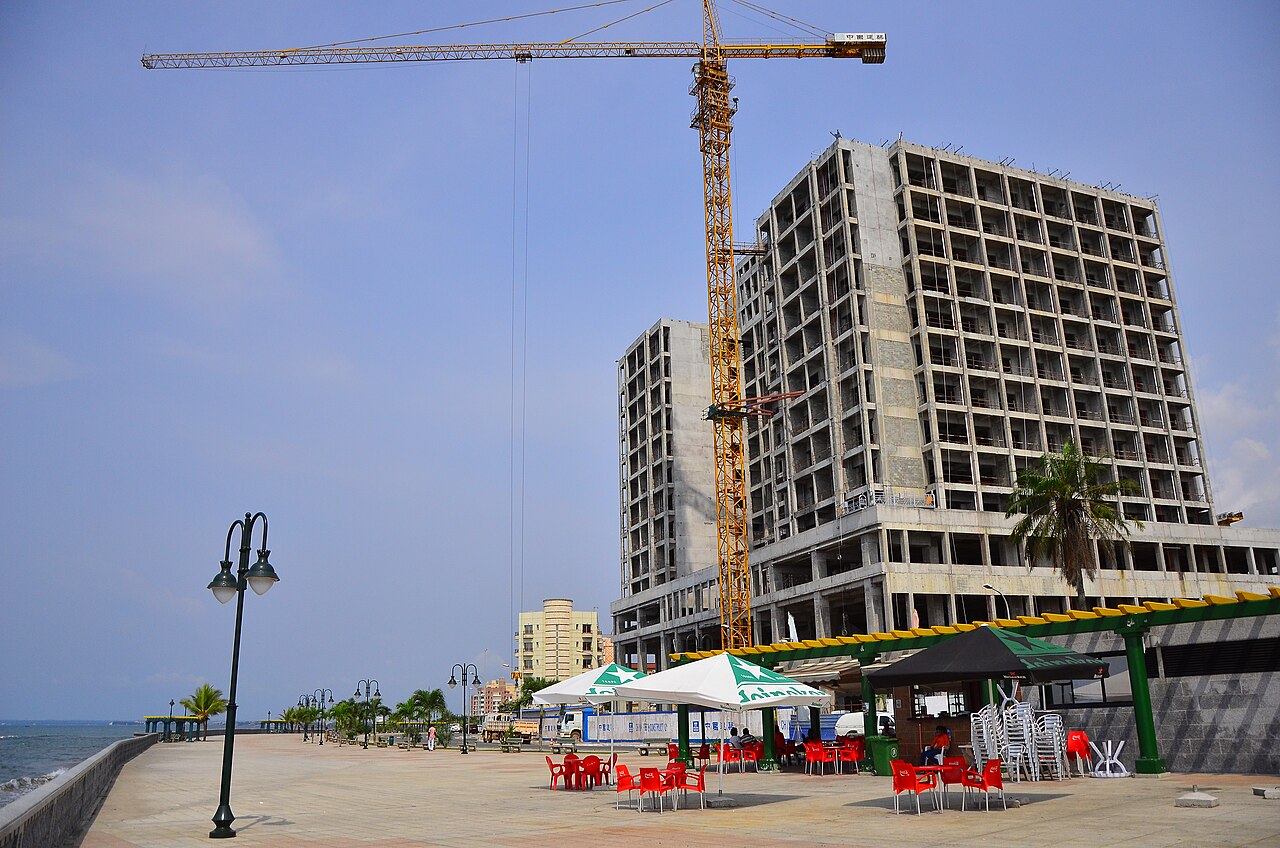
The move is real on paper and partial in practice. The World Bank notes that ministries continue to operate from Malabo and Bata. For a foreign company, that means meetings, filings and embassy business still happen mostly in Malabo, on Bioko, while the political centre of gravity shifts to the mainland.
An Oil Economy in Decline
Oil and gas built modern Equatorial Guinea, and their decline now drives everything else. The World Bank puts 2025 output at about US$12.8 billion, roughly US$6,615 per person. It estimates that the economy contracted by 5.4% in 2025 after growth of 0.4% in 2024, driven by falling hydrocarbon output. The IMF, using its own estimate, put the 2025 contraction at 6.4%, citing “a large fall in hydrocarbon production”.
The outlook is not better. The World Bank projects a contraction of 3.5% over 2026 and 2027 because hydrocarbon output keeps falling. Public debt rose from 36.4% of GDP in 2024 to 39.2% at the end of 2025, according to the IMF, and inflation eased to 2.6% in October 2025.
The country is not borrowing from the IMF but works with it under a Staff-Monitored Program, a non-financing arrangement in which IMF staff track reforms. IMF management completed the third review on Tuesday, 16 December 2025. The fund’s priorities include better tax and customs collection and the publication of a transparency report on the hydrocarbon sector.
American companies remain central. ConocoPhillips, which bought Marathon Oil in 2024, owns 56% of Equatorial Guinea LNG, a gas export plant with capacity of 3.7 million tonnes a year, alongside the national gas company Sonagas (37.93%) and Japan’s Marubeni (6.07%). Gas is contracted from the offshore Alba and Alen fields. Vaalco Energy, a Texas company listed in New York, holds 60% of offshore Block P and operates it; it says it is targeting a final investment decision on the Venus development there in the fourth quarter of 2026.
The Islands Ruling and the Gabon Agreement
On Monday, 19 May 2025, the International Court of Justice ruled for Equatorial Guinea in its long border dispute with Gabon. It held that the title with force of law was the one Spain held on independence day in 1968, and that the islets of Mbanié, Cocotiers and Conga belong to Equatorial Guinea, South Africa’s Business Day reported. The World Bank calls the ruling a reinforcement of the country’s territorial sovereignty.
In late July 2026, the two neighbours signed a Joint Engagement Agreement in Addis Ababa, under African Union mediation, to implement the judgment. The AU welcomed it on Tuesday, 28 July 2026. In Gabon, the government has insisted the text does not change existing borders; how the ruling is applied on the ground is still being worked out.
Money and the CFA Franc
Equatorial Guinea uses the Central African CFA franc, written XAF, shared with Cameroon, the Central African Republic, the Republic of the Congo, Gabon and Chad and issued by the Bank of Central African States (BEAC). It has been pegged at XAF 655.957 per euro since 1 January 1999, so its dollar value moves with the euro.
On Monday, 28 September 2026, the BEAC kept its main rate at 4.50% and forecast 3.0% growth and 2.2% inflation for the six-country zone in 2026. The State Department lists a cash limit for travelers of US$10,000 or XAF 5 million (about US$8,800).
What It Means for You
If you are from Equatorial Guinea, or have family there: a presidential proclamation signed on Wednesday, 4 June 2025, fully suspended entry to the United States for the country’s nationals, as immigrants or visitors, from Monday, 9 June 2025. It cited visa overstay rates of 21.98% for business and tourist visas and 70.18% for student and exchange visas. The 16 December 2025 proclamation kept the full suspension in place. Green card holders, dual nationals traveling on another passport and some other categories are exempt.
If you follow US immigration policy: the United States has also sent deportees from other countries to Equatorial Guinea under an arrangement neither government has published. Senator Jeanne Shaheen of New Hampshire, the top Democrat on the Senate Foreign Relations Committee, said on Monday, 10 November 2025, that Washington had transferred US$7.5 million directly to the government of Equatorial Guinea in exchange for accepting such deportees. The Associated Press counted at least 29 people sent there by March 2026, from countries including Ethiopia, Eritrea, Ghana and Nigeria.
If you travel: Americans need an e-visa approved before arrival and should carry a printed copy, a passport valid six months beyond arrival, and a yellow fever certificate, with the vaccine taken at least 10 days before. The State Department rates the country at Level 2, increased caution, in an advisory issued on Tuesday, 7 October 2025, citing petty crime, very limited medical care and arbitrary enforcement of local laws, under which some travelers have been detained for weeks. Carry your passport and visa at all times to avoid trouble at checkpoints.
If you invest: exposure reaches US portfolios mainly through ConocoPhillips and Vaalco. The main questions are whether new gas supply can keep the LNG plant full as old fields decline, and whether the government’s reforms under IMF monitoring hold.
What Is Not Known
- When the government will actually complete the move to Ciudad de la Paz, and which institutions will stay in Malabo.
- Who will succeed President Obiang, and when. No date for a transfer of power has been announced.
- The full terms of the US arrangement for third-country deportees, which neither government has published.
- Whether the US will ease or keep the full entry ban at its next review; the proclamation requires reports every 180 days.
- How fast oil and gas output will keep falling, and whether new projects such as Venus reach a final investment decision on time.
- How the islands ruling will be applied on the ground under the July 2026 agreement with Gabon.
Frequently Asked Questions
What is the capital of Equatorial Guinea in 2026?
Ciudad de la Paz, on the mainland, was declared the official capital in January 2026. In practice, ministries still work from Malabo, on Bioko island, and from Bata, according to the World Bank.
Who is the president of Equatorial Guinea?
Teodoro Obiang Nguema Mbasogo, who has been in power since 1979 and was re-elected in November 2022. His son Teodoro Nguema Obiang Mangue is Vice-President, and Manuel Osa Nsue Nsua is prime minister.
Can people from Equatorial Guinea travel to the United States?
Not on a normal visa. Since 9 June 2025, the United States has fully suspended entry for nationals of Equatorial Guinea, with limited exceptions such as green card holders and dual nationals traveling on another passport.
Do Americans need a visa for Equatorial Guinea?
Yes. US citizens must obtain an approved e-visa before arrival, carry a printed copy, and show a yellow fever vaccination certificate. The State Department advises increased caution (Level 2).
What languages are spoken in Equatorial Guinea?
Spanish and French are official under the constitution, which allows the law to add others. Spanish is the main language of government and business.
Sources: World Bank, Equatorial Guinea overview, World Bank, Equatorial Guinea data, IMF, third review of the Staff-Monitored Program, 6 February 2026, Constitution of Equatorial Guinea (2012 text), Constitute Project, African Union, Gabon and Equatorial Guinea agreement, 28 July 2026, International Court of Justice, Gabon/Equatorial Guinea case, BEAC, Monetary Policy Committee communiqué, 28 September 2026, BEAC, history of the CFA franc, The White House, proclamation of 4 June 2025, The White House, proclamation of 16 December 2025, US State Department, Equatorial Guinea travel advisory, US State Department, Equatorial Guinea country information, US Justice Department, Obiang Mangue settlement, 10 October 2014, ConocoPhillips, Equatorial Guinea LNG, Vaalco Energy, Equatorial Guinea operations, UN General Assembly general debate, Equatorial Guinea, Ecofin Agency, prime minister reappointed, 22 June 2026, Afrik, Ciudad de la Paz named capital, 4 January 2026, Business Day, ICJ ruling, 19 May 2025, Senate Foreign Relations Committee, Ranking Member Shaheen on US$7.5 million to Equatorial Guinea, 10 November 2025, Associated Press via ABC7, deportees in Equatorial Guinea, 21 March 2026, Gabon Media Time, Gabon on the agreement, 27 August 2026. All retrieved 7 October 2026. Exchange rate: house data, close of Tuesday, 6 October 2026, XAF 567.01 per US dollar.
This article was produced by The Rio Times’ automated newsroom system. How we use AI · Report an error · Editorial responsibility: Matthias Camenzind, Editor-in-Chief