Brazil: understand the fiscal framework and the current government’s spending cap change
By Luís Batistela
The fiscal framework is a letter of intentions elaborated to replace the old spending cap of 2016, established by the Temer government.
New guidelines may be implemented as of July and count on greater tolerance in the relationship between collections and expenditures (primary surplus) carried out in the current term of President Lula.
On Tuesday (18), the Minister of Finance, Fernando Haddad, and President Luiz Inácio Lula da Silva (PT) delivered the final fiscal framework text to Congress.
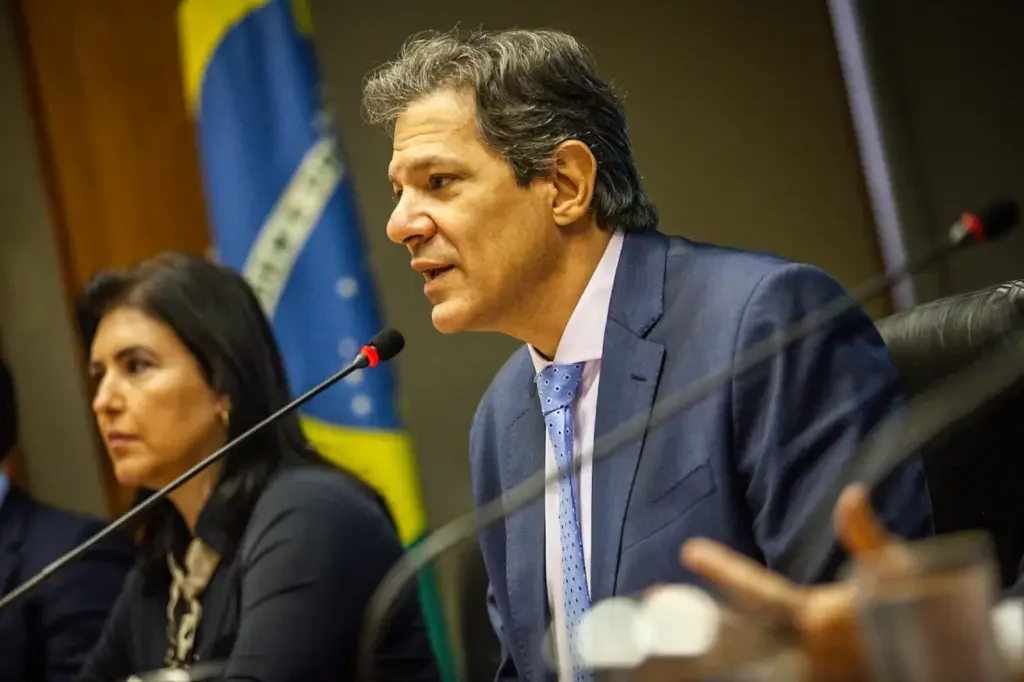
The new regulations were announced on March 30 – at a press conference – by Haddad, together with Planning Minister Simone Tebet.
The criteria established in the framework can be reorganized according to each government’s transition, based, for example, on public debt speculation, tax projections, and the execution of policies targeted by the current presidency.
Such parameters are part of the so-called fiscal policy, i.e., supervising a country’s collections and expenditures.
With the new guidelines established by the current government, they [guidelines] will define the real increase of 70% of the expenses made over the collections’ value.
Every year there will be from 0.6% to 2.5% of expenses above inflation.
That is due to reduced public debt, which limits government spending during economic stability.
According to economist Leandro Ruschel – in an interview with Brasil Sem Medo – the difference between the current spending cap and the possible framework is that “the current one provides spending limits according to the economy.”
In contrast, the “new (framework) is a ‘floor’ guaranteeing spending increases.
In addition, funds allocated by parliamentarians to their electoral bases (parliamentary amendments), as well as investments in health and education, with the framework, will be able to expand according to revenue.
THE 13 ITEMS EXCLUDED FROM THE SPENDING CAP
Despite the stupefying changes in the framework, the new regulation excluded 13 items from the spending cap.
That caused the opposition to declare the tax change an “electoral stultification.”
- Constitutional transfers to states and municipalities;
- Complements for basic education for states and municipalities;
- Extraordinary credits;
- Transfers to health funds of states and municipalities for compliance with the nursing floor;
- Expenses with social-environmental or climate change projects funded with resources from donations and expenses funded by agreements signed as a result of environmental disasters;
- Expenses – funded with own revenues, from donations or from agreements – of universities and federal institutions, of public companies that provide services to federal university hospitals, and other scientific, technological, and innovation institutions;
- Expenses funded with resources coming from transfers from the other entities of the Federation to the Union destined for the direct execution of engineering works and services;
- Expenses in agreements for the payment of precatórios with discount;
- Expenses with Fundef precatórios owed to states and municipalities;
- Non-recurring expenses of the Electoral Justice with the holding of elections;
- Expenses with capital increase of non-financial and non-dependent state companies;
- Legal transfers, to states and municipalities, of resources obtained with forest concessions and the sale of federal properties;
- Expenses related to charging for the management of water resources by the National Water and Basic Sanitation Agency (ANA).
THE END OF PUNISHMENT FOR FISCAL RESPONSIBILITY CRIMES
Another “surprise” inserted in the new regulation is the end of punishments for crimes of fiscal responsibility, such as, for example, the case of former president Dilma Rousseff (PT), who was impeached because of the “pedaladas” [manipulating public accounts] carried out during her mandate.
If the government fails to meet the target established in the framework, it will be sufficient – only – to explain to Congress, that is, no one will be punished for fiscal crimes anymore.
The hope is that the congress members will act to correct some points in the regulation and, by doing so, maintain the possibility of sanctions if a tax penalty crime occurs.
On Wednesday (26), Claudio Cajado (PP-BA), rapporteur of the tax framework in the House of Representatives, said that the vote on the final text of the new regulation should occur in about 15 days.
With information from Brasil Sem Medo
More: Brazil news in English, every day from The Rio Times.
This article was produced by The Rio Times’ automated AI newsroom. Editorial responsibility: Matthias Camenzind, Publisher and Editor-in-Chief. The Rio Times also runs Ask Rio Times, which answers from 100,000+ of our own articles, the daily Latin America Power Map, and prediction-market odds on elections and markets.. How we use AI · Report an error
Brazil runoff, Sunday, October 25: Brazil runoff: date, poll closing times and when results start. Latest: Brazil runoff polls, Flávio 51%, Lula 49%.