Brazil 6×1 Work Schedule Reaches the Senate Floor Tuesday, With 3 of 5 Debate Sessions Set

POLITICS · BRAZIL
Key Facts
- —The country Brazil, where the legal cap is 44 hours a week and many shop and service staff work six days for one day off.
- —What happened On 2 October Senate President Davi Alcolumbre scheduled three floor sessions on the amendment, on 6, 7 and 8 October (Agência Senado).
- —The numbers Five debate sessions are required before the first vote, then three before the second. Each vote needs 49 of 81 senators (Agência Senado, Revista Fórum, 2 October).
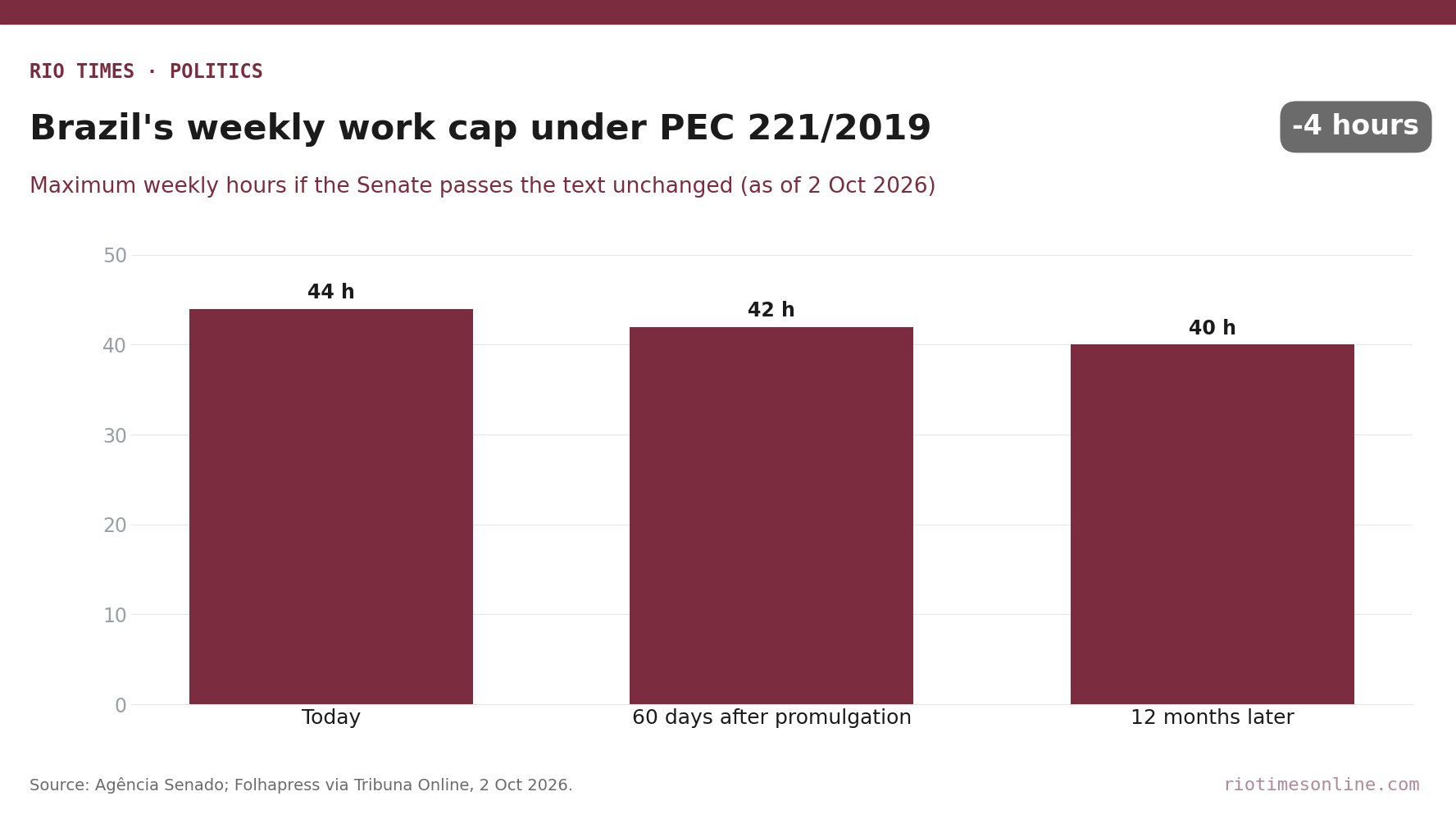
- —What it means for you Nothing changes on rosters yet. If passed unchanged, the cap falls to 42 hours 60 days after promulgation and to 40 hours a year later.
- —Still open Whether senators shorten the debate rite. Valor reports the vote may slip past the 25 October runoff; Folhapress and CNN Brasil say it could come the week before.
Brazil’s Senate will begin floor debate on ending the 6×1 work schedule on Tuesday, 6 October. That is two days after Sunday’s general election. Tuesday opens the debate; it is not yet the decisive vote.
Senate President Davi Alcolumbre announced the timetable on Friday, 2 October. The constitutional amendment would cut the maximum working week from 44 to 40 hours and guarantee two paid rest days.
What the Senate scheduled
The Senate news agency says the plenary will debate the amendment on 6, 7 and 8 October, from 2 pm. The text is PEC 221/2019, a proposed amendment to the Constitution.
Under Senate rules, an amendment needs five debate sessions before a first-round vote, then three more before the second. Each round requires at least 49 of the 81 senators.
Senators can shorten that rite by approving a special calendar, a step known in Brasília as breaking the interval. Without it, three sessions next week leave two still to hold.
What the 6×1 work schedule amendment changes
The 6×1 work schedule means six days of work and one of rest, common in retail and services. The amendment sets an eight-hour daily limit and two paid rest days, one preferably on Sunday.
Pay may not be cut. The weekly cap would fall to 42 hours 60 days after promulgation, then to 40 hours twelve months later.
The phase-in gives employers more than a year to adjust rosters. Collective agreements may also allow hours to be compensated, the Senate agency reports.
How the text got here
The Chamber of Deputies, Congress’s lower house, passed the amendment in late May. The Senate’s Constitution and Justice Committee (CCJ) approved it in early September (see Brazil Senate Panel Approves End of 6×1 Work Schedule).
Rapporteur Omar Aziz rejected all 36 proposed changes, because any change would send the text back to the deputies. On 3 September Alcolumbre promised a vote after the election (report of 5 September: Brazil Senate Delays 6×1 Work Week Vote).
Government pushes for speed, opposition objects
President Lula, who seeks re-election on Sunday, thanked Alcolumbre on social media. He called the measure a government priority. Chamber Speaker Hugo Motta also welcomed the decision.
Institutional Relations Minister José Guimarães said the government’s allies would try to vote on Tuesday itself, Folhapress reported. That would require senators to approve a shorter rite first.
Valor reported that Alcolumbre told people close to him he will hold all five sessions before the first vote. In that case, the vote would likely fall after the 25 October runoff.
Opposition senators told Valor they had agreed with Alcolumbre on a vote only after the presidential race. They see the timing as a gesture that helps Lula’s campaign.
Alcolumbre’s office struck a cautious tone. It said the topic would be debated with balance, weighing workers, the productive sector and the country’s development.
What Is Not Yet Known
No date has been set for the fourth and fifth debate sessions, nor for either vote. Congress is expected to return to normal work in November, Valor reported.
Folhapress and CNN Brasil (3 October) say the last two sessions could follow a week later, allowing a vote before the runoff. It is also unclear whether the government can muster 49 votes in each round. Any Senate amendment would return the text to the Chamber, delaying promulgation.
Sources: Agência Senado, 2 October 2026; Valor Econômico, 2 October 2026; Valor Econômico (Lula), 2 October 2026; Tribuna Online (Folhapress), 2 October 2026; Revista Fórum, 2 October 2026; Agência Brasil, 2 October 2026; CNN Brasil, 3 October 2026.
This article was drafted with automated assistance and reviewed before publication. How we use AI · Report an error · Editorial responsibility: Matthias Camenzind, Editor-in-Chief