
ARGENTINA · ECONOMY
Key Facts
- —The country Argentina, a large South American economy run by President Javier Milei, keeps its peso inside an official band that moves with inflation.
- —Why it matters A jump in the official dollar would push up prices and test the reserves that back Argentine bonds, so investors in both watch the central bank.
- —Why now An economist said in an interview published on 16 October that the dollar is being held still, and central bank data show purchases are not turning into reserves.
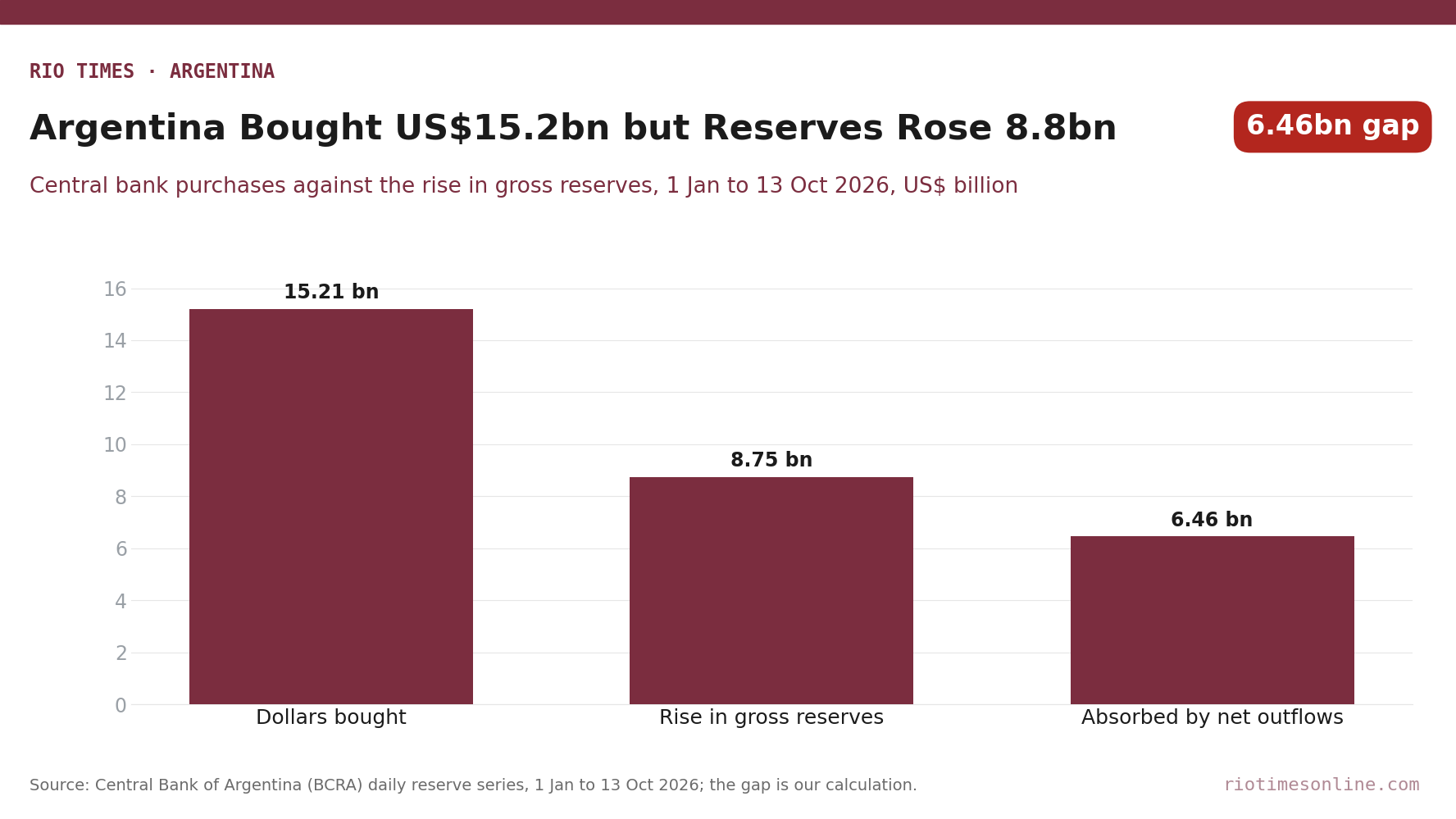
- —What happened The central bank bought US$15.21 billion from 1 January to 13 October, yet gross reserves rose only US$8.75 billion.
- —The numbers The wholesale dollar rose 4.0% from 30 December to 30 September, while consumer prices rose 23.6% in the first nine months.
- —What it means for you US holders of Argentine assets face inflation and currency risk, while visitors paid in dollars would gain buying power from a weaker peso.
- —Still open Whether the government lets the dollar rise, and how much of any move would reach prices in a weak economy.
- —Prediction markets Polymarket gives a 47.5% chance that Argentina’s official dollar ends 2026 at 1,600 pesos per dollar or more (17 October, 3:47 a.m. ET).
- —Power Index Argentina ranks 4th of 14 in The Rio Times Latin America Power Index, with 61.2 points (October 2026 edition).
The Argentina devaluation debate is back after economist Mara Pedrazzoli told +Perfil, in an interview published on 16 October, that the official dollar is being held still. The central bank’s own data show it bought US$15.21 billion since January, yet reserves rose only US$8.75 billion.
For US readers the numbers matter because holders of Argentine bonds and New York-listed shares depend on both prices and reserves. This article sets out what the central bank data show and what past dollar jumps did to inflation.
Wholesale prices rose 3.2% in September, as we covered in Argentina Wholesale Inflation Rises to 3.2%. Consumer prices rose 1.9% in the month and 23.6% over nine months, the statistics office INDEC said.
What an Argentina Devaluation Would Do to Prices
Pedrazzoli spoke on RDEco, the economists’ round table of the +Perfil channel run by the publisher Perfil. She said a devaluation alone would not solve industry’s structural problems, as firms cannot pass higher costs on while demand is weak.
She said a gradual adjustment might reach prices only in part, because the economy is in a low-growth, recessive context. An abrupt jump in the dollar, she added, would be a different case with inflationary effects.
That is one economist’s view, and the official data give it partial support. The central bank’s wholesale dollar rose 4.0% from 1,459.42 pesos per dollar on 30 December to 1,517.52 on 30 September, while consumer prices rose 23.6%.
By our calculation Argentine goods are therefore about 19% dearer in dollar terms than at the start of the year, ignoring US inflation. Economist Marina Dal Poggetto made a similar point in early October, as we covered in Argentina Getting Pricey in Dollars, Dal Poggetto Says.
The dollar moves inside a band whose ceiling rises with inflation, with a two-month lag, iProfesional and Forbes Argentina explained on 14 October. Both put the ceiling near 1,951 pesos per dollar at the end of October, against the wholesale reference rate of 1,514.57 on 16 October.
That leaves about 29% of room, by our arithmetic, a gap we tracked on 5 October in Argentina Peso Holds 21% Below Its Ceiling on 5 October. The central bank’s September market survey put expected inflation over the next 12 months at a median of 21.1%.
Two Earlier Jumps and What Followed
On 13 December 2023 the official wholesale rate jumped from 366.50 to 799.98 pesos per dollar, a rise of 118%, the central bank’s series shows. Monthly inflation was 12.8% in November, 25.5% in December and 20.6% in January 2024.
It then slowed to 13.2% in February and 11.0% in March 2024. A far smaller jump came between 11 and 14 April 2025, when the rate rose 9.6% from 1,078.38 to 1,182.42 pesos per dollar.
Monthly inflation in 2025 was 3.7% in March, 2.8% in April and 1.5% in May. The two episodes differ in size and context, and other policies changed at the same time, so the series cannot isolate the effect of the dollar.
Why Dollar Buying Is Not Lifting Reserves Faster
From 1 January to 13 October the central bank bought US$15.21 billion, its daily series shows, yet gross reserves rose only US$8.75 billion to US$49.85 billion. The gap is US$6.46 billion, by our calculation.
The series splits the change by cause. Operations with international organisations took out US$4.69 billion and other public-sector operations US$3.04 billion, while bank reserve requirements added US$1.32 billion and other items took out US$0.06 billion.
The series gives no breakdown of those outflows, so their causes cannot be read from it. Pedrazzoli summed up the pattern as “it buys, but does not accumulate reserves”, in our translation.
She added that accumulation has improved lately but runs below its early-year pace, and that she sees heavy central bank intervention but no confidence in the peso. Purchases fell from US$2.77 billion in April to US$770 million in August and US$474 million in September.
From 26 August to 30 September reserves fell US$4.82 billion, with reserve requirements alone down US$2.93 billion. They peaked at US$50.91 billion on 25 August and stood at US$49.72 billion on 14 October.
What It Means for You
For US holders of Argentine bonds and shares, an Argentina devaluation can cut the dollar value of local earnings, while higher inflation can erode real returns. Reserves of US$49.7 billion are a cushion, but the 2026 data show that buying alone does not build one.
Visitors and expats paid in dollars would gain buying power from a jump in the dollar, though prices in pesos would then rise. Our Argentina’s 1.9% Inflation and Your Budget guide and Buenos Aires expat city guide cover day-to-day costs.
For the lender’s side, see Argentina’s IMF Programme Explained: The US$20 Billion Loan, Reserves and What Comes Next, and for the politics behind the policy, see Who Dominates Argentina, Elites and Regions Explained. Daily reserve moves are tracked in Argentina Reserves Clear US$50 Billion Mark.
What Is Not Known
No official source in the coverage reviewed says a devaluation is planned, so this article describes a scenario, not a decision. Pedrazzoli’s view on how an Argentina devaluation would pass through to prices is one economist’s estimate, and no official forecast of the effect was found.
The band ceiling comes from press reports of the central bank’s projections, and the survey’s exchange-rate medians from iProfesional, because the bank’s own band table and survey file could not be opened. The reserve figures are gross, so net reserves, which strip out short-term liabilities, are not shown.
The central bank series ends on 13 October for purchases and 14 October for reserves, so later days are missing. Whether the government would let the dollar rise before the 2027 vote is not known.
What Prediction Markets Say
Polymarket’s market on Argentina’s official dollar at the end of 2026 priced a rate of 1,600 pesos per dollar or more at 47.5% on 17 October (3:47 a.m. ET). A companion market on higher ranges priced 1,700 or more at about 17%, and 2,000 or more at about 5%.
The two events have traded about US$12,000 and US$22,700, but the 1,600-peso market alone only about US$2,800, with bids and asks 13 cents apart. These are real-money bets, not polls, and a price of 47.5 cents reads as a 47.5% chance.
Why we show this: prediction markets turn real-money bets into a live probability that moves within minutes of the news, which is why investors, campaigns and newsrooms in the United States now follow them closely. We show them next to polls and official results, never instead of them.
Frequently Asked Questions
What is an Argentina devaluation?
It is a rise in the official price of the dollar in pesos, which the central bank can allow inside its band. The wholesale reference rate was 1,514.57 pesos per dollar on 16 October.
Would a devaluation raise inflation in Argentina?
The December 2023 jump was followed by much higher inflation, but the smaller April 2025 move was not. Economist Mara Pedrazzoli says a gradual adjustment would pass through less in a weak economy.
How many dollars has the central bank bought in 2026?
It bought US$15.21 billion from 1 January to 13 October, its daily series shows. Gross reserves rose US$8.75 billion over the same period.
Why do reserves rise less than the purchases?
Operations with international organisations and the public sector took out US$7.73 billion, partly offset by US$1.32 billion from bank reserve requirements. The series does not say what those outflows were.
How far could the dollar rise before the band ceiling?
iProfesional and Forbes Argentina put the ceiling near 1,951 pesos per dollar at the end of October, about 29% above the current rate. The central bank’s survey expects an average of 1,614 pesos per dollar in December, far below it.
What does it mean for US readers?
It shows how inflation, the dollar and reserves interact for holders of Argentine bonds and shares. Visitors paid in dollars would gain buying power if the peso weakened.
Sources: Central Bank of Argentina (BCRA) statistics series, read 17 October 2026; Perfil, 16 October 2026; iProfesional, 14 October 2026; iProfesional, 6 October 2026; Forbes Argentina, 14 October 2026; El Día, 17 October 2026; Central Bank of Argentina. Prediction-market prices from Polymarket public data, 17 October 2026, 3:47 a.m. ET.
This article was produced by The Rio Times’ automated newsroom system. How we use AI · Report an error · Editorial responsibility: Matthias Camenzind, Editor-in-Chief
In depth