Argentina Poll Shows Milei Keeps 50.5% of His Voters

POLITICS · ARGENTINA
Key Facts
- —The country Argentina, South America’s second-largest economy, has been led since December 2023 by Javier Milei, a libertarian economist. He is expected to seek a second term in October 2027.
- —Why it matters Milei is Washington’s closest ally in South America. In October 2025 the US Treasury agreed a US$20 billion currency swap line to support his programme.
- —Why now With about a year to go, the daily Perfil on Monday 5 October published new figures from a September survey by the Argentine polling firm Escenarios.
- —What happened Milei’s party keeps 50.5% of his 2023 voters, Escenarios found (online, 3 to 11 September 2026, 2,235 cases, margin of error ±2.07 points).
- —The numbers Peronism leads national vote intention with 35.7%, against 27.2% for Milei’s camp (Escenarios). A later Zentrix poll (22 to 30 September) puts his approval at 35.2%, up from 32.2%.
- —What it means for you US funds hold Argentine dollar bonds, and US firms are weighing energy and mining projects there. Their bet rests on Milei’s reforms outlasting 2027.
- —Still open Who leads the Peronist ticket, whether Milei’s party allies with PRO, the centre-right party of former president Mauricio Macri, and whether the undecided share of his 2023 voters comes back.
- —Prediction markets Polymarket gives Javier Milei a 55.5% chance of winning the 2027 presidential election, against 31.5% for Axel Kicillof (5 October, 12:40 p.m. ET).
A Milei poll published on Monday suggests Argentina’s president, Washington’s closest partner in South America, has kept only half of his 2023 voters. The finding lands a year before a presidential vote that US investors follow closely.
The Argentine polling firm Escenarios found that 50.5% of people who backed Javier Milei in 2023 would vote for his camp again. Yet a second survey shows his core support firming in late September.
What the Escenarios Survey Found
The Escenarios Milei poll was carried out online between 3 and 11 September 2026, with 2,235 respondents. Escenarios gives a sampling error of plus or minus 2.07 points at a 95% confidence level.
The sample was weighted after collection by sex, education and age group. The results were published on Monday by the Buenos Aires daily Perfil. The firm’s own report could not be found online, so the figures have not been independently confirmed.
Of Milei’s 2023 voters, 50.5% would stay with his libertarian party, La Libertad Avanza. The largest group that left, 12.6%, now leans towards Peronism, the movement founded by Juan Perón that governed until Milei won.
Another 8.2% would pick a right-wing party outside the government, and 6.2% would not vote at all. Smaller shares go to the left (4.6%), the centre (3.5%) or other options.
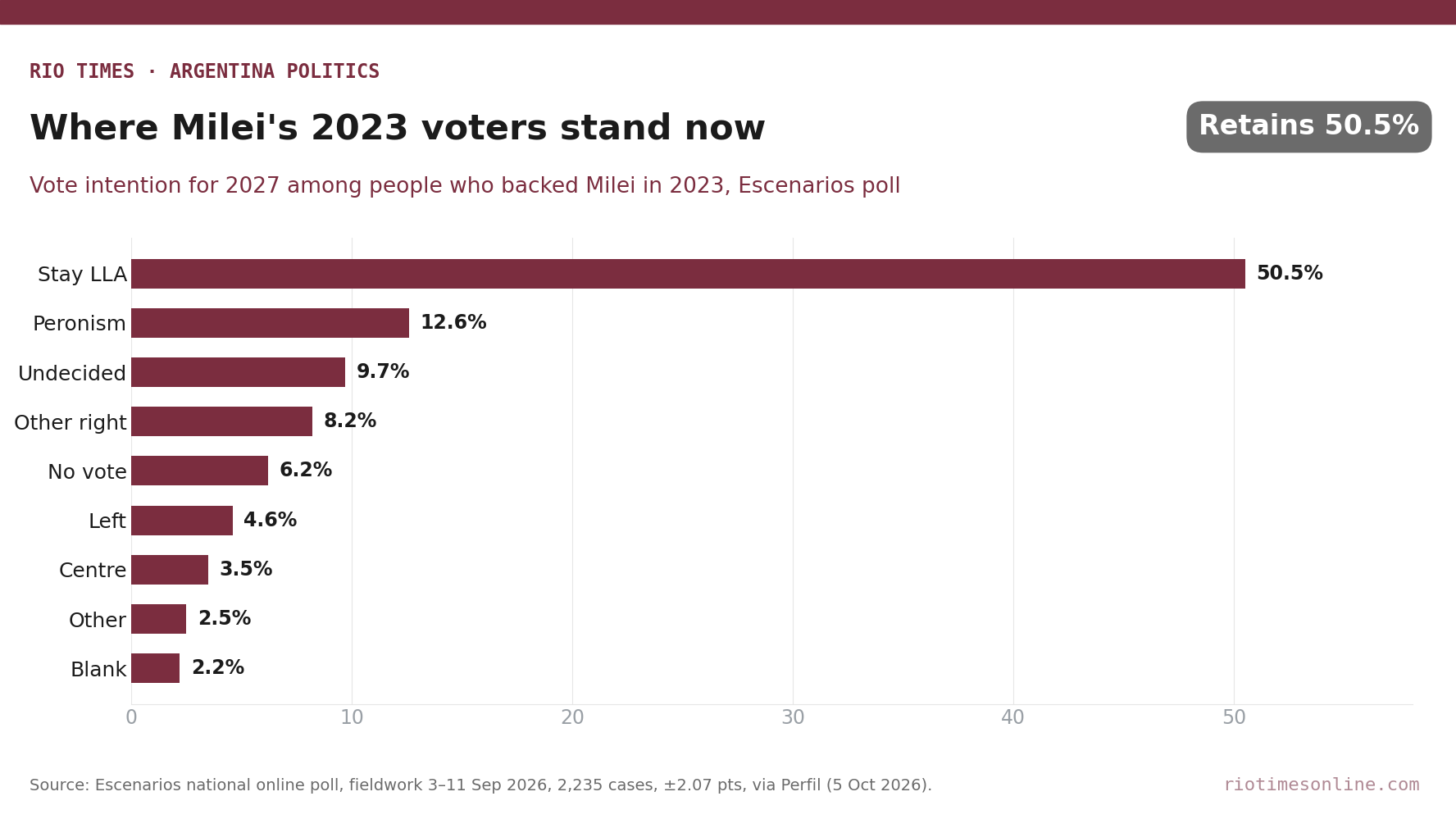
The most useful number for the government may be the 9.7% who are still undecided. Combined with those who would abstain, roughly one in six former Milei voters is not yet committed elsewhere.
Peronism Leads, but the Centre Is Open
Across all voters, Peronism leads national vote intention with 35.7%, against 27.2% for Milei’s camp. A centrist candidate draws 7% and a non-government right-wing option 6.8%.
Peronism also holds its own base better. Among people who backed Sergio Massa, the Peronist economy minister who ran against Milei in 2023, 77.9% would vote Peronist again.
The contest is likely to be decided among voters who call themselves centrist, about a third of the electorate. In that group Peronism has 39.6% and Milei’s camp 10.9%, while 14.4% are undecided.
Those numbers do not translate directly into a runoff. Argentina uses a two-round system, and Milei won the 2023 runoff after finishing second in the first round.
A Second Poll Shows Firmer Ground
A more recent survey points the other way on direction. Zentrix Consultora, an Argentine pollster with a monthly opinion monitor, polled 1,438 people online between 22 and 30 September. Its margin of error is plus or minus 2.6 points.
It found approval of Milei’s government rising to 35.2%, from 32.2% in August, its highest reading since March. Disapproval also rose, to 56.8%, as fewer respondents stayed neutral.
Looking to 2027, 28.3% would certainly vote for Milei and 27.1% for Axel Kicillof, the Peronist governor of Buenos Aires province. Both improved on August, and neither reached 30%.
The difference lies above that floor. Zentrix puts Milei’s potential vote at 37.3% and Kicillof’s at 47.8%, but 59.3% say they would never vote for the president.
Read together, the two polls describe a president with a smaller but firmer base, facing a rival with more room to grow. Earlier polling agreed, as Argentina’s Milei Viewed Negatively by Six in Ten as 2027 Vote Nears showed.
What It Means for You
The Trump administration has tied itself closely to Milei’s programme of spending cuts and deregulation. The US$20 billion swap line agreed in October 2025 was the clearest sign of that support.
For American holders of Argentine bonds, the 2027 result is the main political risk. A Peronist return would raise questions over the fiscal surplus and the opening to foreign capital.
The government is betting that growth arrives in time. Household strain is the risk, as Milei’s Image Recovery in Argentina Slowed by Wages, Utility Bills and Household Debt showed.
What Is Not Known
Perfil’s report does not say whether “2023 voters” means the first round or the runoff. The Escenarios fieldwork ended almost four weeks ago. Both surveys used online samples, which depend on weighting to reflect the electorate.
The Peronist candidate is not settled. The economy over the next twelve months is likely to matter more than any single Milei poll.
More: Argentina news in English, every day from The Rio Times.
What Prediction Markets Say
On Polymarket’s “Argentina Presidential Election Winner” market, bets gave Milei a 55.5% chance and Kicillof 31.5% at 12:40 p.m. ET on 5 October. About US$789,000 has been traded on the market, and neither price moved more than a point over the day.
Why we show this: prediction markets turn real-money bets into a live probability that moves within minutes of the news, which is why investors, campaigns and newsrooms in the United States now follow them closely. We show them next to polls and official results, never instead of them.
What does the new Milei poll show?
Escenarios found that 50.5% of Milei’s 2023 voters would back his party again. Nationally, Peronism leads with 35.7% against 27.2% for his camp, in fieldwork from 3 to 11 September 2026.
When is Argentina’s next presidential election?
The next presidential election is due in October 2027, with a runoff weeks later if no candidate wins outright. Milei is expected to seek a second four-year term.
Who is Axel Kicillof?
Kicillof is the Peronist governor of Buenos Aires province and a former economy minister. Polls treat him as Milei’s most likely rival, though the Peronist ticket is not yet decided.
Sources: Escenarios national survey as reported by Perfil, 5 October 2026; Zentrix Consultora September monitor as reported by Ámbito Reporte Misiones and Sin Filtro, 4 October 2026; Polymarket “Argentina Presidential Election Winner” prices and volume, 5 October 2026, 12:40 p.m. ET.
This article was produced by The Rio Times’ automated newsroom system. How we use AI · Report an error · Editorial responsibility: Matthias Camenzind, Editor-in-Chief
In depth