A small nuclear reactor provides a glimpse into the future of Colombia’s energy transition
By Camilo Amaya
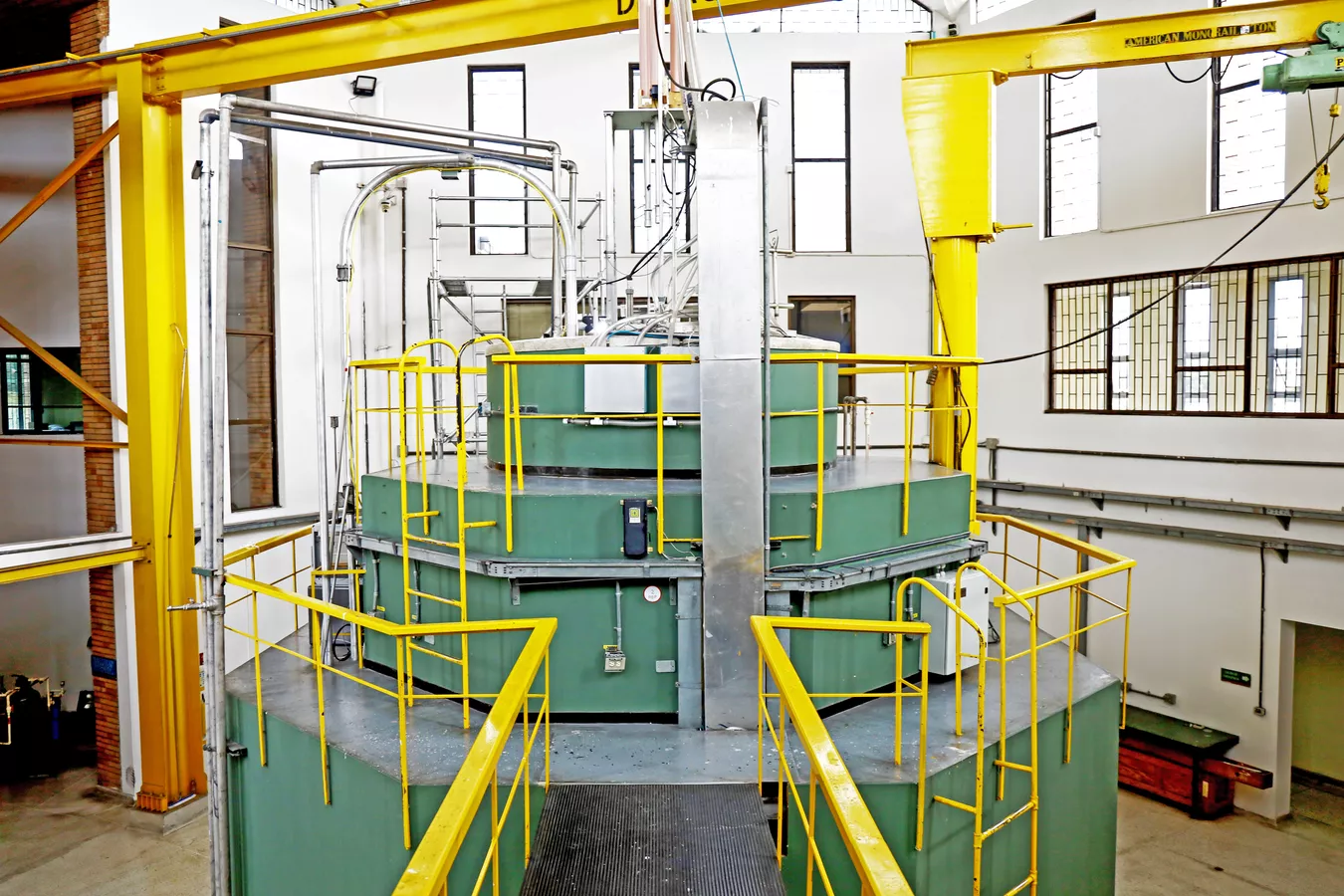
The IAN-R1 is in Bogota, in a neuralgic part of the city.
Few people know about this reactor, which is used for research purposes.
However, considering this type of energy in the energy transition proposed by President Gustavo Petro is not far-fetched.
Perhaps few Bogota citizens know that there is a nuclear reactor in the center of the city, very close to the National University of Colombia (the largest in the country).
The three-story structure, which gets narrower as it grows, has been in operation since 1965 when then-President Guillermo León Valencia (1962-1966) sought the country’s entry into the Atoms for Peace program, which promoted the peaceful use of nuclear technologies.
The IAN-R1, as it is known, has a large pool – four and a half meters deep – at the bottom that allows radiation control thanks to the water and has several purposes, from electricity generation to basic and applied research.
The Colombian Geological Service, which is in charge of the reactor, is working on three lines of research:
- geochronology, which determines the age of geological samples;
- radioactive application for peaceful purposes;
- and neutron activation, an analysis that establishes the elements within a geological sample.
In other words, this is not a reactor like those at Kashiwazaki- Kariwa (Japan), the world’s largest nuclear power plant, let alone generating imminent danger.
“We have used it in different fields, such as agriculture, health, geology, and industry.”
“The Geological Survey is in charge of the facility after the Institute of Nuclear Science and Alternative Energies was liquidated in 1997,” Lorena Rayo, director of Nuclear Affairs, tells Sputnik.
Rayo emphasizes that this is a low-power reactor and that the Colombian government’s priority has always been to work with and take advantage of nuclear energy for peaceful purposes.
To get an idea, the IAN-R1 produces barely 30 kilowatts of thermal power, far less than the power that feeds entire electrical grids (between 12,000 and 135,000).
“We have never been interested in war purposes. Its low power and configuration make it intrinsically safe because of its chemical components.”
“In addition, we have safety, physical and radiological elements that minimize the dangers to the public. That is why there is no problem having it in such a central part of Bogota,” adds Rayo.
Although the IAN-R1 works under the basic principles of nuclear energy – like any other, it operates with uranium fusion – experimentation is easier to control because it is so small.
Four people are more than enough to operate it as long as a backup team is alert to any eventuality.
At the rate it is used, it is estimated that the reactor could have an extended life of 100 years.
This is good news for scientists who want to learn everything related to nuclear energy without leaving aside geotechnical research, which not only helps prevent soil problems but also interprets data to know, for example, which crops grow best in certain terrains due to the composition of the soil.
NUCLEAR ENERGY AT THE FOREFRONT
Although nuclear energy is stigmatized by the major catastrophes that have occurred throughout history – such as Chornobyl in 1986 and Fukushima in 2011 – it is clear that this alternative source is one of the safest on the planet and one of the most environmentally friendly, as well as being sustainable.
For this reason, most countries have researched it to generate large amounts of electricity to meet their demands.
And Colombia does not want to be left behind.
To see how far behind the country is, comparing it with other nations that started using nuclear energy simultaneously is enough.
Argentina, to name one, started up its first reactor in 1958 and, to date, has three plants capable of producing 10% of the energy needed.
Colombia, meanwhile, continues for research purposes but not for production at scale.
According to the Mining and Energy Planning Unit, the country, as President Gustavo Petro has been saying, must look for different sources to produce energy, considering the environment.
That is why, from this entity, the possibility of Colombia having small modular reactors is structured so there is a generation at scale.
The advantage, besides their size, is that they do not require many things for their installation.
This would mean the end of thermal plants and, incidentally, the use of fossil fuels necessary for these facilities to operate and keep the country, together with hydroelectric plants, illuminated. In addition, Colombia would produce fewer greenhouse gases.
Petro’s government has not shed any light on the subject, nor has the Ministry of Mines and Energy, so we can continue to say that the only nuclear reactor in Colombia is located in the capital, something that few people know.
With information from Sputnik
More: Colombia news in English, every day from The Rio Times.
This article was produced by The Rio Times’ automated AI newsroom. Editorial responsibility: Matthias Camenzind, Publisher and Editor-in-Chief. The Rio Times also runs Ask Rio Times, which answers from 100,000+ of our own articles, the daily Latin America Power Map, and prediction-market odds on elections and markets.. How we use AI · Report an error