Zinc Falls to US$4,015 a Tonne but Scarcity Premium Holds
Key Facts
- Zinc for immediate delivery settled at US$4,015 a tonne on the London Metal Exchange on Friday, September 11, 2026, down 2.19% on the day and 1.8% on the week.
- Metal for delivery in three months costs US$3,872, a gap of US$143 that says buyers will pay a premium to get zinc now rather than later.
- Exchange stocks fell 1,775 tonnes to 109,575, a third straight daily drawdown after peaking at 115,675 tonnes on Wednesday.
- Peru mined 1.5 million tonnes in 2025, second only to China, but its output fell 10.2% in the first half of 2026 even as export earnings rose.
- Smelters are now paying miners to supply them, with spot treatment charges into China at minus US$100 to minus US$135 a tonne in late August.
- The catch: the region’s biggest zinc producer is changing hands. Sweden’s Boliden agreed on August 27 to buy control of Nexa Resources.
Today’s Focus
Trade date: Friday, September 11, 2026. Zinc for immediate delivery settled at US$4,015 a tonne in London, down 2.19%, and metal for delivery in three months at US$3,872.
That US$143 gap is the story. In a normal zinc market the later price is higher, because storage and finance cost money.
When the nearby price is dearer, it means the metal is not there. Exchange stocks fell again on Friday, to 109,575 tonnes, a third consecutive drawdown.
The pullback itself was macro. Base metals sold off hard on Thursday after strong American producer-price data pushed up the odds of a US rate rise, and zinc lost 5% in electronic trading that afternoon.
What matters today. The price fell and the scarcity did not. Smelters are paying miners to supply them, which is the clearest sign of a concentrate market that cannot meet demand.
01 The session in one read
Zinc’s official cash settlement fell US$90 to US$4,015 a tonne. The three-month contract fell the same amount, to US$3,872.
The backwardation therefore held at US$143. It has narrowed from more than US$230 in late August, but it remains historically wide.
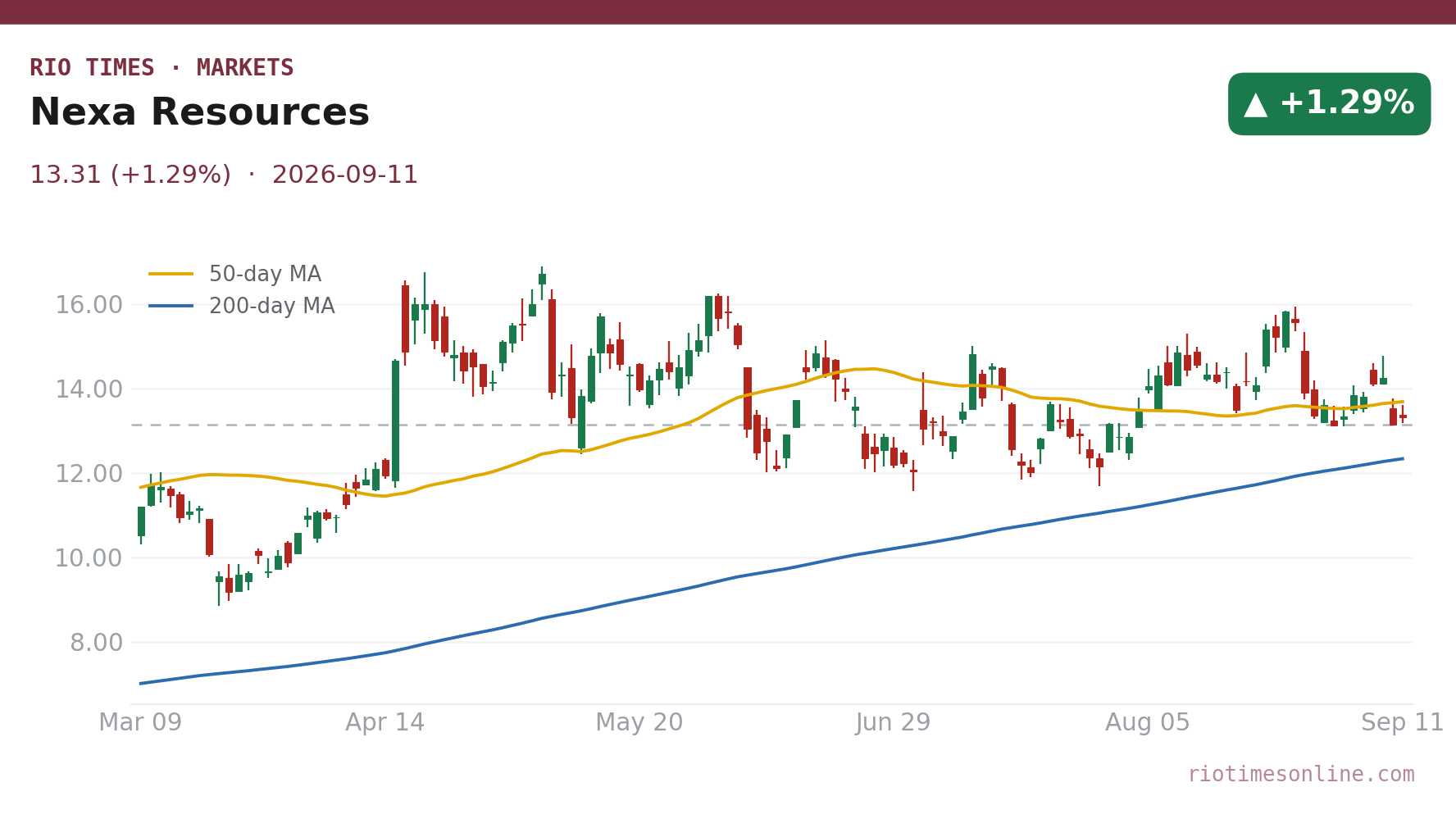
Latin American producer shares went the other way. Nexa Resources rose 1.29% to US$13.31 and Buenaventura 0.56% to US$34.04, both recovering a fraction of Thursday’s losses.
Two things are true at once and they point in opposite directions. Rate expectations are pushing the dollar up and dollar-priced metals down, which is why Thursday was brutal across the whole complex.
Underneath, the physical market is short. Global mine output fell 2.6% in the first half of 2026, and among the largest sampled producers the drop was 8.9%.
Negative treatment charges are the proof. Smelters pay miners rather than the other way round when concentrate is genuinely scarce, and Fastmarkets has had to split its assessment because the gap between what smelters and traders will pay has grown so wide.
The variable to watch is whether smelters start cutting output. Several already have, and that tightens refined metal rather than easing it.
02 The board
Friday was a stabilisation for the equities and a continued decline for the metal. Nexa and Buenaventura both closed higher after losing 7.8% and 4.4% respectively on Thursday.
Elsewhere in base metals the recovery was patchier. Lundin Mining fell a further 3.04% and Hudbay Minerals 0.49%.
| Asset | Level | Change |
|---|---|---|
| Zinc, LME cash | US$4,015/t | -2.19% |
| Zinc, LME three-month | US$3,872/t | -2.27% |
| LME zinc stocks | 109,575 t | -1,775 t |
| Nexa Resources (NEXA) | US$13.31 | +1.29% |
| Buenaventura (BVN) | US$34.04 | +0.56% |
| Lundin Mining (LUN) | US$33.45 | -3.04% |
Trade date 2026-09-11. Zinc prices and stocks are London Metal Exchange official data; equity closes from RT. Lundin Mining is quoted in Toronto. Where a commodity has no spot feed, an exchange-traded tracker or leading producer is shown as a labelled proxy.
Live Market IntelligenceThe live market board
Rio Times · Live Market Intelligence
Latin America — Cross-Market Board
| Instrument | Last | Change | YoY | Prev. | High | Low | Volume |
|---|---|---|---|---|---|---|---|
| IBOV | 187,206.89 | -0.56% | +21.85% | 188,268.59 | 168,310 | 167,142 | — |
| IPSA | 11,220.60 | -0.16% | — | 11,238.58 | 11,210 | 10,984 | 1,513,213,483 |
| IPC MEX | 63,924.77 | -0.28% | +12.17% | 64,106.82 | 66,121 | 65,405 | 108,886,187 |
| MERVAL | 3,098,898 | -1.87% | +30.51% | 3,022,485 | 3,042,365 | 2,991,150 | — |
| COLCAP | 2,589.69 | -1.41% | — | 9.04 | 9.05 | 9.02 | 4,133 |
| BVL PERÚ | 59,373.28 | — | — | — | — | — | — |
| USD/BRL | 5.16 | +0.01% | -5.13% | 5.16 | 5.18 | 5.14 | — |
| EUR/BRL | 5.95 | +1.01% | -5.83% | 5.89 | 5.98 | 5.94 | — |
| USD/MXN | 17.06 | -0.24% | -8.58% | 17.10 | 17.08 | 17.01 | — |
| USD/CLP | 913.98 | +0.04% | -5.67% | 913.65 | 915.11 | 906.68 | — |
| USD/COP | 3,140 | +0.03% | -22.04% | 3,139 | 3,141 | 3,105 | — |
| USD/PEN | 3.36 | -0.66% | -4.82% | 3.38 | 3.38 | 3.35 | — |
| USD/ARS | 1,493 | +0.10% | +12.96% | 1,491 | 1,494 | 1,480 | — |
| USD/UYU | 40.27 | +1.24% | +1.80% | 39.77 | 40.27 | 40.23 | — |
| USD/PYG | 5,939 | +1.68% | -19.54% | 5,841 | 5,939 | 5,925 | — |
| USD/BOB | 11.64 | -0.76% | +72.04% | 11.73 | 11.72 | 11.64 | — |
| USD/DOP | 58.34 | +1.25% | -3.44% | 57.62 | 58.34 | 58.04 | — |
| USD/CRC | 445.92 | +0.89% | -9.71% | 441.97 | 448.50 | 445.92 | — |
03 What moved it
Thursday did the damage. American producer prices came in hotter than expected and crude oil traded above US$105 a barrel, lifting the market-implied odds of a September rate rise sharply.
Zinc opened that session at US$4,058 a tonne and closed at US$3,855, a fall of 5.04%. Because the exchange strikes its official price at midday, most of that move lands in Friday’s official numbers rather than Thursday’s.
Copper had its own trigger. Reuters reported that Washington had stalled its plan to tax imported refined copper, and the unwinding of positions built on that expectation dragged the whole complex down.
The physical picture did not change. Stocks reached a low of 86,525 tonnes on August 18, rebuilt through early September as Chinese refined exports arrived, and have been falling again since Wednesday.
The concentrate market is the tighter half. The 2026 annual treatment charge benchmark was settled in March at US$85 a tonne, barely above last year’s record low, and spot charges have since gone deeply negative.
04 The Latin American read
Peru is the world’s second-largest zinc miner, at 1.5 million tonnes in 2025, behind China’s 4.1 million. Mexico is fifth on 780,000 tonnes and Bolivia seventh on 500,000.
Between them the three account for about 21% of world mine supply. That is why a squeeze in London registers as a policy question in Lima and La Paz.
Peru’s own output is falling, though. Production dropped 6.5% in the first five months of 2026 and 10.2% over the first half, according to the mining ministry.
Three operations account for more than two-fifths of it. Antamina supplies 25.1%, Volcan 11.0% and Nexa’s Peruvian mines 7.1%.
Falling volumes have not hurt export earnings. Peruvian zinc exports reached US$1.01 billion in the first four months of 2026, up 28.5% from a year earlier, because the price rose faster than the tonnage fell.
Reserves keep the region in the picture for the long run. Peru holds 18 million tonnes and Mexico 14 million, out of a world total of 240 million.
05 The names to watch
Nexa Resources is the region’s largest zinc business, with five mines in Peru and Brazil and three smelters. It guides to 310,000 to 360,000 tonnes of zinc in concentrate this year and 535,000 to 560,000 tonnes of refined metal.
Its second quarter was strong. Net income reached US$98 million against US$13 million a year earlier, on revenue of US$908 million, and mined zinc rose 8%.
A fire at its Cajamarquilla smelter in Peru on May 13 cost about 7,000 tonnes of refined output. Normal operations resumed in June and sales guidance was left unchanged.
The bigger news came on August 27. Sweden’s Boliden agreed to buy Votorantim’s 64.68% controlling stake in an all-share deal, issuing 21.4 million new shares for a stake worth about US$1.31 billion.
That values Nexa’s equity at roughly US$2.03 billion and the whole business at about US$3.67 billion. Completion is expected in the first quarter of 2027, followed by a cash offer to minority shareholders.
Buenaventura is the smaller zinc story. It produced 7,360 tonnes in the second quarter, almost all of it from Uchucchacua, with Tambomayo contributing 342 tonnes.
Those two are its only zinc mines. Output fell 5% from a year earlier on lower grades at Tambomayo, against full-year guidance of 28,600 to 31,800 tonnes.
06 The outlook
The rate decision on Wednesday is the near-term risk. A stronger dollar weighs on every metal priced in it, whatever the warehouse numbers say.
The physical story runs on a longer clock. The International Lead and Zinc Study Group reversed its view in April and now expects a refined zinc deficit of 19,000 tonnes this year.
Watch the stock draw. If exchange inventories keep falling from here, the nearby premium will widen again regardless of what the Federal Reserve does.
07 What to watch
- Federal Reserve decision, Wednesday: Consensus is a rise to 4.00%. A firmer dollar would keep pressure on zinc even with stocks falling.
- Exchange stock levels: Three consecutive drawdowns have started. A return towards the August low of 86,525 tonnes would push the nearby premium wider.
- Peru’s monthly output data: Zinc production is down 10.2% in the first half. The mining ministry’s next release shows whether Antamina’s steep May decline has continued.
- The Boliden takeover of Nexa: Regulatory approvals across Brazil, Peru and Luxembourg must clear before the first quarter of 2027, and minority shareholders await a cash offer.
Frequently Asked Questions
Why is zinc for immediate delivery dearer than zinc for later?
Because buyers cannot get enough metal now. On Friday the London Metal Exchange cash price was US$4,015 a tonne against US$3,872 for delivery in three months, a gap of US$143. In a normal zinc market the later price is the higher one.
Which countries mine the most zinc?
China led in 2025 with 4.1 million tonnes, or 31.5% of world output, according to the US Geological Survey. Peru was second on 1.5 million tonnes, Mexico fifth on 780,000 and Bolivia seventh on 500,000.
Why are smelters paying miners to take concentrate?
Treatment charges have gone negative because there is not enough mined concentrate to keep smelters running. Spot charges into China were minus US$100 to minus US$135 a tonne in late August, meaning the smelter pays for the privilege of processing.
What does the Boliden deal mean for Nexa?
Boliden agreed on August 27 to buy Votorantim’s 64.68% controlling stake in Nexa in an all-share deal valuing the equity at about US$2.03 billion. Completion is expected in the first quarter of 2027, with an offer to remaining shareholders after that.
Market data: London Metal Exchange official prices and stocks, and RT equity closes, for Friday, September 11, 2026. Production and reserve data: US Geological Survey, Mineral Commodity Summaries 2026, and Peru’s Ministry of Energy and Mines.
This article was produced by The Rio Times’ automated newsroom system. How we use AI · Report an error
LatAm Markets: Live Signals → — real-time movers, turnover leaders and FX across Latin America.
Read More from The Rio Times