Via the Caribbean, China tries to undermine support for Taiwan and the power of the West
By Fábio Galão*
China’s tentacles are spreading throughout South America, as evidenced by the establishment of a space station in the Argentine province of Neuquén, a structure that the United States suspects has military objectives, and the free trade agreement being sewn with Uruguay.
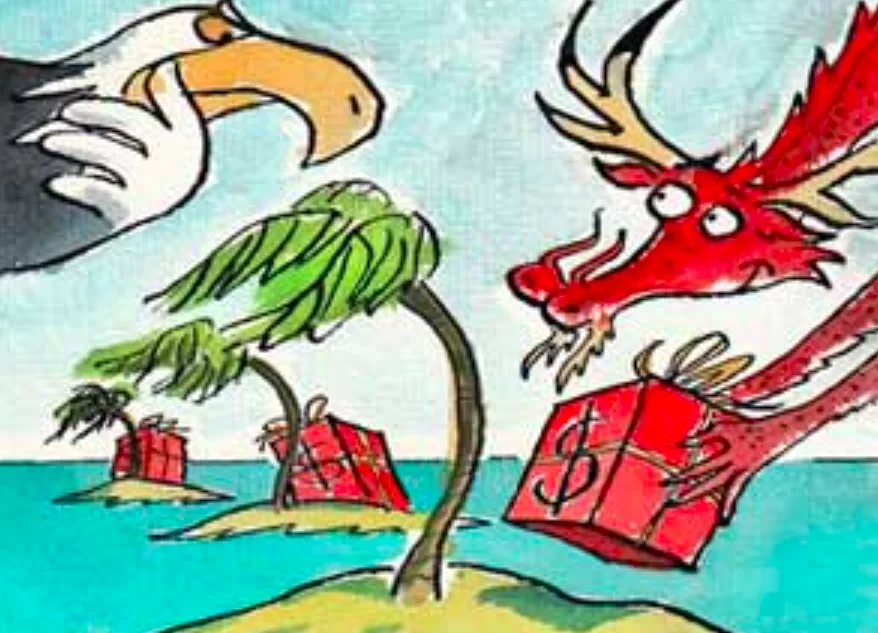
Meanwhile, the Americas have another strategic point through which Beijing is trying to undermine American global influence: the Caribbean.
A US Lower House Foreign Affairs Committee report pointed out that Caribbean trade with China rose from US$1 billion to US$8 billion annually between 2002 and 2019.
In addition, Chinese investments in the Caribbean occur in various areas, such as agriculture, industry, mining, tourism, and technology, but mainly in energy and infrastructure, with more than US$7 billion from 2005 to 2020.
Ten Caribbean countries participate in the New Silk Road, China’s worldwide infrastructure investment project.
Among Chinese projects for the region are a deep-water port in the Bahamas, a US$3 billion project to build 88 kilometers off the US coast, and a US$6 billion industrial park in Jamaica.
The partnership extends to soft power: the Caribbean countries have ten of the 45 branches in Latin America and the Caribbean of the Confucius Institute, aimed at spreading Chinese culture.
In security, China has donated military or policing equipment to Guyana, Jamaica, and Trinidad and Tobago and participated in the UN peacekeeping mission in Haiti between 2004 and 2012.
As Beijing does not usually do anything without ulterior motives, the question remains: why does the world’s second-largest economy invest in one of the planet’s poorest regions?
The first point is ideological since China has historical ties with the communist regime in Cuba, the first government in the region to diplomatically recognize the People’s Republic of China.
However, during the Cold War, this relationship was never very intense due to the rupture between Beijing and the Soviet Union, then the main ally of Castro.
Today, Cuba receives Chinese investments in areas such as telecommunications, energy, and mining, and the dictatorships maintain a relationship based on sharing communist ideals.
“Cuba is highly dependent on China, and ongoing economic challenges have resulted in the renegotiation of an estimated $4 billion debt with China in 2011 and another restructuring in 2015,” the US House report pointed out.
The second point is the greater ease of influencing local governments compared to other regions.
“In contrast to the larger nations of South America, the small sizes of Caribbean states and the more limited capabilities of their governments have created greater opportunities for China and its companies to influence government and business elites through large projects and, in the process, gain significant [political] influence,” said Evan Ellis, professor, and researcher on Latin America at the US Army War College’s Institute for Strategic Studies, in a recent article published by the Infobae website.
SIEGE ON TAIWAN
A central concern is the increasing isolation of Taiwan, an island with an autonomous government since 1949, which Beijing considers part of its territory and plans to incorporate.
Of the 14 countries that maintain diplomatic relations with Taiwan, five are in the Caribbean: St. Lucia, St. Vincent and the Grenadines, St. Kitts, Nevis, Haiti, and Belize.
Beijing’s idea is to use political and economic power to pressure the governments of these countries to stop recognizing Taipei.
“In the Caribbean, Haiti may be vulnerable to a change in recognition, as key politicians who would replace President Ariel Henry in the event of a democratic transition have expressed interest in doing business with China,” Ellis pointed out.
In 2018, following Chinese pressure, the Dominican Republic stopped recognizing Taiwan, repeating what Panama had done the year before.
The Dominican Republic pointed out in a statement that it “recognizes that there is only one China and Taiwan is an inalienable part of Chinese territory” and that establishing diplomatic ties with Beijing would be “extraordinarily positive for the future of our country.”
In 2021, Guyana also ended negotiations for a trade agreement with the Taiwanese due to Chinese pressure.
However, Chinese political ambitions in the Caribbean seem to go beyond the Taiwan issue and aim to wear down the West.
In 2021, when Barbados cut ties with the British crown, the then chairman of the UK Parliament’s Foreign Affairs Committee (and now Security Minister), Tom Tugendhat, said that “China has used infrastructure investment and [foreign] debt diplomacy as a means of control” in the Caribbean country and other nations.
“Some islands appear to be close to exchanging a token queen in Windsor for a royal and demanding emperor in Beijing,” Tugendhat fired back at the time.
For Evan Ellis, the United States needs to revise its policies toward the Caribbean, preaching with more emphasis the ideals of “democracy, a private sector-dominated economy, the prevalence of the rule of law, and the protection of individual rights” not only for the sake of these countries but for American survival itself.
“In the event of a US-Chinese war, China’s commercial presence, port operations, and economic base influence in the Caribbean may assume additional importance, presenting opportunities for Chinese intelligence services or military units to observe and disrupt [military force] deployment and maintenance operations centered in Asia, or even conduct operations to enter and/or attack the continental territory of the United States,” the researcher warned.
*Journalist graduated from the State University of Londrina (UEL). He worked at Folha de Londrina and the technology portal Futurista. At Gazeta do Povo, he contributed to the newspaper’s weekly magazine, UmDois Esportes, and the editorial Paraná. He is currently the editor of Mundo
With information from Gazeta do Povo
This article was produced by The Rio Times’ automated AI newsroom. Editorial responsibility: Matthias Camenzind, Publisher and Editor-in-Chief. The Rio Times also runs Ask Rio Times, which answers from 100,000+ of our own articles, the daily Latin America Power Map, and prediction-market odds on elections and markets.. How we use AI · Report an error