Ceuta Photos Were Used to Invent a Moroccan Migration Wave in Brazil

MOROCCO · SOCIETY
Key Facts
The scale: The Brazilian fact-checking outfit Observatório Lupa counted about 13,400 mentions of the claim between 21 and 27 August. Roughly 11,000 were in Spanish and 2,000 in Portuguese.
The claim: Posts asserted that Brazil was receiving a wave of Moroccan migrants because of President Luiz Inácio Lula da Silva’s policies. No official evidence of a mass arrival was produced.
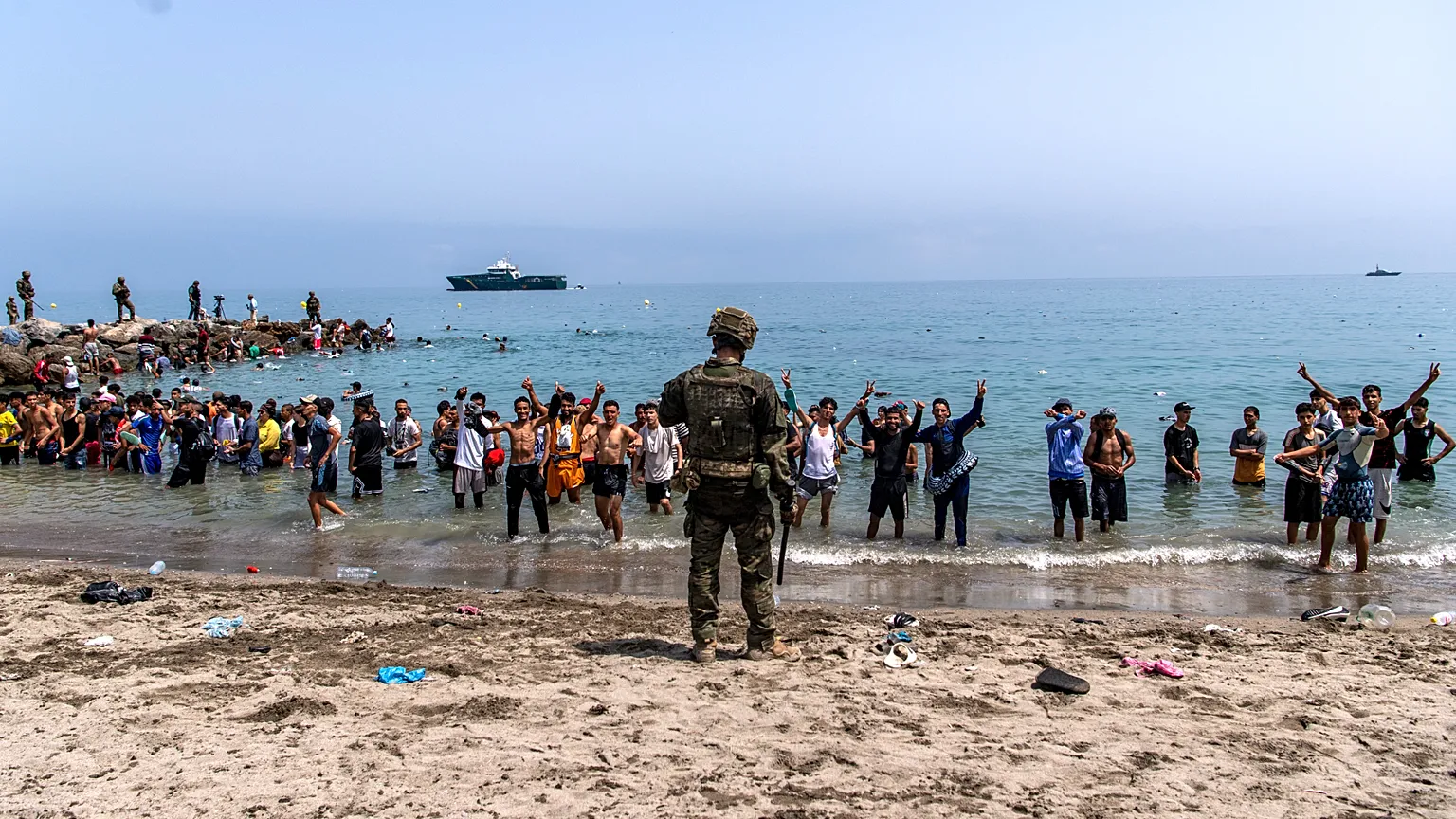
The pictures: Several posts used photographs of migrant crossings at Ceuta, the Spanish enclave on Morocco’s northern coast. Others used images unrelated to either country.
Where it started: The narrative accelerated on 25 August after the Argentine outlet La Derecha Diario published a piece claiming Moroccan immigration to Santa Catarina had risen sharply. Lupa says the narrative circulated mainly among Argentine accounts before reaching Brazil.
The actual figures: Fifty-seven Moroccans applied for asylum in Santa Catarina between January and July, 1.86% of the state’s 3,059 applications. Cubans filed 1,707, Haitians 543 and Venezuelans 227.
National context: Across Brazil, Moroccans filed 835 of 40,961 asylum applications in the same period. One post pushing the claim was viewed more than 475,000 times.
The story of a wave of Moroccan migration to Brazil was assembled from a real but tiny statistic, a set of photographs taken at the Ceuta border fence, and about 13,400 posts in seven days. Brazilian government data record 57 Moroccan asylum applications in the state at the centre of the claim.
How the Moroccan migration to Brazil story was built
The Brazilian fact-checking organisation Observatório Lupa tracked roughly 13,400 mentions of the claim across social media and websites between 21 and 27 August. About 11,000 of those were in Spanish and about 2,000 in Portuguese.
The assertion was that Brazil was absorbing a wave of Moroccan migrants as a result of President Luiz Inácio Lula da Silva’s policies. Lupa found no official evidence of any mass arrival.
Its account of the mechanics is precise. Real figures were stripped of context, unsupported policy claims were attached, and photographs from unrelated places were used as illustration.
The most-shared images came from migrant crossings at Ceuta, the Spanish enclave on Morocco’s Mediterranean coast, roughly 7,000km from Santa Catarina. Others had nothing to do with either country.
The number underneath the story
The seed was a real report that fifty Moroccans had sought refugee assistance in the southern Brazilian state of Santa Catarina over three months. That is a small, verifiable, unremarkable fact.
The official series is not much larger. Fifty-seven Moroccans applied for asylum in Santa Catarina between January and July, which is 1.86% of the state’s 3,059 applications.
By comparison, Cubans filed 1,707 applications in the state over the same period, Haitians 543 and Venezuelans 227. Moroccan arrivals are a rounding error against Brazil’s actual migration flows.
Nationally the picture is the same. Moroccans accounted for 835 of Brazil’s 40,961 asylum applications in the period.
Argentina to Brazil, in Spanish first
Lupa found the narrative circulated mainly among Argentine accounts before it moved into Portuguese. That sequence is visible in the language split, with Spanish posts outnumbering Portuguese ones by more than five to one.
It gathered pace on 25 August, after the Argentine outlet La Derecha Diario published an article claiming Moroccan immigration to Santa Catarina had risen sharply because of Lula. A single post pushing the claim was viewed more than 475,000 times.
La Derecha Diario’s response was not recorded in the material available. Lupa did not establish whether the accounts amplifying the claim were coordinated or inauthentic, and it did not name the platforms involved.
What the research does establish is direction of travel. The story was manufactured about Brazil, in Spanish, from Argentina, using pictures of Morocco.
Why Ceuta is the image bank of choice
Ceuta is one of two Spanish enclaves on the North African coast, and its border fence has produced some of the most reproduced migration photographs of the past decade. Those pictures are dramatic, plentiful and free to lift.
They are also specific. They show a European land border in North Africa, with its own history and its own politics, and none of it transfers to a Brazilian state.
Ceuta has had a genuinely severe year, with mass crossings, deaths and confrontations between protesters and police. That is what makes the imagery so easy to repurpose and so misleading when repurposed.
The reuse is a small case study in how South-South stories get written by people with no stake in either country. Morocco supplied the pictures, Argentina supplied the framing, and Brazil supplied the target.
What readers can check for themselves
Brazil publishes asylum application data by nationality and by state, which is how Lupa was able to test the claim within days. The gap between 57 applications and a migration wave is not a matter of interpretation.
Reverse image search resolves the second half of the problem. A photograph of a fortified land border between Africa and Europe is not evidence about the South Atlantic.
For internationally minded readers, the useful habit is to ask which government published the underlying number, and when. Almost every viral migration claim collapses at that question.
The claim itself will probably outlive the correction. The figures, at least, are on the record.
Background: Brazil Poll: Flávio Bolsonaro Closes on Lula and Edges Ahead in Run-Off.
Background: Brazil Tax Reform Timeline: Tech Sector Faces 2026 Invoice Shock.
Background: Fintechs and Digital Banks in Brazil 2026: Market Guide.
Background: Brazil Inflation Rate 2026: IPCA, Selic and What’s Next.
More: Morocco news in English, every day from The Rio Times.
Frequently Asked Questions
Is Brazil receiving a wave of Moroccan migrants?
Brazilian government data record 57 Moroccan asylum applications in Santa Catarina between January and July, which is 1.86% of the state’s 3,059 applications. Across Brazil, Moroccans filed 835 of 40,961 applications in the same period.
Where did the claim come from?
Observatório Lupa found the narrative circulated mainly among Argentine accounts and accelerated on 25 August after the outlet La Derecha Diario published an article about Santa Catarina. It distorted a report that 50 Moroccans had sought refugee assistance over three months.
What were the photographs?
Several posts used images of migrant crossings at Ceuta, the Spanish enclave on Morocco’s northern coast, and others used pictures unrelated to either country. Ceuta is roughly 7,000km from Santa Catarina.
How widely did the claim spread?
Lupa counted about 13,400 mentions between 21 and 27 August, roughly 11,000 in Spanish and 2,000 in Portuguese. One post pushing the claim was viewed more than 475,000 times.
Connected Coverage
The real situation at the enclave is covered in the standoff between protesters and police in Ceuta and in the crossings that killed at least 72 people. For migration politics further south, see how South Africa’s anti-migrant violence got this far, and more from the region in the Northern Africa hub.
This article was produced by The Rio Times’ automated newsroom system. How we use AI · Report an error · Editorial responsibility: Matthias Camenzind, Editor-in-Chief