Chile Markets: IPSA & the Peso — September 3, 2026
Key Facts
- Chile’s main stock index, the S&P IPSA, advanced on Wednesday with heavyweight bank and retail names doing most of the lifting
- The Chilean peso was nearly unchanged against the US dollar closing at 937.58 pesos per dollar, a move of just +0.02%
- Banco Santander Chile and Falabella each climbed 2.3% leading the domestic board alongside CMPC’s 3.4% gain
- Lithium giant SQM-B rose 1.0% on turnover of $17 million making it the second most-traded name of the session
- The peso remains well off its 52-week low sitting 2.9% below the 965.50 mark reached over the past year
Today’s Focus
Santiago’s equity market advanced on Wednesday, September 2, with the benchmark S&P IPSA — the index tracking Chile’s largest listed companies — closing higher as banking and retail shares caught a bid. The move came with very little drama in the currency market.
The Chilean peso was effectively flat against the US dollar at 937.58, a tiny +0.02% drift on the session. That calm is notable: the peso has spent the year trading between 851.67 and 965.50 per dollar, and it now sits comfortably in the middle of that range.
Among individual shares, Banco Santander Chile and Falabella — one of the country’s best-known retailers — each gained 2.3%. Banco de Chile, the nation’s largest bank by assets, added 1.2% with $19 million in turnover, making it the most actively traded stock of the day.
Pulp and paper producer CMPC was the session’s biggest gainer, up 3.4%, while investment holding company Quinenco followed with a 2.5% rise. On the losing side, utilities dragged: Enel Chile fell 1.2% and investment company ILC dropped 1.6%.
What matters today. Chilean stocks are grinding higher on broad domestic buying rather than any single catalyst, while the peso’s stability suggests investors see no urgent need to hedge or reposition.

01 The session in one read
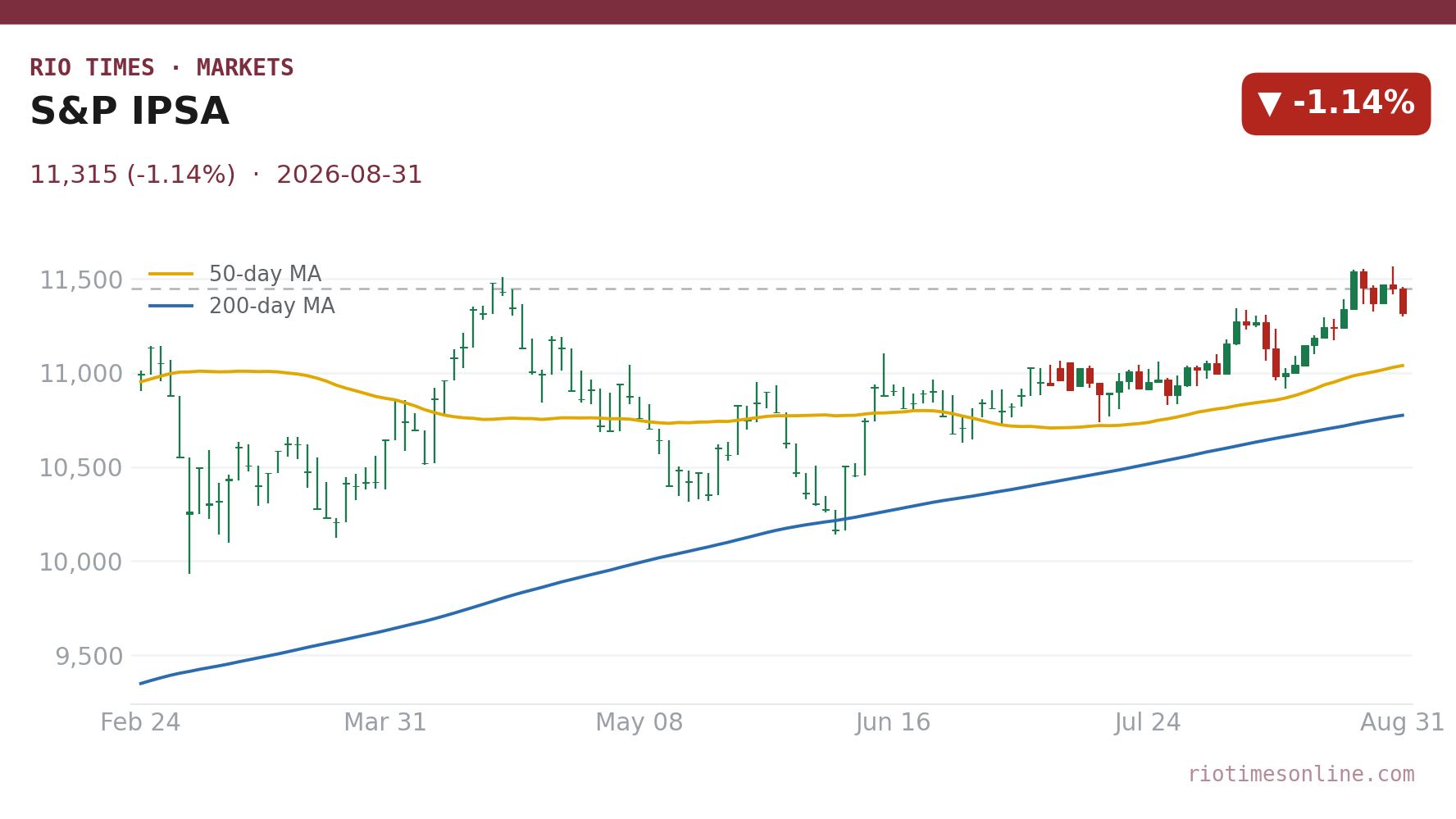
Chilean stocks closed firmly higher on Wednesday, September 2, with the locally focused names doing much of the work. Banco Santander Chile and Falabella each rose 2.3%, while pulp maker CMPC led all gainers with a 3.4% jump.
The peso, meanwhile, had one of its quietest sessions in weeks. It closed at 937.58 per US dollar — a move of just +0.02% — leaving the exchange rate right in the middle of its 52-week range.
Trading volumes were respectable but not exceptional. Banco de Chile was the most-traded stock at $19 million, followed by lithium producer SQM-B at $17 million and Banco Santander at $14 million.
The tone was constructive without being euphoric. With US markets posting modest gains and the dollar index slipping 0.13%, Chilean assets found enough support to grind higher, but not enough to spark a stampede.
The evidence points to a session of steady accumulation rather than a sharp re-rating: banks, a major retailer, and a pulp producer led gains, while utilities and shopping-mall operators slipped. Turnover was moderate — Banco de Chile traded $19 million, SQM-B $17 million — which suggests conviction rather than exuberance. The peso’s near-flat close against a slightly weaker US dollar index reinforces the picture of a market holding its ground. The variable to watch is copper’s next move, given how closely Chilean asset prices track the red metal.
02 The day’s numbers
| Measure | Level | Change | Read |
|---|---|---|---|
| USD/CLP (Chilean peso) | 937.58 | +0.02% | Peso flat, mid-range, calm session |
| USD/CLP 52-week high | 965.50 | — | Weakest peso level of past year |
| USD/CLP 52-week low | 851.67 | — | Strongest peso level of past year |
| S&P 500 (US stocks) | 7,667 | +0.46% | Mild global tailwind |
| VIX (US volatility gauge) | 15.2 | -6.98% | Appetite for risk improving |
The peso’s stability stands out in the table above. At 937.58, the dollar-peso pair — the number of Chilean pesos needed to buy one US dollar — is just 2.9% below the 52-week high of 965.50, where the peso was at its weakest.
That leaves plenty of room on both sides of the current level. A supportive global backdrop helped too: the S&P 500, the benchmark for large American companies, added 0.46%, while the VIX — Wall Street’s fear gauge — fell nearly 7%. Rio Times · Live Market Intelligence
Live Market IntelligenceChile — Live Market Board
Chile — Live Market Board
Instrument Last Change YoY Prev. High Low Volume
IPSA
10,970.29
-0.01%
—
10,971.88
11,210
10,984
1,513,213,483
USD/CLP
913.98
+0.04%
-5.67%
913.65
915.11
906.68
—
COPPER
6.61
+0.03%
+46.70%
6.61
6.71
6.61
39,543
SQM-B
65,305
-0.84%
+49.03%
65,860
66,949
64,978
76,539
COPEC
5,964
-1.09%
-11.70%
6,030
6,100
5,960
634,331
BSANTANDER
78.37
-2.28%
+35.94%
80.20
81.69
78.34
36,288,711
FALABELLA
6,334
-1.48%
+23.28%
6,429
6,450
6,300
26,085,814
ENELAM
87.09
+0.10%
-10.13%
87.00
87.40
86.50
13,106,417
CENCOSUD
1,946
-2.19%
-35.30%
1,990
2,010
1,945
966,528
CMPC
1,020
-1.96%
-29.10%
1,040
1,050
1,015
3,526,677
BANCO CHILE
184.96
-1.01%
+32.87%
186.85
189.99
184.33
18,101,240
LATAM AIR
24.08
-1.11%
+16.61%
24.35
24.59
23.88
573,612,753
SOUTHERN COPPER
193.97
-0.26%
+104.01%
194.48
199.36
192.59
367,102
03 Why it moved — banks, retail and a calm peso
The session was driven by local stories rather than a single powerful external catalyst. Banco Santander Chile’s 2.3% gain echoed a broadly positive tone for Latin American financials, with bank shares also outperforming in Brazil and Colombia.
Falabella — the department-store and financial-services group — matched that 2.3% rise, suggesting investors see resilience in Chilean consumer spending. Cencosud, the supermarket and mall operator, added a steadier 1.2%.
Copper, the country’s main export and a reliable barometer for Chilean risk appetite, offered no dramatic news on the day. With the US dollar index dipping 0.08%, emerging-market currencies like the peso found no fresh pressure.
The peso’s near-flat close at 937.58 confirms that no one was aggressively repositioning. After months of range-bound trading between roughly 850 and 965, the exchange rate is in a holding pattern that investors appear comfortable with.
04 The day’s movers
| Driver | Level / Move | Change | Note |
|---|---|---|---|
| CMPC (pulp & paper) | — | +3.4% | Strongest gainer on the domestic board |
| Quinenco (holding company) | — | +2.5% | Second-biggest riser, diversified group |
| Banco Santander Chile | — | +2.3% | Leading bank gainer, $14m traded |
| Falabella (retail) | — | +2.3% | Consumer exposure in favour |
| ILC (investment firm) | — | -1.6% | Worst performer of the day |
The most-traded names tell the story of a broad-based advance. Banco de Chile led turnover at $19 million with a 1.2% gain, while SQM-B — Chile’s flagship lithium producer — traded $17 million and rose 1.0%.
Pulp and paper giant CMPC was the star of the session, up 3.4%. It was followed by holding company Quinenco at +2.5%, while Banco Santander Chile and Falabella tied for third place among large caps at +2.3% each.
05 The regional scoreboard
| Index | Country | Change |
|---|---|---|
| Ibovespa (Brazil’s main stock index) | Brazil | +3.05% |
| Merval (Argentina’s main stock index) | Argentina | +1.86% |
| COLCAP (Colombia’s main stock index) | Colombia | +0.77% |
| IPC (Mexico’s main stock index) | Mexico | +0.49% |
| BVL Perú (Peru’s main stock index) | Peru | +0.34% |
It was a broadly positive day across Latin American stock markets. Brazil’s Ibovespa was the standout with a 3.05% surge, followed by Argentina’s Merval at +1.86% — both far outpacing the more measured gains elsewhere in the region.
Chile’s performance fits neatly into that regional picture: not the biggest mover, but a solid positive session. The live market board above carries the full closing levels for each regional benchmark.
06 The technical picture
The peso’s technical position is remarkably tidy. At 937.58 per dollar, it sits 2.9% below the 52-week high of 965.50 — the level where the currency was at its weakest over the past year — and about 10% above the 52-week low of 851.67.
For the IPSA, the broader 52-week range of roughly 4,510 to 6,062 gives context to the recent advance. The index has been climbing back from its lower reaches without yet challenging the top end of that range.
The calm in volatility — with the VIX falling nearly 7% to 15.2 — supports the view that Chilean assets can continue to recover gradually. A break above 965.50 in USD/CLP would signal renewed peso weakness, while a push toward 850 would mark a meaningful strengthening.
Until then, the technical story is one of consolidation. Investors appear content to let the range hold as they watch copper and the US Federal Reserve’s next signals.
07 What to watch
- Copper prices: The red metal is Chile’s main export; a sustained rally would likely lift the IPSA and strengthen the peso
- US nonfarm payrolls (Sep 4): A strong US jobs report could strengthen the dollar and pressure emerging-market currencies including the peso
- Lithium demand signals: SQM-B is the IPSA’s heavyweight; news on lithium pricing or Chinese demand moves the whole index
- Chilean pension reform details: AFP fund changes could shift domestic institutional flows into local stocks
Background: Itaú BBA Cuts Chile’s CMPC to a New Floor Over Its US$6 Billion Natureza Megaproject.
Background: Mercado Libre to Triple Its Logistics Network in Chile by 2027.
The big picture: Chile explained — economy, politics, society and daily life in one read.
More: Chile news in English, every day from The Rio Times.
Frequently Asked Questions
What is the S&P IPSA?
It is Chile’s benchmark stock index, tracking the 29 largest and most liquid companies listed on the Santiago Stock Exchange, with heavyweights like SQM-B, Banco de Chile, and Falabella.
Why did the Chilean peso barely move on September 2?
The dollar index slipped 0.13% and there was no major domestic news, leaving USD/CLP at 937.58, up just 0.02% on the day.
Which Chilean stocks rose the most?
CMPC led with +3.4%, followed by Quinenco at +2.5%, and Banco Santander Chile and Falabella at +2.3% each.
How does copper affect Chilean markets?
Copper is Chile’s largest export, so its price strongly influences the value of the peso and the earnings of major mining and industrial companies listed on the IPSA.
Market data: RT; exchange figures from Bolsa de Santiago
This article was produced by The Rio Times’ automated newsroom system. How we use AI · Report an error · Editorial responsibility: Matthias Camenzind, Editor-in-Chief
LatAm Markets: Live Signals → — real-time movers, turnover leaders and FX across Latin America.