Washington Puts a US$7 Billion Number on Cameroon

CAMEROON · BUSINESS
Key Facts
The meeting: The inaugural US-Cameroon Bilateral Economic and Commercial Dialogue was held in Yaoundé on 27 August 2026. Joint working groups will be created, with follow-up talks expected in the United States in 2027.
The headline figure: The US Embassy in Yaoundé says American companies are pursuing nearly US$7 billion, about CFAF 4 trillion, in trade and investment opportunities. They span energy, mining, transport, technology, forestry and logistics.
The biggest single item: The Grand Eweng hydropower project on the Sanaga River is rated at 1,080 megawatts and valued at about US$3 billion. The developer is the New York company Hydromine.
Minerals in the mix: Tronox and Australia’s Lion Rock are working on a rutile development the embassy values at US$500 million. American Renaissance Minerals is in talks on the Nkamouna cobalt, nickel and manganese deposit, starting at about US$85 million.
Who was in the room: Cameroon was led by Alamine Ousmane Mey, Minister of the Economy, Planning and Regional Development. The United States was led by Deputy Assistant Secretary of State Sarah Troutman.
The macro backdrop: Cameroon’s own annual economic report puts 2025 growth at 3.5% and inflation at 3.4%. The goods trade deficit was CFAF 2.098 trillion, on imports of CFAF 5.240 trillion against exports of CFAF 3.142 trillion.
The first Cameroon United States investment dialogue met in Yaoundé on 27 August, around a published pipeline of nearly US$7 billion in American commercial interest. Almost none of it is signed, and that is the point of setting up a standing channel.
What the Cameroon United States investment dialogue produced
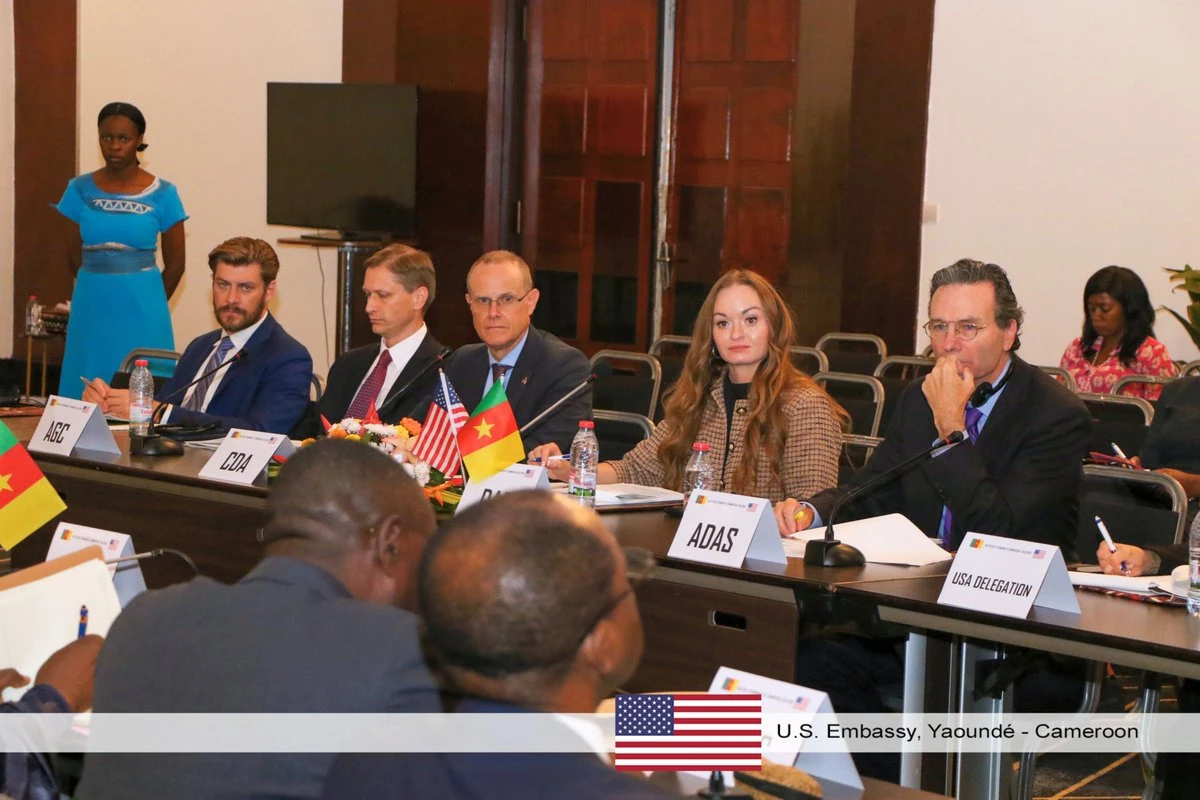
The inaugural Bilateral Economic and Commercial Dialogue was held in Yaoundé on 27 August 2026. Cameroon was led by Alamine Ousmane Mey, Minister of the Economy, Planning and Regional Development.
The United States was represented by Deputy Assistant Secretary of State Sarah Troutman, alongside the chargé d’affaires ad interim, John Robinson.
The two sides agreed to create joint working groups, and to meet again in the United States in 2027. The agenda ran across the business climate, investment promotion, and bilateral trade and market access.
The substantive output was an inventory. The US Embassy put American commercial interest at nearly US$7 billion, about CFAF 4 trillion, across energy, mining, transport infrastructure, technology, forestry and logistics.
Almost all of it is described as being at various stages of development. Nothing in the published account identifies a binding commitment, and Paul Biya’s involvement is not mentioned.
The projects on the list
The largest is Grand Eweng, a 1,080 megawatt hydropower scheme on the Sanaga River valued at about US$3 billion, developed by the New York firm Hydromine. It appears in Cameroon’s latest public-private partnership pipeline.
A proposed US$2 billion airport in the Douala metropolitan area is being pursued by the Illinois firm A. Epstein and Sons International, with the financial partner ITF.
The same company is working on a separate US$230 million project for theatre halls in Yaoundé, Douala and Bamenda.
On minerals, Tronox of Connecticut and Australia’s Lion Rock are developing a rutile deposit the embassy values at US$500 million, still at exploration stage. American Renaissance Minerals is in talks on the Nkamouna cobalt, nickel and manganese deposit, starting at an estimated US$85 million, and has not yet secured a new mining permit.
The smaller items are the ones most likely to happen. Cybastion of Virginia is proposing a US$75 million artificial-intelligence data centre in Douala with its own power plant, Hoffman Equipment of New Jersey has an US$83 million equipment transaction, and FedEx is working with Globex Cameroun on a warehouse at Douala International Airport.
Taylor Guitars continues to source ebony through its local partner Crelicam. That relationship is two decades old and is the only item on the list with a track record.
The economy the pipeline would land in
Cameroon’s own annual economic report, presented by Ousmane Mey in Yaoundé on 25 August, puts 2025 real growth at 3.5%. Non-oil activity grew 3.8% and services 4.3%.
Inflation fell to 3.4% from 4.5% the year before, though food prices rose 6.8%, well above the headline rate. That gap is what households actually experience.
The trade position is the constraint. Imports came to CFAF 5.240 trillion against exports of CFAF 3.142 trillion, leaving a goods deficit of CFAF 2.098 trillion, which the ministry attributes partly to lower hydrocarbon exports.
An earlier estimate published in May put the 2025 deficit slightly higher, so the two figures should not be merged. The report is the government’s own, running to nearly 200 pages, and feeds the National Development Strategy to 2030.
Why the timing is the story
Cameroon is a CEMAC member with a currency pegged to the euro, which means a persistent goods deficit has to be financed rather than devalued away. That is precisely the position in which foreign direct investment stops being optional.
It is also a country whose succession question has been open for years. Paul Biya has governed since 1982, and the vice-presidency created in the last reshuffle has stood empty.
Washington building an institutional channel to the economy ministry, with working groups and a 2027 follow-up, is a bet on continuity of administration rather than on any individual. That is a deliberate choice.
It is not happening in a vacuum. Chinese industrial capital is already established in Cameroon, and the American pitch is explicitly a competitive one.
What would make it real
The test for Grand Eweng is financial close, not the announcement. A 1,080 megawatt hydro scheme in Central Africa needs multilateral cover, and none has been named.
For the minerals projects, the test is permits. American Renaissance Minerals does not yet hold a new mining permit for Nkamouna, and the rutile venture is at exploration stage.
For the smaller technology and logistics deals, the test is simply whether they open. A US$75 million data centre is the kind of commitment that either exists in eighteen months or does not.
The most useful thing the dialogue produced is the inventory itself. Before this week there was no published list of what American capital was actually looking at in Cameroon.
Frequently Asked Questions
What was agreed at the US-Cameroon dialogue?
The two governments held their first Bilateral Economic and Commercial Dialogue in Yaoundé on 27 August 2026, agreed to create joint working groups and to meet again in the United States in 2027. The US Embassy put American commercial interest at nearly US$7 billion.
What are the largest projects?
The Grand Eweng hydropower project on the Sanaga River is rated at 1,080 megawatts and valued at about US$3 billion, developed by Hydromine. A proposed airport in the Douala area is valued at US$2 billion.
Are any of the deals signed?
The published account describes the projects as being at various stages of development, and identifies no binding commitment. American Renaissance Minerals has not yet secured a new mining permit for the Nkamouna deposit.
How is Cameroon’s economy performing?
The government’s annual report puts 2025 real growth at 3.5% and inflation at 3.4%, with food prices up 6.8%. The goods trade deficit was CFAF 2.098 trillion, on imports of CFAF 5.240 trillion against exports of CFAF 3.142 trillion.
Connected Coverage
An earlier test of foreign financing in the same sector is described in the frozen loan stalling Cameroon’s first bauxite mine, and the political backdrop in Paul Biya’s return and the empty deputy post. The wider competition for African assets is tracked in Africa: The New Scramble, with more from the region in the Central Africa hub.
This article was produced by The Rio Times’ automated newsroom system. How we use AI · Report an error · Editorial responsibility: Matthias Camenzind, Editor-in-Chief
Great Powers in Africa
- Who Backs Whom in Africa 2026: China, Russia, US, Gulf
- Africa: The New Scramble
- DP World and AD Ports Drive Gulf States Africa Investment as Saudi Deals Follow
- China Slashes Africa Lending 46% as Kenya and Angola Race to Refinance Old Debts