Brazil’s Inflation Forecast Rises for 19th Week as Economic Pressures Mount
Brazil’s financial market has raised its inflation forecast for 2025 for the 19th consecutive week, according to the Central Bank’s Focus report released on February 24.
The median projection for the Broad National Consumer Price Index (IPCA), Brazil’s official inflation measure, climbed from 5.60% to 5.65%, well above the Central Bank’s target of 3%, which allows a tolerance range of 1.5 to 4.5%.
This persistent upward revision underscores growing inflationary pressures in Latin America’s largest economy. For 2026, inflation expectations also rose slightly from 4.35% to 4.40%, while projections for 2027 held steady at 4.00%.
Economists attribute these increases to various factors, including currency depreciation, rigid service prices, and a tight labor market. The Central Bank has responded with a restrictive monetary policy, keeping the benchmark Selic rate high.
Projections indicate the Selic rate will remain at 15% by the end of 2025 before gradually declining to 12.50% in 2026 and 10.50% in 2027. Despite these challenges, Brazil’s economy is expected to grow modestly.
The Focus report maintained its GDP growth forecast for 2025 at 2.01%, with a slight increase from 1.98% to 2.00% for 2027. However, growth for 2026 remains subdued at an estimated 1.70%.
Analysts warn that high interest rates could dampen household consumption and investment, further constraining economic expansion. The currency market has also seen adjustments.
Brazilian Real Outlook Amid Economic Headwinds
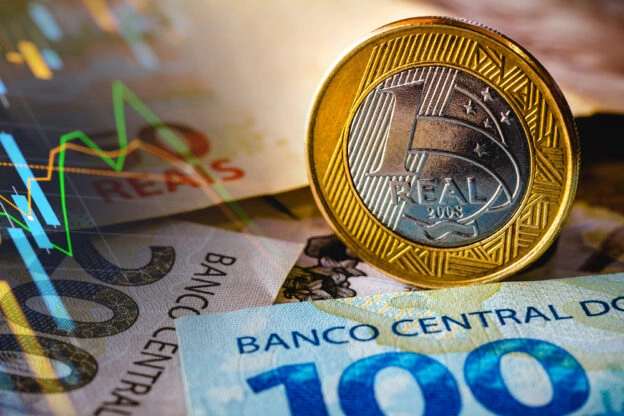
The Brazilian real is projected to weaken slightly against the U.S. dollar, with forecasts revising the exchange rate for the end of 2025 from R$6.00 to R$5.99 and projecting R$6.00 for 2026 and R$5.92 for 2027.
Brazil faces additional headwinds from fiscal uncertainties and external economic pressures, including slowing demand from China and global geopolitical tensions.
While domestic reforms like tax system modernization and a regulated carbon market aim to boost long-term productivity, short-term risks remain significant. The persistent rise in inflation expectations underscores Brazil’s struggle to maintain price stability.
This challenge persists as the country seeks economic growth amid a complex global and domestic environment. Policymakers face mounting pressure to implement effective measures that restore investor confidence while addressing structural economic vulnerabilities.
This article was produced by The Rio Times’ automated newsroom system. How we use AI · Report an error · Editorial responsibility: Matthias Camenzind, Editor-in-Chief
LatAm Markets: Live Signals → — real-time movers, turnover leaders and FX across Latin America.