Kassio Nunes Marques Runs Brazil’s Election Court
Kassio Nunes Marques, 54, a Supreme Court justice named by Jair Bolsonaro, has led Brazil's electoral court since May and announced Lula's re-election.
Kassio Nunes Marques, 54, is the Brazilian Supreme Court justice who has run the country’s Superior Electoral Court since Tuesday 12 May 2026. On Sunday 25 October he announced President Lula’s re-election, with 51.79% of valid votes.
Jair Bolsonaro, Brazil’s former conservative president, chose him for the Supreme Court in 2020. For US readers he is the referee of the vote that returned Lula to power in Latin America’s largest economy.
Key Facts
- The role Kassio Nunes Marques, 54, has led Brazil’s Superior Electoral Court since Tuesday 12 May 2026.
- Runoff night He announced Lula’s re-election on Sunday 25 October 2026, with 51.79% of valid votes to 48.21%.
- The count Lula won 64,256,232 votes to 59,826,041, a margin of 4,430,191, on 128.2 million ballots.
- Latest ruling On Tuesday 27 October 2026 he wrote a unanimous court ruling that put PSOL-Rede over the party-funding bar.
- What to watch The court’s services reopen Tuesday 3 November; no date is published for Lula’s certification.
- Power Index Brazil ranks 1st of 14 in The Rio Times Latin America Power Index, with 74.2 points (November 2026 edition).

BRAZIL · PROFILE
Today, Monday 2 November 2026, the court’s own notice says its services are paused through 2 November and reopen on Tuesday 3 November. Its next step is Lula’s certificate of election, for which no date is published.
Who Kassio Nunes Marques Is
Nunes Marques was born on 16 May 1972 in Teresina, the capital of Piauí, a state in Brazil’s north-east. He took his law degree at the Federal University of Piauí and opened his own law firm in 2001.
From 2008 to 2011 he served as an electoral judge in Piauí, in the seat reserved for lawyers. He then joined a federal appeals court, the Federal Regional Court of the 1st Region, after then-president Dilma Rousseff chose him from a lawyers’ shortlist.
He told senators in 2020 that he finished a master’s in law at the Autónoma University of Lisbon in 2015. He also said he earned a public-law doctorate at Spain’s University of Salamanca, with the title obtained in 2020.
Bolsonaro’s First Supreme Court Pick
Bolsonaro, then president, named him by decree on 22 October 2020 to the seat of Justice Celso de Mello, who retired. The Senate approved him by 57 votes to 10, and he was sworn in on 5 November 2020.
André Mendonça, Bolsonaro’s second pick, joined the court in December 2021. Both men also sit on the electoral court.
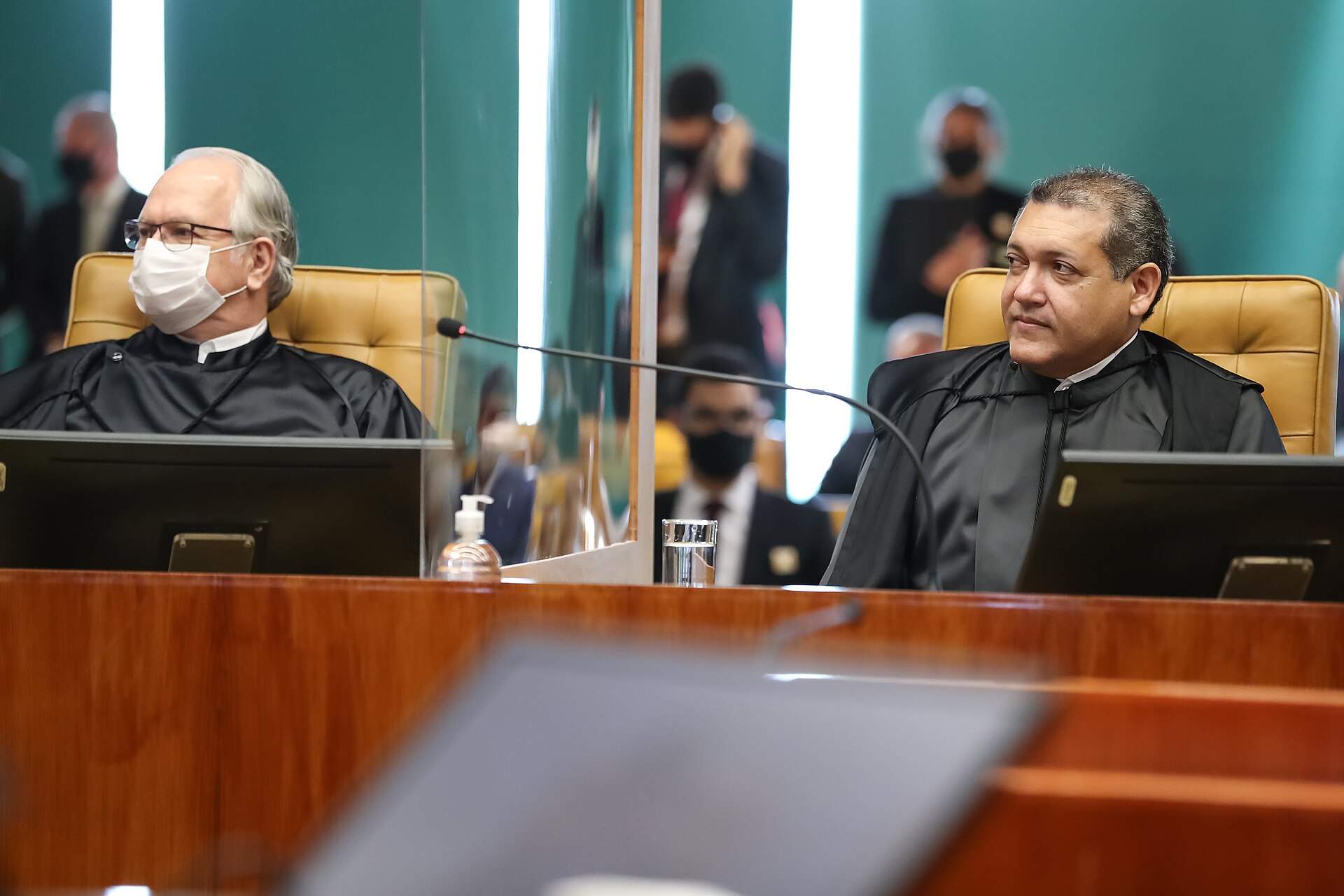
How He Came to Run the Election Court
Nunes Marques joined the electoral court as a substitute judge on 31 August 2021 and became a full member on 25 May 2023. He was renewed for a second two-year term on 25 May 2025.
He became the court’s vice-president on 3 June 2024 and its president on 12 May 2026, succeeding Justice Cármen Lúcia. The court’s own profile does not say when his presidency ends.
What the Electoral Court Does
The electoral court is the body that organises every national vote in Brazil, from registering candidates to counting ballots. It also rules on campaign disputes and certifies the winners.
Its chief therefore sets the tone for whether parties, voters and markets accept a result. A president-elect receives a certificate from the court, a step called diplomação, before taking office.
Runoff Night and the Voting Extension
The court’s count gave Lula 64,256,232 votes, or 51.79% of valid votes, and Flávio Bolsonaro, of the conservative Liberal Party, 59,826,041, or 48.21%. About 128.2 million of more than 158 million eligible voters cast ballots, and abstention was about 19.2%.
The court says the result was mathematically settled at 21:09 on Sunday, and that all ballot-box reports were counted at 23:26. It calls that a record count for a second round.
A late Supreme Court injunction extended voting in sections still open from 17:00 to 19:00. Nunes Marques said that order arrived after many machines had closed, so the court briefly paused receiving ballot files and a backlog built up.
The court replaced 1,551 of the 499,248 voting machines used in the runoff, or 0.31%. It says more than 95,000 polling places were open nationwide, with free public transport on voting days.
On the night he said extending an election is possible but must be planned and structured. He also reported 2,265 cases filed with the court, including 827 complaints and 446 right-of-reply requests.
His Latest Ruling on Party Funding
On Tuesday 27 October 2026 the full electoral court ruled unanimously, with Nunes Marques as the judge who wrote the opinion. It rounded each party’s vote share in a state before testing the new 1.5% state-by-state minimum.
That helped PSOL-Rede, a left-wing alliance of two small parties. Its Espírito Santo share was about 1.49%, which rounds to 1.5%, giving it the minimum in nine states.
The alliance therefore qualifies for the party fund and free radio and television airtime in the 2027 to 2031 legislature. The court did not publish an amount for the fund.
What Happens Next at the Electoral Court
The court’s own notice says its services are paused through Monday 2 November and reopen on Tuesday 3 November. Lula’s certificate of election, called diplomação, is the next formal step.
The court published an explainer on Friday 30 October on diplomação, the certificate that confirms who may take office. No date for Lula’s diplomação is published, and he is due to be sworn in on Tuesday 5 January 2027.
The Banco Master Request
Workers’ Party deputies Rui Falcão and Rogério Correia asked the Supreme Court on Monday 12 October 2026 to investigate him over alleged Banco Master links. They also asked that the prosecutor-general receive the case.
A request is not a charge, and no public decision on it is confirmed as of Monday 2 November 2026. The Supreme Court’s news page shows nothing on it since the filing, and the allegations in it have not been tested by any court.
Separately, Supreme Court president Edson Fachin ruled on Thursday 29 October that Compliance Zero stays with him for up to 90 days from 12 September. The court’s note says police reports cite an official under its jurisdiction, and it names no justice.
What It Means for You
For anyone with money in Brazil, the electoral court chief matters because his court decides whether results and campaign rules are accepted. Investors read the court’s rulings as a gauge of political risk.
Travellers and expats are not affected directly. US investors with Brazilian assets through funds or American depositary receipts watch the court mainly for signs of a disputed vote.
See Brazil Court Chief Holds Bank Probe 90 Days and Brazil Court Chief Admits Voter Bus Gaps. More is on the Brazil hub, in the Brazil Big Read and in The Rio Times Latin America Power Index.
What Is Not Known
It is not known whether the Supreme Court or the prosecutor-general will act on the deputies’ request. It is also not known when the court will certify Lula, because its published material gives no date.
The profile lists a two-year term as full member from 25 May 2025, but it does not say how long he can stay as president. The Supreme Court plenary has still to review Fachin’s 29 October decision on Compliance Zero.
More: Brazil news in English, every day from The Rio Times.
Frequently Asked Questions
Who Is Kassio Nunes Marques?
He is a Brazilian Supreme Court justice, sworn in on 5 November 2020, and president of the Superior Electoral Court since 12 May 2026. He was born in Teresina on 16 May 1972.
Who Appointed Kassio Nunes Marques to the Supreme Court?
Jair Bolsonaro, then president, nominated him in 2020 to replace the retired Justice Celso de Mello. The Senate approved him by 57 votes to 10.
Did Kassio Nunes Marques Declare Lula the Winner?
Yes, as president of the electoral court he announced Lula’s re-election on the night of Sunday 25 October 2026. Lula had 51.79% of valid votes to 48.21% for Flávio Bolsonaro.
Is Kassio Nunes Marques Under Investigation?
Two Workers’ Party deputies asked the Supreme Court on 12 October to investigate him over Banco Master. A request is not an investigation, and no public decision on it is confirmed.
How Old Is Kassio Nunes Marques?
He is 54. He was born on 16 May 1972 in Teresina, in Brazil’s Piauí state.
Sources: Superior Electoral Court (TSE), profile of Minister Kassio Nunes Marques, accessed 2 November 2026; Supreme Federal Court (STF), nomination decree and swearing-in dates, accessed 2 November 2026; Federal Senate, confirmation hearing and academic background, 21 October 2020; TSE, runoff result and statements of its president, 26 October 2026; TSE, ruling on the performance clause and party funding, 29 October 2026; TSE, news list with closure, certificate and audit-report notices, accessed 2 November 2026; STF, decision of its president on Compliance Zero, 29 October 2026.
This article was produced by The Rio Times’ automated AI newsroom. Editorial responsibility: Matthias Camenzind, Publisher and Editor-in-Chief. The Rio Times also runs Ask Rio Times, which answers from 100,000+ of our own articles, the daily Latin America Power Map, and prediction-market odds on elections and markets.. How we use AI · Report an error
In depth
Brazil runoff, Sunday, October 25: Brazil runoff: date, poll closing times and when results start. Latest: Brazil runoff polls, Flávio 51%, Lula 49%.