How LatAm is doing in terms of labor legislation for women
The 21st century has arrived, but the conditions of access to work for women are still not on par with those of men.
This is shown in the ninth Women, Business and the Law 2023 report, prepared by the World Bank, which shows that only in 14 countries are the legal conditions for labor development equal for both sexes.

The report presents eight indicators structured around women’s interactions with the law as they move through their lives and careers:
- Mobility: Examines limitations on freedom of movement.
- Workplace: Analyzes the laws that affect women’s decision to work
- Wage: Legislative and regulatory measures that affect women’s pay
- Marriage: Evaluates legal constraints related to marriage
- Parenthood: Examines laws affecting women’s work after childbearing
- Entrepreneurship: Analyzes the constraints women face in starting and running businesses
- Wealth: Considers gender differences in property ownership and inheritance
- Pension: Evaluates the laws that affect the amount of a woman’s pension.
HOW DOES LATIN AMERICA RANK GLOBALLY?
The score of this ranking goes from 0 to 100, and the only countries that reach the ideal score are: (Germany, Belgium, Canada, Denmark, Spain, France, Greece, Ireland, Iceland, Latvia, Luxembourg, Netherlands, Portugal and Sweden).
The world average is 77.1, while Latin America and the Caribbean are 80.9.
The eleven countries with the best scores in the region are:
- Peru: 95 points
- Paraguay: 94.4
- Costa Rica: 91.9
- Ecuador: 89.4
- Bolivia: 88.8
- El Salvador: 88.8
- Mexico: 88.8
- Uruguay: 88.8
- Guyana: 86.9
- Dominican Republic: 86.3
- Nicaragua: 86.3
Considering the main Latin American economies, the worst positioned is Argentina (79.4), although Chile does not enjoy a good position either (80.4).
The region’s largest economy, Brazil, shows an above-average score (85 points), as do Venezuela (85 points) and Colombia (84.4).
Among the Spanish-speaking countries in the region, Panama (79.4), Honduras (75), and Guatemala (73.8) are also below the regional average.
According to this ranking, Haiti is the Caribbean country with the worst working conditions for women (61.3).
WHERE ARE THE COUNTRIES WITH THE LOWEST SCORES WEAK?
Bloomberg Linea put the magnifying glass on the Latin American countries that rank below the regional average (80.9) to find out why they are so poorly positioned.
- Chile: The lowest score is in the assets category (60 out of 100).
- Argentina: A very poor score in terms of payment (50) and paternity (60)
- Panama: Only 50 points in the pension and payment categories.
- Honduras: Only 20 points in the paternity category
- Guatemala: Only 25 points in the item workplace
CONCLUSIONS AT THE GLOBAL LEVEL
The World Bank highlighted that: “90 million working-age women achieved legal equality in the last decade. However, 2.4 billion working-age women do not have the same legal rights as men.
More than half live in East Asia and the Pacific (710 million) and South Asia (610 million), followed by Sub-Saharan Africa (330 million), the high-income countries of the Organization for Economic Cooperation and Development (260 million), Latin America and the Caribbean (210 million), the Middle East and North Africa (150 million), and Europe and Central Asia (140 million).”
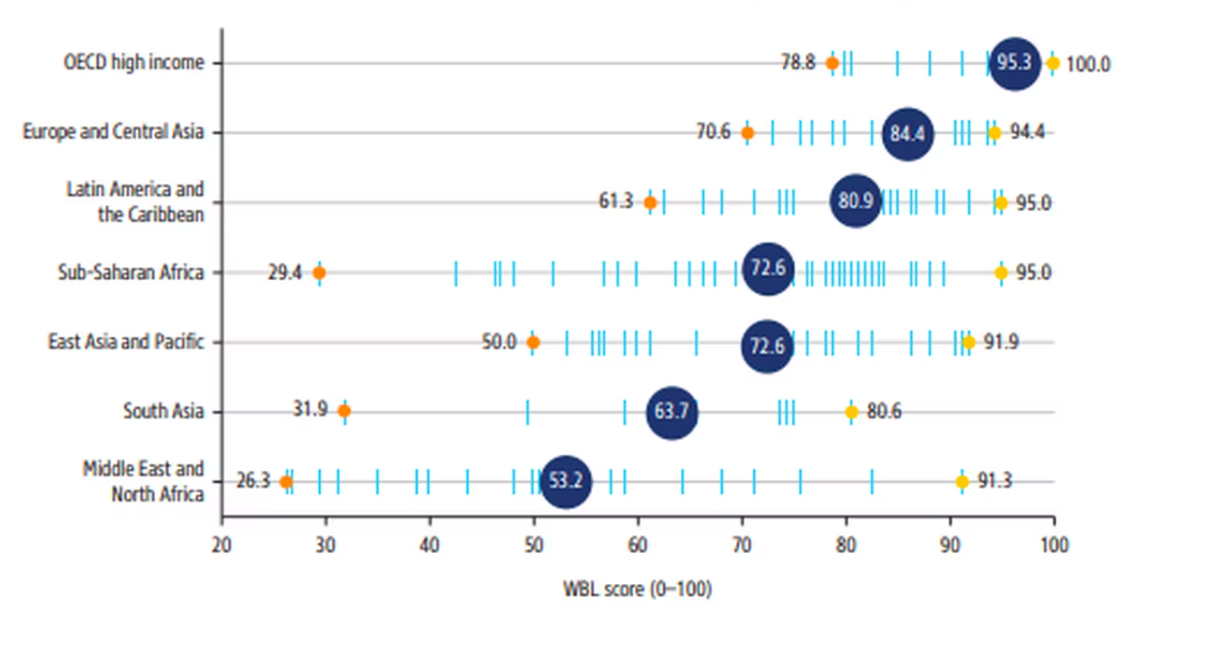
Globally, 44 economies in six regions score above 90.
Of these, 28 are in the OECD, 7 are in Europe and Central Asia, 3 are in East Asia and the Pacific, and 3 are in Latin America and the Caribbean.
In 2022, one economy in the North Middle East and North Africa region (Malta) and 2 economies in the Sub-Saharan Africa region (Côte d’Ivoire and Gabon) also exceed 90 %. and Gabon) also exceed 90 points for the first time.
No economy in the South Asia region has achieved a score of 90.
MORE POVERTY AMONG WOMEN THAN MEN
According to the Economic Commission for Latin America and the Caribbean (ECLAC), in 2019, in Latin America and the Caribbean, for every 100 men living in poor households in the region, there were 112.7 women in a similar situation.
This, for the agency, “evidences the lack of economic autonomy of women, who in the absence of other household income are more likely to be in poverty, a situation that is exacerbated in households with a greater presence of children.”
Although there is no subsequent aggregate data at the regional level, the country-by-country analysis that can be seen in an ECLAC report published in 2022 states, “The poverty reduction observed in 2021 did not contribute to reducing gender gaps. The femininity index of poverty only decreased in Panama, while in the other countries, it remained constant or tended to increase”.
With information from Bloomberg
More: Latin America news in English, every day from The Rio Times.
Read More from The Rio Times