Flávio Vows Payroll Tax Relief 9 Days Out

ELECTION 2026 · BRAZIL
Key Facts
- —The country Brazil, Latin America’s largest economy, picks a president in a runoff on Sunday 25 October between President Lula and Flávio Bolsonaro.
- —Why it matters Flávio now promises payroll tax relief to help companies absorb a shorter work week, but he has not said what it costs or who pays.
- —Why now The promise aired in his television campaign slot on Friday 16 October, the day Congress promulgated the end of the 6×1 schedule and nine days before the vote.
- —What happened On Friday 16 October Flávio said a government of his would make up the difference by cutting taxes, lowering interest rates and relieving the payroll.
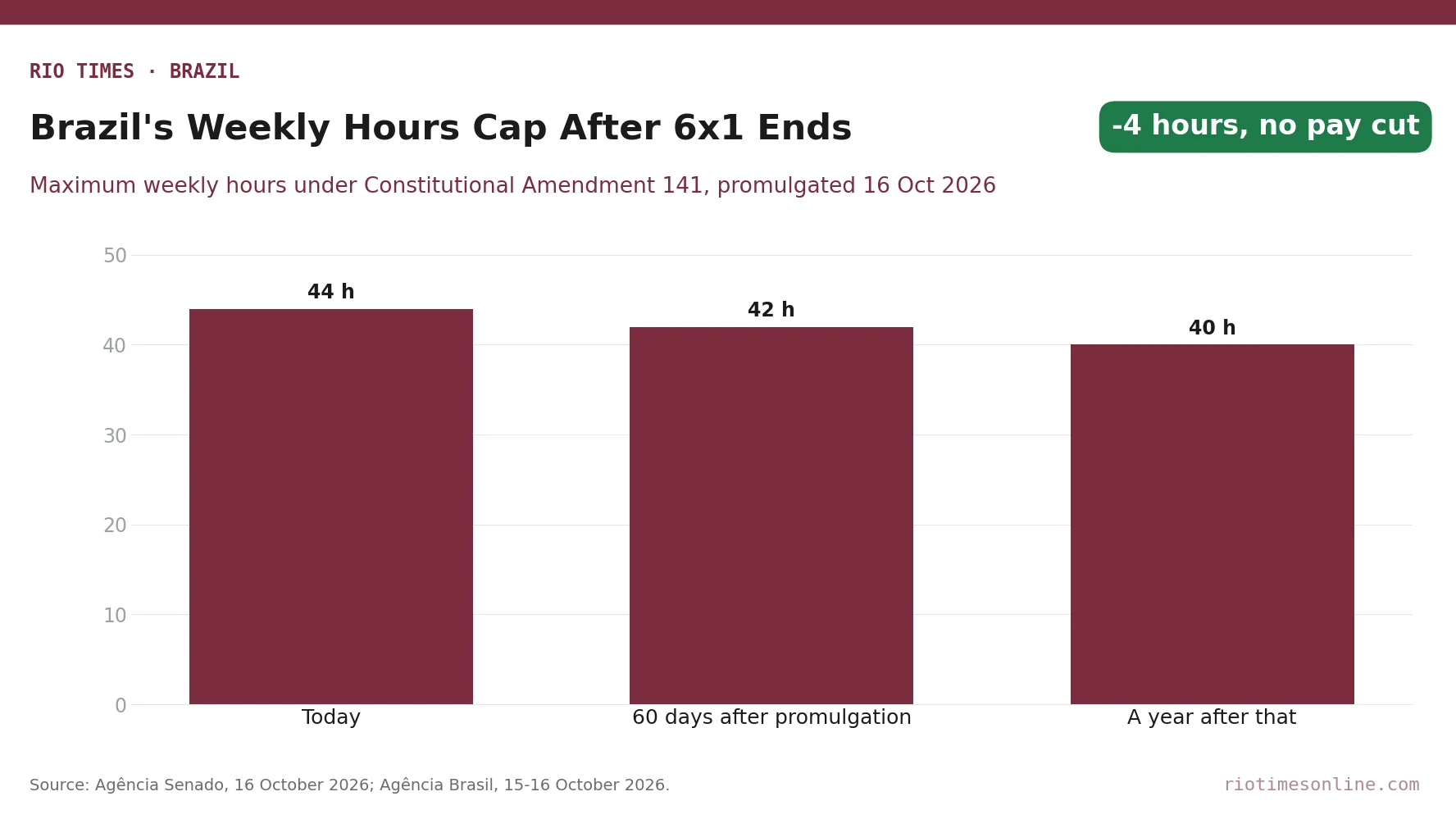
- —The numbers The weekly limit falls from 44 to 42 hours after 60 days and to 40 hours a year later. One industry estimate puts the extra cost at up to R$267 billion (about US$52.5 billion).
- —What it means for you US firms with Brazilian staff face a 5×2 week and a 42-hour cap within 60 days, whoever wins on 25 October. A payroll cut would need a new law.
- —Still open How the relief would work, which wages and sectors it covers, what it costs the budget and whether Congress would pass it.
- —Prediction markets Polymarket gives Flávio Bolsonaro a 77% chance of winning the 25 October runoff and Lula 24% (17 October, 2:31 a.m. ET). Polymarket puts Flávio Bolsonaro’s chance of winning at 77% and Kalshi at 77% (Lula: 24% and 21%), as of 17 October, 3:20 am ET; prices are bets, not polls.
- —Power Index Brazil ranks 1st of 14 in The Rio Times Latin America Power Index, with 75.0 points (October 2026 edition).
Runoff · Sunday, 25 October
Brazil Runoff 2026: Lula vs Flávio
Date, polls, debates, odds and how the runoff works, updated every day.
Brazil election 2026 · Brazil election polls · Brazil election odds · Brazil runoff date and results start · Brazil election results · All election stories
Flávio Bolsonaro, the conservative candidate in the Brazil election 2026 runoff, promised payroll tax relief on Friday 16 October to help companies pay for the end of the 6×1 work week. For US readers, the pledge matters because American firms with Brazilian staff face a shorter week within 60 days, and the plan has no price tag.
He used a 30-second spot in his televised campaign programme and gave no detail on how the relief would work, InfoMoney reported. The vote falls on the Brazil runoff date, Sunday 25 October, against President Luiz Inácio Lula da Silva of the left-wing Workers’ Party (PT).
What Flávio Bolsonaro Said on Friday
“Our government will make up the difference by cutting taxes, lowering interest rates and relieving the payroll,” he said, in our translation from Portuguese. He added that Brazil will prosper and workers will have more time for their families.
Flávio is a senator for Rio de Janeiro and the candidate of the Liberal Party (PL), Brazil’s main conservative party. He is the son of former president Jair Bolsonaro.
The spot also said his proposal is for people to “work one day less without losing pay,” in our translation. InfoMoney noted that this is not the first time he has floated payroll relief.
On Thursday 20 August he told his weekly YouTube show the idea was a progressive payroll relief, InfoMoney reported. He asked Daniella Marques, who coordinates his economic plan, to explain how it would work, and she did not.
How Flávio Moved From Critic to Backer of a Shorter Week
Until last week Flávio called the amendment, known as a PEC, opportunistic and preferred pay by the hour worked. On Tuesday 13 October he said he would vote for it and that the government must bear the cost because employers are stretched, Estadão Conteúdo reported.
The Senate passed the amendment on Wednesday 14 October by 75 votes to 1, as set out in Brazil Senate Passes 5-Day Week, 75 to 1. Congress promulgated it on Friday 16 October as Constitutional Amendment 141, covered in Brazil Enacts End of Six-Day Work Week.
Sixty days after promulgation, employers must run a 5×2 schedule with two rest days and cap the week at 42 hours, Agência Senado reported. A year later the cap falls to 40 hours, with no cut in pay.
The turn in his position is told in Brazil’s Flávio Backs Ending 6X1 Work Week. The payroll pledge adds a mechanism to his earlier call for the government to compensate employers.
What Payroll Tax Relief Would Mean for Employers
In plain terms, payroll tax relief lowers the charges employers pay on top of wages, which makes each worker cheaper to hire. The spot did not say which charges, which wages or which sectors would be covered.
CNI, the national industry confederation, estimates that the shorter week could add up to R$267 billion (about US$52.5 billion) to production costs. It also projects a 0.7% fall in GDP and average inflation of 6.2%, Agência Brasil reported on 15 October.
Ipea, a federal research institute, estimates a smaller effect of about 1% of total costs in commerce and industry, and up to 6.6% in security and surveillance. Studies disagree, and some find only a small residual loss, Agência Brasil noted.
Payroll tax relief would shift part of that cost from firms to the public purse, which US investors watch through the budget deficit and the real. The spot gave no figure for the lost revenue or the spending cuts that would pay for it.
Finance Minister Dario Durigan said on Friday 16 October that the government is studying credit lines and training for affected firms. He announced no payroll tax cut or other direct compensation for employers, Agência Brasil reported.
Where Lula and the Liberal Party Stand
Lula, who made the shorter week a campaign flag, said at the ceremony that nobody wants a company to go bankrupt but nobody wants a worker to die from lack of rest. Opposition leaders did not attend the session, Agência Brasil reported.
Sóstenes Cavalcante, the Liberal Party leader in the Chamber of Deputies, told TV Jovem Pan that, if elected, Flávio should approve PEC 12/2026, which provides for a contract “per hour worked”. The hourly model Flávio once preferred is therefore still alive in his party, Agência Brasil reported.
Runoff poll results are collected in Brazil election polls, and the 6×1 issue is now common ground for both sides. The fight is over who pays, which is where the payroll pledge enters.
What It Means for You
If you employ staff in Brazil, the 5×2 schedule and the 42-hour cap apply 60 days after promulgation whoever wins on 25 October. A payroll cut would follow only if the winner sends a bill and Congress passes it, and the spot named no bill or date.
Investors in Brazilian equities and real-denominated bonds should read the pledge as a statement of intent, not a costed policy. It adds to fiscal questions about the next government if it is not matched by spending cuts, and none have been described.
We convert reais at the central bank’s PTAX sell rate of R$5.0826 per US$1 on Friday 16 October. For the wider picture, see What Brazil’s Election Means for US Investors and Lula vs Flávio: Where They Stand on 7 Issues.
São Paulo, Brazil’s largest city, has a page in our São Paulo expat city guide. Our What to Do in São Paulo in October 2026 lists what is on this month.
What Is Not Known
The spot did not say which payroll charges would be cut, for which wages or sectors, or from when. It also gave no estimate of the revenue the state would lose.
It is not known whether Congress, where the amendment passed 75 to 1 after the opposition freed its senators to vote, would back a payroll cut after the runoff. The sources reviewed also give no figure for the government’s own credit lines.
No poll reviewed here measures whether the payroll pledge changes votes. Prediction-market prices move on many events, so they cannot show its effect alone.
What Prediction Markets Say
Polymarket’s Brazil presidential election market priced Flávio Bolsonaro at about 77% and Lula at about 24% at 2:31 a.m. ET on Saturday 17 October. Over the previous day Flávio’s price slipped about 2 points while Lula’s gained about 3.
The event has traded about US$185 million in total, and these prices are bets, not polls. Our Brazil election odds page tracks the live prices on both platforms.
Prediction markets · who wins the runoff
Implied chance of winning Brazil’s presidency on 25 October, from traders’ prices.
Polymarket
Flávio Bolsonaro 77% · Lula 23.5% (US$185 million traded)
Kalshi (regulated in the US by the CFTC)
Flávio Bolsonaro 77% · Lula 21%
As of 17 October, 3:20 am ET (08:20 Lisbon), updated every 20 minutes. Prices are bets, not polls, and can move fast.
Why we show this: prediction markets turn real-money bets into a live probability that moves within minutes of the news, which is why investors, campaigns and newsrooms in the United States now follow them closely. We show them next to polls and official results, never instead of them.
Why we show this: prediction markets turn real-money bets into a live probability that moves within minutes of the news, which is why investors, campaigns and newsrooms in the United States now follow them closely. We show them next to polls and official results, never instead of them.
Frequently Asked Questions
What did Flávio Bolsonaro promise on 16 October?
He said a government of his would make up the cost of ending the 6×1 schedule by cutting taxes, lowering interest rates and relieving the payroll. The spot gave no detail on how.
What is the 6×1 work schedule?
It is a pattern of six working days followed by one rest day, which Constitutional Amendment 141 replaces with a 5×2 week. The change was promulgated by Congress on Friday 16 October.
When does the 5×2 week start?
The 5×2 schedule and a 42-hour weekly cap start 60 days after promulgation. A year later the cap falls to 40 hours, with no reduction in pay.
What is payroll tax relief?
It lowers the charges employers pay on top of wages, which makes hiring cheaper for companies. The cost falls on public revenue unless it is matched by spending cuts.
How much could the shorter week cost companies?
The industry confederation CNI estimates up to R$267 billion (about US$52.5 billion) in extra production costs. Ipea, a federal research institute, estimates about 1% of total costs in commerce and industry.
Who is Flávio Bolsonaro?
He is a Rio de Janeiro senator for the conservative Liberal Party and the son of former president Jair Bolsonaro. He faces President Lula in the runoff on Sunday 25 October.
Sources: InfoMoney, 17 October 2026; Agência Senado, 16 October 2026; Agência Brasil, 16 October 2026; Agência Brasil, 15 October 2026; Diário do Nordeste (Estadão Conteúdo), 13 October 2026; Agência Brasil, 16 October 2026; Hoje em Dia, 16 October 2026; Banco Central do Brasil PTAX, 16 October 2026. Prediction-market prices from Polymarket public data, 17 October 2026, 2:31 a.m. ET.
This article was drafted with automated assistance and reviewed before publication. How we use AI · Report an error · Editorial responsibility: Matthias Camenzind, Editor-in-Chief
Read More from The Rio Times