Will the dollar lose more strength against the real? This is the current bet of global funds
By Ruth Carson, Malavika Kaur Makol and Karl Lester
Some of the world’s biggest institutional investors are betting on emerging-market currencies like Brazil to outperform their rich-nation peers as monetary tightening draws to a close, growth slows and calls for a weaker dollar increase.

T. Rowe Price, which manages US$1.3 trillion in assets, Fidelity International, and abrdn are among global firms making optimistic bets on certain assets in Latin America, where two years of aggressive interest rate hikes have dampened inflation, setting it on course for cuts earlier than in most other regions.
On Monday (15), the dollar fell 0.89% and closed traded at R$4.89. At the end of 2022, the American currency was quoted at R$5.28.
France’s Amundi, Europe’s largest fund manager with about US$2.1 trillion in assets under management, expects the Mexican peso and the Brazilian real to lead the recovery.
With average consumer price increases down for two successive quarters after an 11-year high, more developing nations are seeing their inflation-adjusted rates turn positive and widen the gap with developed countries.
Latin America is at the forefront of this change.
Brazil and Mexico offer real yields of 9.1% and 5%, respectively, compared with returns close to zero in the United States and negative 5.6% in the United Kingdom.
And this encourages the so-called carry trade: borrowing in countries with lower interest rates and investing them in markets with higher yields.
“Most of the time, high yield currencies will perform better,” said Edwin Gutierrez, head of emerging market sovereign debt at the UK’s abrdn, with over US$600 billion in assets under management.
The manager remains “constructive” on assets “given the slowdown in the US economy and the Federal Reserve’s monetary tightening cycle coming to an end.”
Developing country currencies have risen this year, even as economic data from China and the US have sent mixed signals about what to expect and even as investors wait for a change in Fed policy has lingered.
The MSCI EM Currency Index has stabilized after a rollercoaster start to the year, rising 1.3% since the end of February.
Investors are betting that such currency gains may continue as most of the Fed’s interest rate hikes end and the dollar rally loses steam.
That, and the ongoing struggle to resolve a US debt ceiling impasse, are driving the thesis of a rotation away from the dollar.
“Currencies with good real yields and strong external balance of payments should benefit,” said Esther Law, senior resource manager at Amundi.
“Once there is more clarity on the impact of banking concerns, and the Fed is taking a break, I think that will offer a good opportunity for emerging currencies.”
Currencies are leading gains from Mexico, Chile, Brazil, Colombia, Hungary, Poland, and Indonesia.
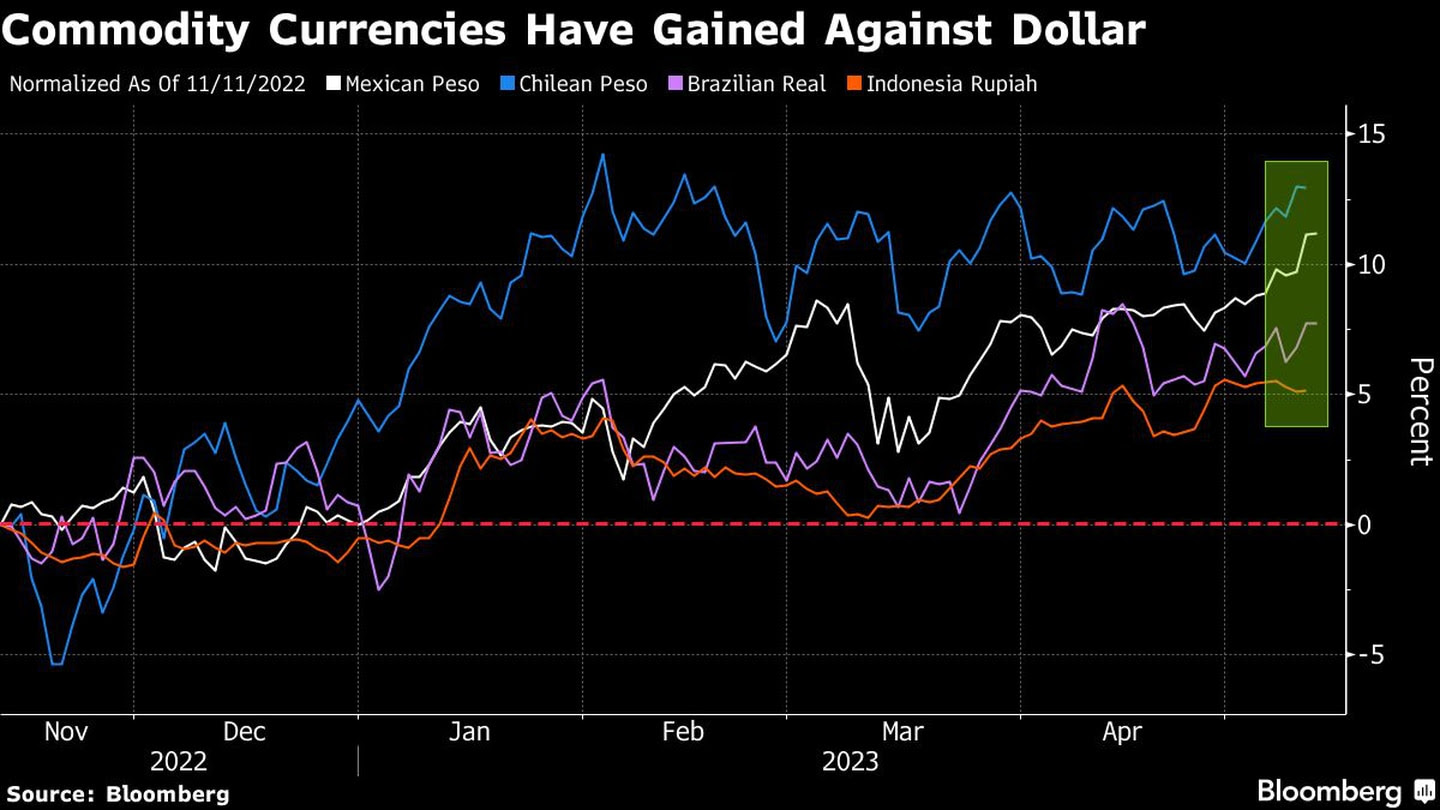
COMMODITIES REINFORCE GAINS
The outlook for emerging market currencies outside Latin America is mixed.
The Indian rupee is preferred by managers, including the American T. Rowe Price, while other Asian currencies are supported by rapid economic growth.
But other currencies remain vulnerable to risks, including outstanding debt, political turmoil, and diplomatic stalemates.
That vulnerability was on display in South Africa last week, when the rand fell to successive lows after the US accused the nation of being on aid to Russia.
Geopolitics is just the latest in a series of risk factors that worry the currency, including a domestic energy crisis and the falling popularity of President Cyril Ramaphosa.
The potential for such crises continues to keep some investors away from emerging markets.
Man Group, the world’s largest publicly traded hedge fund, warned that a “violent” rout is approaching the asset class.
Lazard Asset Management warned investors to be “highly selective” as the full impact of US banking concerns on global growth remains to be seen.
Those threats are also on Leonard Kwan’s radar.
The Hong Kong-based manager at T. Rowe Price still favors the Chilean peso, the rupiah, and the Mexican peso.
He remains “constructive” on the currencies, even as he sees some effect from a US economic slowdown.
Meanwhile, all eyes are on the Fed for any sign of a pause in monetary tightening.
If the US central bank signals a shift in inflation-fighting priorities, the dollar should weaken further, and emerging markets should benefit, according to Paul Greer, asset manager at Fidelity in London.
“From a valuation standpoint, emerging market currencies are still cheap,” said Brendan McKenna, a strategist at Wells Fargo in New York.
“Emerging currencies may not only strengthen against the dollar this year as the Fed comes to the end of its tightening cycle, but they may also outperform against peer G10 currencies [a group that brings together the world’s ten largest economies].”
With information from Bloomberg
News Brazil, English news Brazil, Brazilian economy
More: Brazil news in English, every day from The Rio Times.
This article was produced by The Rio Times’ automated AI newsroom. Editorial responsibility: Matthias Camenzind, Publisher and Editor-in-Chief. The Rio Times also runs Ask Rio Times, which answers from 100,000+ of our own articles, the daily Latin America Power Map, and prediction-market odds on elections and markets.. How we use AI · Report an error
Brazil runoff, Sunday, October 25: When is the Brazil runoff election. Latest: Brazil runoff polls, Flávio 51%, Lula 49%.