Mexico Stocks Rise 0.83% as Peso Weakens | Mexico Market Report, Nov 24
Key Facts
- The S&P/BMV IPC, Mexico’s main stock index, rose 0.83% to 69,933.
- The dollar closed at 19.41 pesos (+1.21%), the weakest peso close in 12 months.
- Alpek (petrochemicals) gained 7.4%, airport group GAPB 4.0%; mining giant Grupo México fell 5.5%.
- Mid-November inflation was 3.96% a year, against 3.92% expected.
- The dollar index fell 0.45%, so the peso’s slide looks home-grown.
Today’s Focus
Mexico’s stock market and its currency told two different stories on this session. The S&P/BMV IPC, the benchmark index of the largest companies listed in Mexico City, rose 0.83% to 69,933, while the peso fell to 19.41 per US dollar — the weakest close in at least 12 months.
A weaker peso is a bit like a sale on Mexican goods: companies that earn dollars and pay costs in pesos look better. That is why exporters and airports climbed even as the currency sagged.
The scale of the peso’s slide is the real headline. The dollar is 5.38% dearer than five sessions ago and 14.2% dearer than 60 sessions ago, and it has now risen five sessions running.
For a visitor or expat, pesos now buy noticeably less abroad but your dollars stretch further in Mexico. For an investor, the index looks steady while the currency underneath is doing the moving.
What matters today. The index held up because dollar earners gained, but the peso’s five-day slide is the move that will decide whether foreign money stays comfortable.

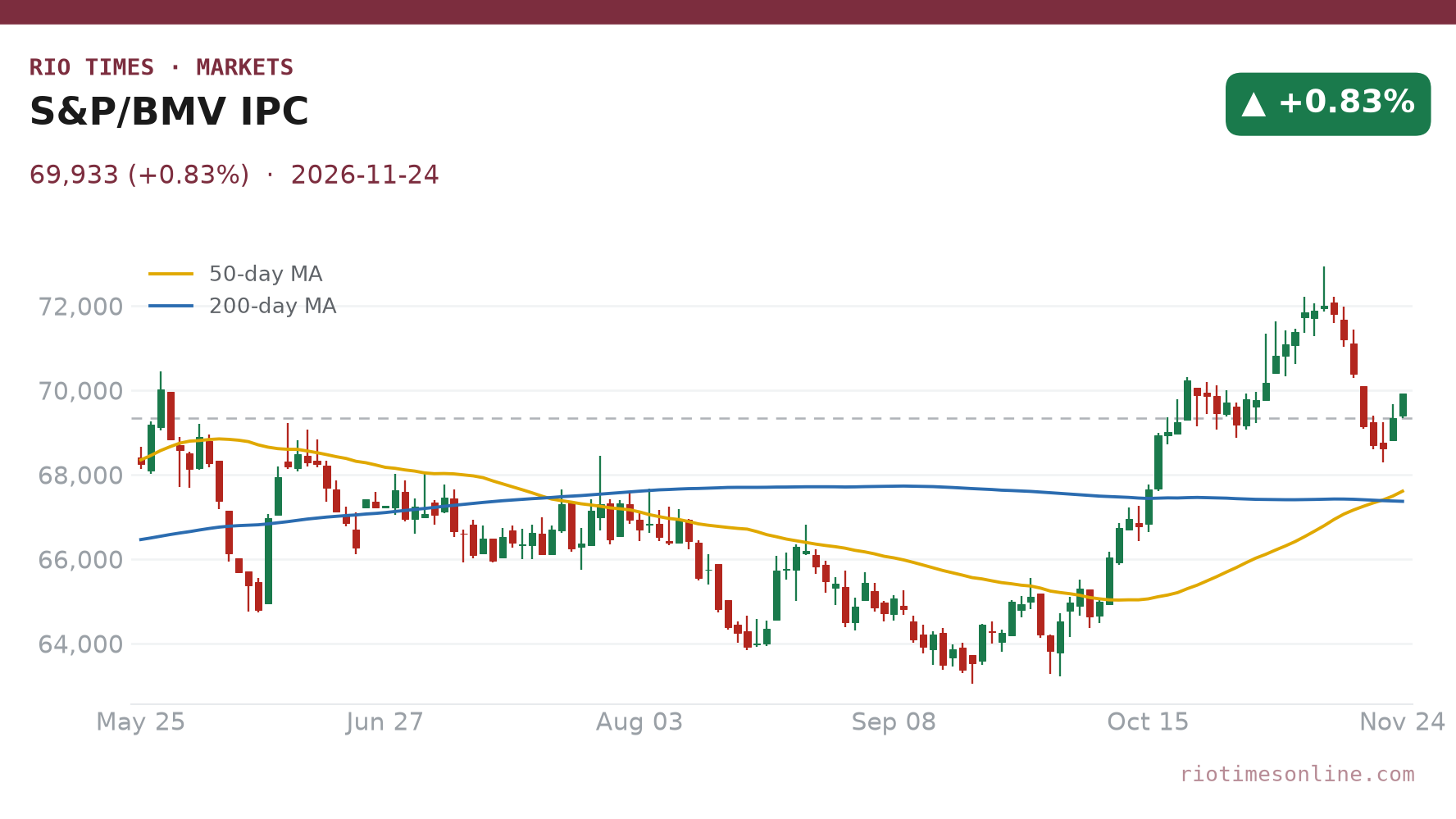
01 The session in one read
The S&P/BMV IPC added 0.83% to close at 69,933, its second rise in a row. That follows a six-session losing run that ended on Monday.
Under the surface the market was split. Companies that earn in dollars or benefit from a cheaper peso rose, while mining groups fell with metals.
The currency, not the index, was the louder story: the dollar rose 1.21% to 19.41 pesos, a 12-month high.
Mexico’s statistics office, INEGI (inegi.org.mx), published mid-November inflation that morning. Headline inflation came in at 3.96% year on year against 3.92% expected (0.54% on the month against 0.51% expected), while core inflation, which strips out volatile food and energy prices, came in at 3.68% against 3.88% expected.
The evidence points to a peso-specific move rather than a global dollar rally, because the US dollar index fell 0.45% while the peso weakened 1.21%. The likeliest mix is a softer core-inflation print that keeps interest-rate cuts alive, plus nervous risk appetite after a volatile week for US technology shares; we hold that view with medium confidence. The variable to watch is whether the dollar closes above 19.41 pesos again, which would confirm the slide is still running.
02 The day’s numbers
| Measure | Level | Change | Read |
|---|---|---|---|
| S&P/BMV IPC close | 69,933 | +0.83% | Second gain in a row, after a six-session slide ended Monday |
| Session range | — | — | Intraday high and low not in our verified scan |
| USD/MXN (pesos per US dollar) | 19.41 | +1.21% | Highest close of the past 12 months; fifth rise in a row |
| IPC 52-week range | 62,528 to 72,006 | — | 2.9% below the 11 November high, 11.8% above the 17 December 2025 low |
| USD/MXN 52-week range | 16.89 to 19.41 | — | At the top of its range; the low came on 4 September |
| Key technical level | 70,000 | — | Round number just above the close; the index sits at 69,933 |
Read the table from the bottom up. The index is within touching distance of 70,000, a round number traders treat as a doorway, but it stopped short.
The peso row is the stretched one. A dollar 15.0% above its 12-month low of 16.89 means the peso has given back most of the year’s gains.
Over 20 sessions the IPC is up 0.08% and over 60 sessions it is up 6.2%. That is a market drifting sideways in the short run and climbing in the medium run. Rio Times · Live Market Intelligence
Live Market IntelligenceMexico — Live Market Board
Mexico — Live Market Board
Instrument Last Change YoY Prev. High Low Volume
IPC MEX
69,932.54
+0.83%
+10.84%
69,355.62
70,179
69,141
155,016,795
USD/MXN
19.45
+1.40%
+5.15%
19.18
19.46
19.40
—
WALMEX
53.53
-2.07%
-12.74%
54.66
55.19
53.41
9,949,698
GMEXICO
188.23
-5.14%
+21.71%
198.42
197.90
187.24
5,905,726
FEMSA
243.18
+0.65%
+39.84%
241.62
246.34
241.98
1,525,501
CEMEX
18.51
+0.05%
-0.48%
18.50
18.63
18.39
16,033,725
GFNORTE
199.60
+0.74%
+15.69%
198.14
201.25
196.51
6,667,559
BIMBO
71.25
+0.07%
+20.41%
71.20
71.80
70.51
2,030,444
TELEVISA
8.04
+1.52%
-21.84%
7.92
8.18
7.86
4,093,044
AMX
23.96
+0.63%
+12.00%
23.81
24.24
23.71
34,037,299
GAP
442.55
+4.17%
+3.43%
424.83
444.74
422.77
732,830
ASUR
278.93
+0.24%
-8.70%
278.27
281.06
275.04
70,839
OMA
252.19
+1.15%
+5.95%
249.33
255.96
242.97
867,237
KOF
227.39
+1.44%
+43.39%
224.17
228.95
224.51
420,745
GRUMA
288.82
+0.96%
-7.31%
286.08
292.00
284.59
241,429
KIMBER
39.44
+1.05%
+8.05%
39.03
39.55
39.14
3,030,186
AMX ADR
24.64
-0.57%
+6.39%
24.78
25.10
24.60
1,978,082
03 Why it moved — a peso-led wobble with soft core inflation
First cause, medium confidence: the peso is trading on interest-rate hopes. Core inflation fell 0.1% month on month against a 0.1% rise expected, and ran at 3.68% year on year against 3.88% expected, which supports the case for Banxico, Mexico’s central bank, to keep easing or pause gently. Lower rates make holding pesos less rewarding.
Second cause, medium confidence: risk appetite is jumpy. The S&P 500 fell 0.50% and the Nasdaq 1.48%, and the VIX, Wall Street’s fear gauge, sits at 26.36 after a volatile week for US technology shares. The peso tends to be sold first when investors reduce risk.
The usual drivers disagree with the move. The US dollar index fell 0.45%, the 10-year US Treasury yield slipped to 4.93%, and oil, a major Mexican export, rose; none of those explains a weaker peso, so we treat this as a Mexico-specific story.
04 The day’s movers
| Driver | Level / Move | Change | Note |
|---|---|---|---|
| Banorte (GFNORTEO) | $87m traded | +0.4% | Most-traded name; Mexico’s biggest domestically owned bank |
| Grupo México (GMEXICOB) | $70m traded | −5.5% | Biggest fall among heavy hitters; copper miner hit by weak metals |
| América Móvil (AMXB) | $54m traded | +0.7% | Telecoms giant earning in many currencies |
| Walmex (WALMEX) | $39m traded | −1.9% | Walmart’s Mexican arm; sells pesos-priced goods, some imported |
| Femsa (FEMSAUBD) | $31m traded | +0.3% | Convenience stores and Coca-Cola bottling |
| Airports, Pacific group (GAPB) | $22m traded | +4.0% | Earns part of its revenue in dollars |
| Alpek (ALPEKA) | — | +7.4% | Top domestic gainer; petrochemicals sold in dollars |
| Peñoles (PE&OLES) | — | −3.9% | Silver and gold miner; second-worst domestic loser |
The pattern is clear: exporters and dollar earners up, miners and a peso-priced retailer down. Metals matter here, as the gold fund GLD fell 2.27% and silver slipped 1.03%.
Two names in the most-traded list are not Mexican companies. BRKB (Berkshire Hathaway, +1.9%) and the IVVPESO tracker (−0.9%) are cross-listed foreign instruments whose moves mainly reflect the US market and the currency, so we leave them out of the story.
05 The regional scoreboard
| Index | Country | Change |
|---|---|---|
| Ibovespa | Brazil | −0.43% |
| S&P/BMV IPC | Mexico | +0.83% |
| IPSA | Chile | −1.13% |
| Merval | Argentina | — |
| COLCAP | Colombia | — |
Mexico rose while Brazil and Chile fell, and the Chilean peso also weakened, with the dollar up 1.62% to 1,033 pesos.
Brazil bucked the currency trend, with the dollar down 0.40% to 5.9066 reais. The live market board above carries the full closes for every market.
06 The technical picture
On the chart, the IPC has a clear ceiling and floor. The ceiling is the 12-month high of 72,006 from 11 November, with 70,000 as the first hurdle just above today’s 69,933 close.
The floor is the 12-month low of 62,528 from 17 December 2025, which the index now sits 11.8% above. Nothing nearby threatens it, but the five-session dip of 0.65% shows how quickly momentum faded after November’s peak.
For the peso, 19.41 is both the latest close and the 12-month extreme. The next round-number test is 20 pesos per dollar, while the old low of 16.89 shows how far the currency has travelled.
What it means for readers: visitors and expats paid in dollars get more for their money in Mexico, while importers and Mexicans with dollar debts lose out. Watch the 19.41 line before any big purchase priced in dollars.
07 What to watch
- USD/MXN at 19.41: A close above it would extend the peso’s slide; a close below would be the first sign the five-day run is fading.
- IPC at 70,000: A close above this round number would reopen the path towards the 72,006 high; failure keeps the index range-bound.
- Mexico’s current account, 25 November: A weak figure would add to peso worries.
- US growth and inflation data, 25 November: Third-quarter GDP growth and the core PCE price index (the Federal Reserve’s preferred inflation gauge) feed directly into dollar and risk sentiment.
Background: Mexico Stocks Rise 1.26% on Growth Data.
Background: Mexico Stocks Edge Down as Peso Hits 19.14.
Frequently Asked Questions
How did the Mexico stock market close?
The S&P/BMV IPC closed at 69,933, up 0.83%, its second gain in a row. It remains 2.9% below its 12-month high of 72,006.
Why did the peso weaken?
The dollar rose 1.21% to 19.41 pesos, the highest close of the past 12 months. Softer core inflation, nervous risk appetite after a volatile week for US tech shares, and weak investment sentiment are the best-supported causes.
Who benefits from a weak peso?
Companies that earn in dollars but pay costs in pesos, such as Alpek and the airport group GAPB, which rose 7.4% and 4.0%. Tourists and expats with dollar income also get more for their money.
What is the IPC?
The S&P/BMV IPC is the main index of the largest companies on the Mexican Stock Exchange, similar in role to the S&P 500 in the US. It is the number most people mean by the Mexican stock market.
Market data: The Rio Times; exchange figures from BMV
In depth
This article was produced by The Rio Times’ automated AI newsroom. Editorial responsibility: Matthias Camenzind, Publisher and Editor-in-Chief. The Rio Times also runs Ask Rio Times, which answers from 100,000+ of our own articles, the daily Latin America Power Map, and prediction-market odds on elections and markets.. How we use AI · Report an error
LatAm Markets: Live Signals → — real-time movers, turnover leaders and FX across Latin America.
Get The Rio Times delivered to your inbox — market intelligence, daily briefs, and breaking analysis across Latin America.
Start for US$1