Mexico Stocks Edge Down as Peso Hits 19.14 | Mexico Market Report, Nov 20
Key Facts
- Mexico’s main stock index, the IPC, fell 0.12% to 68,629, its sixth straight loss.
- The peso weakened to 19.14 per US dollar, its weakest close in at least 12 months.
- Wall Street drove it: the S&P 500, the main US index, fell 3.70% and the Nasdaq 5.28%.
- The IPC is 4.7% below its 12-month high of 72,006, so this is a dip, not a collapse.
- Tortilla maker Gruma rose 5.5% and airports group Asur 2.3%, while Walmart Mexico fell 1.7%.
- Prediction markets: Polymarket, a real-money prediction market, puts “no change” in the Bank of Mexico’s December rate decision at 97.5% (US$34,000 traded, 9:25 p.m. ET, 20 November).
Today’s Focus
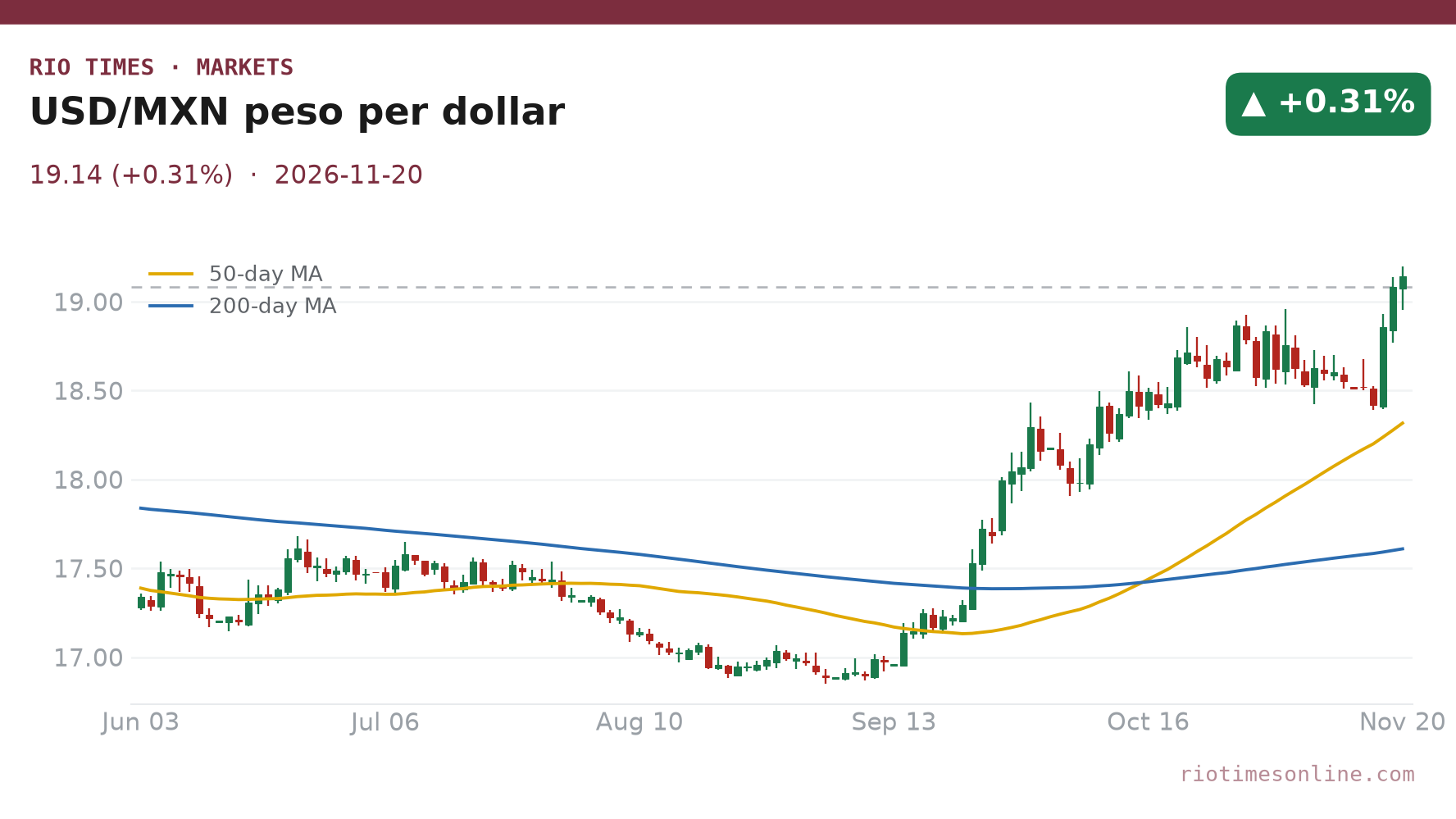
Mexico’s main share index, the S&P/BMV IPC, slipped 0.12% to 68,629 — its sixth fall in a row — while the peso weakened to 19.14 per US dollar. That is the weakest peso close in at least 12 months.
The trigger was a rout on Wall Street, where the S&P 500 lost 3.70% and the Nasdaq 5.28%. Doubts over artificial intelligence and fears of a US interest-rate rise in December sent money out of emerging markets.
The IPC is down 4.43% over five sessions and sits 4.7% below its 11 November high of 72,006. The dollar has gained 12.4% on the peso over 60 sessions, so the currency is moving faster than the shares.
What matters today. Mexico is being sold as part of a global flight from risk, and the peso is taking more of the strain than the stock market.

01 The session in one read
Mexico’s market spent the day bending rather than breaking. The S&P/BMV IPC — the benchmark index of the country’s largest listed companies — closed at 68,629, down 0.12%.
That is mild beside Wall Street, where the S&P 500, America’s benchmark, dropped 3.70% to 6,910. Yet it is the IPC’s sixth losing session in a row, a run that has left it down 4.43% over five sessions.
The peso told the sharper story. The dollar bought 19.14 pesos, up 0.31% on the day, and the highest dollar close of the past 12 months.
For a tourist, that means dollars stretch further in Mexican shops and restaurants. For a Mexican company that borrowed in dollars, it means a heavier repayment bill.
The evidence points to a risk-off wave rather than a Mexican problem: the US dollar index barely moved at 103.84, down 0.05%, yet the peso fell and the VIX fear gauge jumped 26.20% to 35.89. Mexico’s narrower interest-rate advantage after the central bank’s recent cut makes the peso an easy asset to sell. The variable to watch is Wall Street: if the S&P 500 stabilises, the peso’s move back below 19 per dollar is the first sign the worst has passed.
02 The day’s numbers
| Measure | Level | Change | Read |
|---|---|---|---|
| S&P/BMV IPC close | 68,629 | −0.12% | Sixth straight daily fall |
| Session range | — | — | High and low not in our scan |
| USD/MXN (pesos per dollar) | 19.14 | +0.31% | Peso at its weakest in 12 months |
| IPC vs 12-month high | 72,006 (11 Nov 2026) | — | Index sits 4.7% below it |
| IPC vs 12-month low | 62,528 (17 Dec 2025) | — | Index sits 9.8% above it |
| Peso vs 12-month best | 16.89 (4 Sep 2026) | — | Dollar now 13.4% dearer |
| Key technical level | 70,000 | — | Round-number ceiling, then 72,006 |
Read the table as a tale of two assets. The index is about a twentieth below its peak, while the peso has surrendered most of the strength it built in early September.
The dollar is 13.4% dearer than at its September low of 16.89 pesos. Over 20 sessions the dollar has gained 2.54% on the peso, so the slide is steady rather than a one-day shock. Rio Times · Live Market Intelligence
Live Market IntelligenceMexico — Live Market Board
Mexico — Live Market Board
Instrument Last Change YoY Prev. High Low Volume
IPC MEX
68,456.71
-0.37%
+11.28%
68,713.60
69,253
68,306
201,576,684
USD/MXN
19.14
+0.30%
+4.51%
19.09
19.20
18.95
—
WALMEX
54.42
-1.57%
-11.49%
55.29
55.99
54.17
45,227,086
GMEXICO
192.25
+0.52%
+32.57%
191.26
197.78
184.56
10,115,160
FEMSA
241.89
-0.73%
+39.85%
243.66
244.86
240.71
1,797,102
CEMEX
17.95
-0.50%
-4.22%
18.04
18.07
17.60
34,305,395
GFNORTE
196.23
-1.55%
+11.90%
199.31
200.29
196.21
4,092,116
BIMBO
71.33
+0.34%
+22.33%
71.09
72.28
71.00
3,005,295
TELEVISA
8.16
-0.61%
-17.78%
8.21
8.27
8.05
3,737,922
AMX
23.87
+0.76%
+13.99%
23.69
24.05
23.60
31,326,653
GAP
421.88
-2.04%
+3.96%
430.68
429.40
415.00
855,097
ASUR
272.60
+2.06%
-8.60%
267.10
275.93
267.14
88,141
OMA
243.27
-1.24%
+4.54%
246.32
247.55
241.41
954,785
KOF
222.94
-0.73%
+38.58%
224.59
225.93
221.25
1,529,064
GRUMA
288.91
+5.15%
-7.44%
274.75
293.00
274.61
1,253,131
KIMBER
39.11
+0.72%
+5.62%
38.83
39.59
38.81
3,974,917
AMX ADR
24.81
-0.12%
+8.44%
24.84
25.19
24.77
2,065,390
03 Why it moved — a Wall Street rout and Fed fears
The first and heaviest cause, with high confidence, is Wall Street. The S&P 500 fell 3.70% to 6,910 and the Nasdaq, home of the technology giants, fell 5.28% to 22,618.
The VIX, Wall Street’s ‘fear gauge’ that tracks how much investors pay to insure against swings, rose 26.20% to 35.89. Doubts over artificial intelligence deepened, and chipmaker Nvidia fell 14.0% to US$125.53 in New York.
The second cause, with medium confidence, is the fear that the US Federal Reserve could raise interest rates in December. Higher US rates make dollar assets more attractive and pull money out of emerging markets such as Mexico.
That fear bites harder in Mexico because Banxico, the central bank, cut its rate to 6.25% on 5 November. Banxico’s board voted 3 to 2 for the cut, with two members preferring to hold at 6.50%.
The third cause, with lower weight, is softer domestic data. INEGI, Mexico’s statistics office, reported September retail sales down 0.3% on the month, as expected, but up only 2.2% on the year against a forecast of 2.7%.
The cross-asset check shows the usual drivers disagreeing. The dollar index was flat at 103.84, down 0.05%, and the US 10-year Treasury yield eased to about 4.9%.
Those moves would normally help emerging markets, so the best-supported explanation, at medium confidence, is a flight from risk that hit the peso regardless. An oil fund rose 1.12% while a gold fund fell sharply, which fits investors selling whatever they could.
04 The day’s movers
| Driver | Level / Move | Change | Note |
|---|---|---|---|
| Walmex (Walmart’s Mexican unit) | Most traded, $142m | −1.7% | Biggest turnover of the day |
| Grupo México (miner, rail) | $102m | +0.5% | Edged up despite the rout |
| Banorte (bank) | $56m | −1.2% | Rate-cut worries for lenders |
| América Móvil (telecoms) | $52m | +0.6% | Defensive, dollar-linked revenue |
| Arca Continental (Coca-Cola bottler) | $37m | +2.2% | Among the top gainers |
| Cemex (cement) | $32m | −0.4% | Held up better than the index |
| Femsa (Oxxo, Coca-Cola bottling) | $28m | −0.5% | Mild decline |
| Gruma (tortilla maker) | Top gainer | +5.5% | Dollar earnings from the US |
| Asur (Cancún airports) | Gainer | +2.3% | Tourism earnings in dollars |
| Pacific airport group (GAP) | $21m | −1.9% | Fell as peer Asur rose |
The leaders and laggards do not follow a simple pattern. Gruma, up 5.5%, sells tortillas in the US and so earns dollars, while Asur, up 2.3%, runs the Cancún airport and benefits from visitors paying in dollars.
Other gainers were Inbursa, up 2.3%, and Grupo Carso, up 2.3%. Among losers, petrochemicals group Alpek fell 2.9%, miner Peñoles 1.6% and airline Volaris 1.1%.
05 The regional scoreboard
| Index | Country | Change |
|---|---|---|
| S&P/BMV IPC | Mexico | −0.12% |
| S&P IPSA | Chile | — |
| Merval | Argentina | — |
| COLCAP | Colombia | — |
| BVL General | Peru | — |
Mexico’s IPC was the one Latin American share index whose Friday close we could confirm for this edition. We leave the other regional closes blank rather than guess.
Brazil’s B3 exchange was shut for the Black Consciousness Day holiday, so it has no Friday close.
The currency story was broader than the share story. The dollar gained 0.52% on the Chilean peso and 0.93% on the Argentine peso, and the Colombian peso also weakened.
For anyone holding local assets while earning or borrowing in dollars, a weaker currency on top of weaker shares is the sharper pain.
06 The technical picture
The nearest ceiling for the IPC is the round 70,000, which the index has fallen back from. Above that sits the 12-month high of 72,006, set on 11 November.
The floor is far away. The 12-month low of 62,528, set on 17 December 2025, is 8.9% below today’s close, so there is plenty of room to fall before a major support.
For the peso, 19.14 per dollar is itself the 12-month extreme, so there is no chart resistance above it. The round 19 is the first level to reclaim, and a return toward 18 would signal that fears of a US rate rise are easing.
Does the slide stop? It will once Wall Street steadies, but six straight losing days show momentum is against the index for now.
07 What to watch
- Wall Street’s mood: If the S&P 500 and the VIX fear gauge calm down after today’s rout, the pressure on emerging markets should ease with them.
- The peso at 19 per dollar: Closing back below 19 would suggest the Fed fear is fading, while a push beyond 19.14 would set a new 12-month extreme.
- The IPC at 70,000: A close above this round number would break the six-day losing streak’s grip; failing at it keeps the 62,528 low in view.
- Banxico’s next signals: Watch whether the divided board keeps cutting rates while the US rate path is in question.
Background: Mexico Stocks Fall 0.6% as Peso Hits 19.09.
Background: Mexico Stocks Post Biggest Fall Since June.
What Prediction Markets Say
Polymarket, where users bet real money, lists a market on the Bank of Mexico’s December decision, with US$34,000 traded as of 9:25 p.m. ET, 20 November 2026. It prices “no change” at 97.5%, a 0.25-point cut at 2.9% and a 0.5-point or larger cut at 0.2%.
The same site prices a 0.25-point US Federal Reserve rise in December at 89.5% (US$47.6 million traded). These prices are bets, not polls.
Why we show this: prediction markets turn real-money bets into a live probability that moves within minutes of the news, which is why investors, campaigns and newsrooms in the United States now follow them closely. We show them next to polls and official results, never instead of them.
More: Mexico news in English, every day from The Rio Times.
Frequently Asked Questions
Why did Mexico’s stock market fall?
The S&P/BMV IPC fell 0.12% to 68,629, its sixth loss in a row, mainly because a Wall Street rout and fears of a US rate rise in December pulled money out of emerging markets.
Why is the Mexican peso weaker?
The dollar rose 0.31% to 19.14 pesos, its highest close in 12 months, as investors sold risky currencies and Mexico’s rate advantage narrowed after Banxico’s cut to 6.25%.
Is this a crash for Mexican shares?
No. The IPC is 4.7% below its 12-month high of 72,006 and 9.8% above its 12-month low of 62,528, so it is a sharp dip within a wider range.
What does a weak peso mean for travellers?
Dollars buy more in Mexico, with 19.14 pesos per dollar, but Mexican firms and families with dollar debts face higher costs.
Market data: The Rio Times; exchange figures from BMV
In depth
This article was produced by The Rio Times’ automated AI newsroom. Editorial responsibility: Matthias Camenzind, Publisher and Editor-in-Chief. The Rio Times also runs Ask Rio Times, which answers from 100,000+ of our own articles, the daily Latin America Power Map, and prediction-market odds on elections and markets.. How we use AI · Report an error
LatAm Markets: Live Signals → — real-time movers, turnover leaders and FX across Latin America.
Get The Rio Times delivered to your inbox — market intelligence, daily briefs, and breaking analysis across Latin America.
Start for US$1