Mexico City Police inaugurates Latin America’s first Virtual Reality Training Center
The Mexico City Police (CDMX) inaugurated Latin America’s first Virtual Reality Training Center (CERV).
The event was attended by SSC commanders and representatives of the Secretary of the Navy, Secretary of Defense, and authorities of the Government of Mexico City, among others.

In this regard, the Secretary of Citizen Security of the CDMX (SSC), Omar Garcia Harfuch, said that the CERV will improve training “as it allows, through analytical data, to measure and correct failures, to achieve the improvement of tactics, always in compliance with human rights. Tools such as these allow us to improve training with efficient use of resources since the use of ammunition is reduced, and accidents are also reduced”.
In addition, García pointed out that “this technology is unique in Latin America; this system is only available to three police forces in the United States, as well as the Israeli Police. With this investment and the development of this training center, we are consolidating our position not only as the best police force in the country but also as the best police training institution.
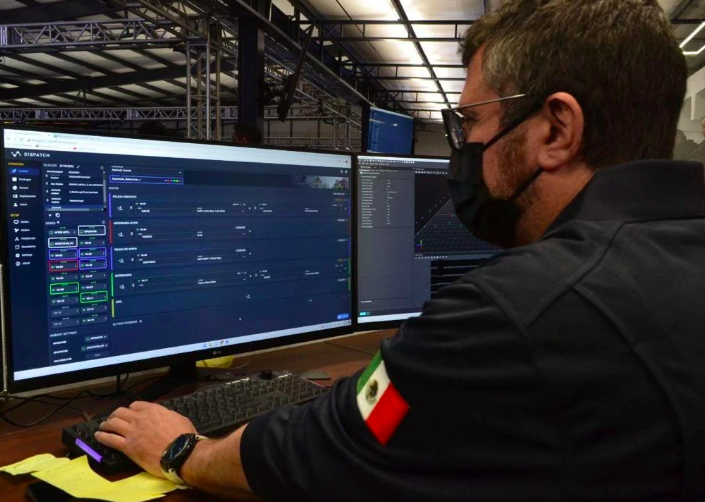
RECREATION OF REAL SCENARIOS
The secretary added that among the advantages offered by this system is the ability to practice the regulated use of force with lethal and non-lethal force weapons.
It is possible to interact with real or virtual avatars in realistic or virtual scenarios, where available scenarios can be used, or real scenarios can be recreated.
This new training center is a 100% reality experience simulator, which operates through sophisticated devices, sensors, and commands to perform physical, visual, auditory, and emotional interactions that allow physical and psychological training in various crisis situations, where police forces are trained to acquire tactical movements, decision making, strategies, acquire skills and experience in complex cases.
One of the essential characteristics of this type of training is based on respect for human rights and the rational use of force to avoid violence with safe operations.
Hence, the system has digital tools to analyze and review each training to identify areas that require individual and group improvements.
With information from Infodefensa
Editorial responsibility: Matthias Camenzind, Editor-in-Chief · Editorial standards · Report an error
Read More from The Rio Times