DR Congo Will Move Its Israel Embassy to Jerusalem, Joining a Very Short List
DR CONGO · GEOPOLITICS
Key Facts
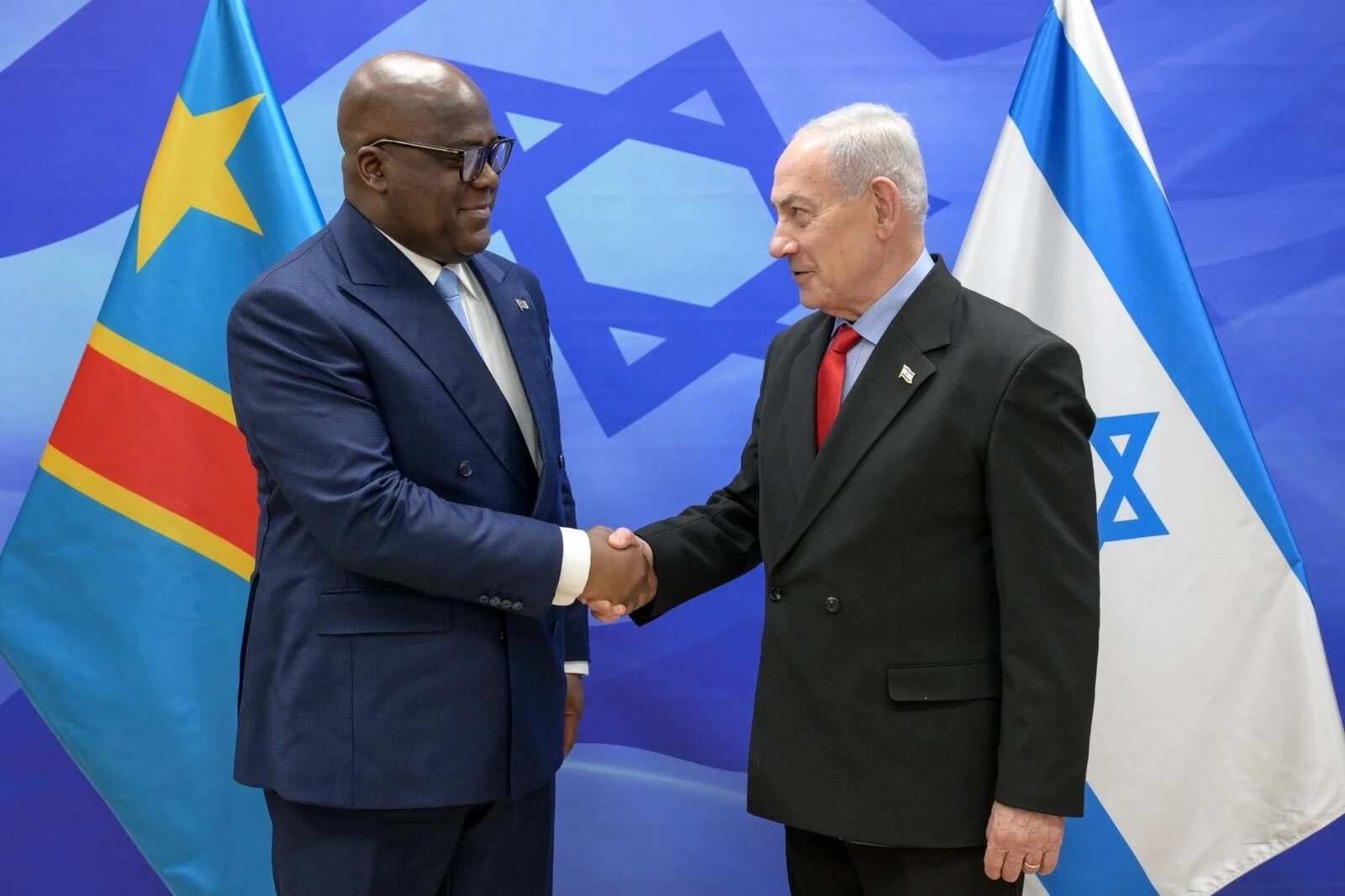
- —What happened A joint statement issued after the meeting of President Felix-Antoine Tshisekedi and Prime Minister Benjamin Netanyahu says the two countries will take steps toward relocating the DR Congo embassy from Tel Aviv to Jerusalem.
- —The catch The statement gives no date. Announcing an intention and opening a building are separate acts, and only the first has happened.
- —A short list Very few states have moved their embassies. The group includes the United States, Fiji, Guatemala, Honduras, Papua New Guinea and Paraguay.
- —Why it matters here Three of those five non-US states are in Latin America, a story our readers have already watched play out at home.
- —The stated motive Tshisekedi has spoken warmly about Israel for years and has linked his position to his Christian faith.
- —A regional echo Weeks earlier, Colombia’s new president, Abelardo de la Espriella, announced the same step for his country, a sharp turn from his predecessor’s criticism of Israel.
The Democratic Republic of Congo says it will move its embassy in Israel from Tel Aviv to Jerusalem, making the DR Congo embassy Jerusalem decision the newest addition to a list of barely half a dozen countries. The commitment came in a joint statement after President Felix-Antoine Tshisekedi met Prime Minister Benjamin Netanyahu, and it carries no date.
What was actually agreed
The joint statement commits both governments to take steps toward relocating the mission. It does not name a building, a budget or a month.
That is worth stating plainly, because embassy relocations have been announced before and then left unfinished for years.
Alongside the move, the two sides spoke of a shared commitment to strengthening diplomatic relations. What that means in practice — for the Israeli presence in Kinshasa or Congolese interests in Israel — has not been spelled out.
Why the DR Congo embassy Jerusalem list is so short
Most countries keep their embassies in Tel Aviv because the status of Jerusalem is unresolved under international law and is meant to be settled in negotiations.
Moving a mission is therefore read as taking a position on that question rather than as an administrative convenience. That is precisely why so few governments do it.
The United States moved in 2018. Since then only Fiji, Guatemala, Honduras, Papua New Guinea and Paraguay have followed. Kosovo and Somaliland, neither of them UN member states, have also opened what they consider embassies in the city.
The Latin American precedent our readers already know
Three of the five countries on that list are Latin American, and their experiences have not been identical. Guatemala moved early and stayed; Paraguay moved, reversed the decision under a new government, and later moved again.
Honduras opened its embassy in Jerusalem in 2021 under one administration and the question resurfaced under the next. The lesson from the region is that these decisions travel with the government that made them.
The region’s newest example points both ways. Colombia’s new president, Abelardo de la Espriella, announced weeks ago that he would move his country’s embassy too. Argentina’s Javier Milei promised the same step more than a year ago and has still not taken it, reportedly because of a dispute over Israeli drilling plans near the Falkland Islands, which Argentina claims as the Malvinas.
That is the most useful thing a Congolese reader could take from the Latin American record. An announcement of this kind is durable only if the next president also wants it.
What Kinshasa is looking for
The DR Congo is fighting an insurgency in its east and is trying to convert its mineral wealth into processing capacity and revenue. Both goals require partners with technology, capital and security expertise.
Israel has long-standing commercial and security links in the region, and Congolese governments have engaged with them for decades. A closer relationship is a bid for those capabilities. Tshisekedi is also eager for support from the United States, which has pressed Rwanda over rebel advances in Congolese territory.
The counter-argument is equally plain. The DR Congo also needs standing in the African Union and among Gulf and Arab partners, several of whom read this move unfavourably.
The cost side of the ledger
There is no public assessment of what the decision might cost Kinshasa in other relationships. Any confident claim in either direction is speculation for now.
What can be said is that the DR Congo has just spent diplomatic capital on a symbolic question while its most pressing problems are material ones.
The African Union has historically backed the Palestinian position, and several of Kinshasa’s neighbours hold to it firmly. A move of this kind is noticed in those capitals.
Gulf states are also among the larger sources of infrastructure and mining capital reaching central Africa. Kinshasa will now be managing two sets of relationships that pull in different directions.
None of that makes the decision wrong. It makes it a choice with a price, and the price has not been published.
What an embassy move costs and what it buys
Relocating a mission is not expensive in absolute terms. A small embassy can be housed for a fraction of what a single infrastructure contract is worth.
The value being exchanged is therefore political rather than financial. A country with few levers in Washington and Jerusalem is offering one of the few symbolic goods it controls.
Whether that converts into anything material is the open question. Guatemala and Honduras both hoped for trade and security dividends, and the results have been modest and slow.
Paraguay’s experience is the most instructive because it went both ways. The reversal in 2018 damaged the relationship immediately, and rebuilding it took years.
The lesson Kinshasa might draw is that the gesture only pays if it is not revisited. That makes the durability of Congolese domestic politics part of the calculation.
There is one more asymmetry worth naming. The countries that have moved are, with the exception of the United States, small states for whom the gesture is one of the few forms of leverage available.
That is not a criticism of any of them. It is a description of how diplomacy works when a country has more goodwill to offer than money.
Frequently Asked Questions
Has the DR Congo already moved its embassy to Jerusalem?
No. The two governments issued a joint statement saying they would take steps toward relocating the embassy, without giving a timeline.
Which countries have embassies in Jerusalem?
The group is very small: the United States, Fiji, Guatemala, Honduras, Papua New Guinea and Paraguay. Kosovo and Somaliland, which are not UN member states, also have missions there they call embassies. The DR Congo would be the next addition.
Why do most countries keep their embassies in Tel Aviv?
Because the status of Jerusalem is unresolved under international law and is meant to be settled through negotiation. Relocating a mission is read as taking a position on that question.
What is the Latin American connection?
Three of the five non-US countries on the list are Latin American. Paraguay in particular moved, reversed the decision under a new government, and later moved again. Colombia’s new president has now announced the same step, while Argentina’s promised move has stalled.
What has Tshisekedi said about Israel?
He has spoken warmly about Israel for years and has linked his support to his Christian faith.
Sources
Agence France-Presse (via Al-Monitor), “DR Congo latest to promise moving Israel embassy to Jerusalem”, 4 September 2026; Times of Israel, background on DR Congo-Israel relations; Buenos Aires Times, “Milei: Argentina will move Israel Embassy to Jerusalem in 2026″, 11 June 2025.
Connected Coverage
We have also reported on the war in the east that Kinshasa still has to finance, and on the push to keep more mining value inside the country. Both sit inside Africa: The New Scramble, our running account of the contest for the continent.
More Africa news: Nigeria | South Africa | Kenya | Egypt | Ghana | Morocco | DR Congo | Angola | Ethiopia | Tanzania
This article was produced by The Rio Times’ automated newsroom system. How we use AI · Report an error · Editorial responsibility: Matthias Camenzind, Editor-in-Chief