Brazil Heads to 7 Governor Runoffs as Rio Awaits Court

ELECTIONS 2026 · BRAZIL
Runoff · Sunday, 25 October
Flávio Bolsonaro vs Lula: what happens next
First-round results, how the runoff works, the key dates and who backs whom, in one guide.
Key Facts
- —The country Brazil, Latin America’s largest economy, elects governors for 26 states and the Federal District. Seven races go to a runoff on Sunday 25 October, alongside the presidential vote.
- —Why it matters Governors run state police, schools and budgets. Winners can lend networks to conservative Senator Flávio Bolsonaro or President Lula of the left-wing Workers’ Party (PT), 1.87 points apart.
- —Why now The day after the 4 October first round, Brazil’s electoral court (TSE) received the case that decides whether Rio de Janeiro votes again.
- —What happened Former governor Anthony Garotinho’s lawyers sought an urgent ruling on 5 October; his file reached the TSE at 10:37 a.m. Without his 274,411 votes, assembly speaker Douglas Ruas would have about 50.9%.
- —The numbers Four leaders fell less than one point short of 50%. Rio Grande do Norte is split by 15,509 votes and Tocantins by 13,412, according to TSE figures.
- —What it means for you Rio de Janeiro hosts Petrobras and many foreign oil firms, US companies among them. Its next governor shapes policing and state finances for investors and visitors.
- —Still open No date is set for the full court to hear Garotinho’s appeal. The TSE sits on 6 October and six more times in October.
- —Prediction markets Polymarket gives Douglas Ruas a 93% chance of becoming Rio de Janeiro governor (5 October, 12:30 p.m. ET). Polymarket puts Flávio Bolsonaro’s chance of winning at 83% and Kalshi at 83% (Lula: 18% and 18%), as of 5 October, 2:20 pm ET; prices are bets, not polls.
Brazil governor runoffs on Sunday 25 October will settle who runs seven states, including Rio de Janeiro. Whether Rio votes at all now depends on Brazil’s electoral court, the TSE.
For foreign investors, Rio matters most: it hosts Petrobras and many foreign oil companies, US firms among them. Its next governor runs state policing and finances for four years.
On Monday 5 October the file on Anthony Garotinho’s barred candidacy reached the court at 10:37 a.m. Brasília time, G1 reported. If judges void his votes, Douglas Ruas, speaker of Rio’s state assembly, wins Rio outright.
Ruas belongs to Jair Bolsonaro’s Liberal Party (PL), Brazil’s main conservative party, chaired by Valdemar Costa Neto.
Rio’s Runoff Now Rests With the Electoral Court
Garotinho, a former Rio governor, finished third with 3.17% of valid votes. Rio’s regional electoral court had rejected his candidacy over an administrative misconduct conviction that suspended his political rights.
His lawyers argue that the suspension ended in July and have appealed. On Monday they filed an urgent request at 9:42 a.m., citing priority rules for older litigants, CBN reported.
The regional court sent the case to Brasília less than an hour later. The rapporteur is Justice Floriano de Azevedo Marques, who stripped Garotinho’s campaign funding and airtime on 2 October.
On election day, TSE president Kassio Nunes Marques ruled that Garotinho’s votes stay in the percentages until the full court decides. That order, reported by O Globo and Valor, is why Rio officially has a runoff.
With Garotinho’s votes included, Ruas has 49.27% against 42.76% for former Rio mayor Eduardo Paes of the centre-right PSD, chaired by Gilberto Kassab. Without them, G1 calculated, Ruas rises to about 50.9% and is elected.
The rules give the process a fixed path while the appeal runs. Free runoff airtime on radio and television starts on Friday 9 October either way.
Earlier coverage: Brazil’s Governors Map: 20 Won Outright, Seven Runoffs and TSE Voids Garotinho Votes Before Rio Governor Vote.
Four Leaders Fell Within a Point of Victory
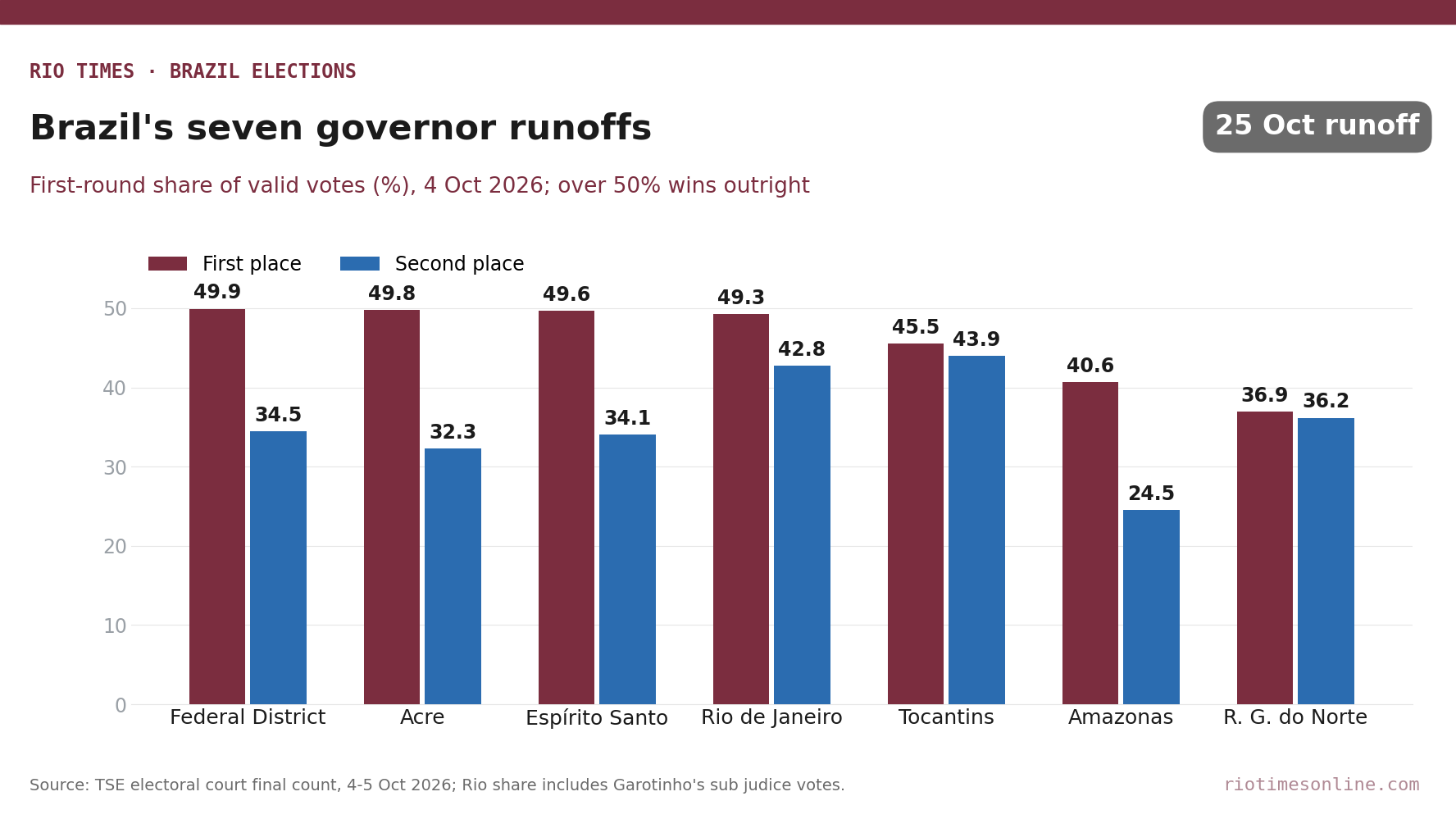
A candidate needs more than half of valid votes, which exclude blank and spoilt ballots, to avoid a runoff. Four of the seven leaders in the Brazil governor runoffs missed by less than one point, TSE figures show.
In the Federal District, home of Brasília, Governor Celina Leão of the centre-right Progressistas (PP), led by Ciro Nogueira, took 49.93%. She faces former district lawmaker Leandro Grass of the PT, chaired by Edinho Silva, on 34.47%.
In Acre, on the Peruvian border, Governor Mailza Assis (PP) took 49.76% against 32.27% for Senator Alan Rick of the Republicanos, a conservative party led by Marcos Pereira. In Espírito Santo, former Vitória mayor Lorenzo Pazolini (Republicanos) won 49.65% against 34.06% for Governor Ricardo Ferraço of the centrist MDB, led by Baleia Rossi.
Ferraço took office in April after Governor Renato Casagrande resigned to run for the Senate, Bloomberg Línea reported. Leão became governor in March, when Governor Ibaneis Rocha stepped down.
Two Races Decided by a Few Thousand Votes
Rio Grande do Norte is the tightest contest. Former Mossoró mayor Allyson Bezerra of the centre-right União Brasil, led by Antonio Rueda, took 36.94%. That put him 15,509 votes ahead of former state finance secretary Cadu de Lula (PT), on 36.16%.
Álvaro Dias of the PL, a former Natal mayor, finished third with 26.71%, Bloomberg Línea reported. His voters are the largest pool still in play.
In Tocantins, Senator Professora Dorinha of União Brasil leads federal deputy Vicentinho Júnior of the centre-right PSDB, led by Aécio Neves, by 45.52% to 43.94%. That gap is 13,412 votes.
Amazonas is the exception. Senator Omar Aziz of the PSD, a former governor, took 40.63% against 24.49% for Professora Maria do Carmo, a Bolsonaro supporter from the PL.
How the Brazil Governor Runoffs Feed the Presidential Race
The governor races share the ballot with the presidential runoff between Flávio Bolsonaro and Lula. Flávio led the first round with 47.03% of valid votes to Lula’s 45.16%, according to the TSE.
Both camps want allies on the ground in the seven states. Ruas belongs to Flávio’s camp, while Paes has called himself a “proud ally” of Lula, UOL reported.
Flávio phoned Ruas on Sunday night to congratulate him, O Globo reported. In Espírito Santo he has backed Pazolini, while Ferraço stayed neutral in the first round.
In Amazonas, Aziz is a Lula ally and Maria do Carmo backs Flávio, the news site PlatôBR noted. Allyson, in Rio Grande do Norte, has kept his distance from both presidential candidates.
What It Means for You
For holders of Brazilian shares and ADRs, the presidential runoff on the same day is the bigger market event. The governor results show where each camp holds local power once governors take office on 6 January.
A quick TSE ruling would end Rio’s uncertainty early, while a long appeal keeps two campaigns running until 25 October. Either way, the state’s oil royalties and police budget pass to the winner.
Visitors should expect rallies in all seven states until the vote. Voting is compulsory for Brazilians aged 18 to 70, so polling stations and roads are busy on election Sunday.
What Is Not Known
No date has been set for the full court to rule on Garotinho’s appeal. The TSE sits on Tuesday 6 October and again on 8, 13, 15, 20, 22 and 27 October, O Globo reported.
It is unclear whether a ruling will come before campaign airtime begins. If the court upholds his candidacy, his votes become valid and Rio votes on 25 October as planned.
The court also faces pending cases on Deltan Dallagnol, elected senator for Paraná, and Dr. Furlan, elected governor of Amapá. Neither touches the seven runoffs, but both compete for the same session time.
What Prediction Markets Say
Bets on Polymarket’s “Rio de Janeiro Governor Election Winner” market priced Douglas Ruas at 93% and Eduardo Paes at 6% at 12:30 p.m. ET on 5 October. About US$655,000 has been traded on the market.
The big move came after the first round: Ruas gained about 76 points in 24 hours, while Paes lost about the same.
Prediction markets · who wins the runoff
Implied chance of winning Brazil’s presidency on 25 October, from traders’ prices.
Polymarket
Flávio Bolsonaro 82.5% · Lula 17.5% (US$173 million traded)
Kalshi (regulated in the US by the CFTC)
Flávio Bolsonaro 83% · Lula 18%
As of 5 October, 2:20 pm ET (19:20 Lisbon), updated every 20 minutes. Prices are bets, not polls, and can move fast.
Why we show this: prediction markets turn real-money bets into a live probability that moves within minutes of the news, which is why investors, campaigns and newsrooms in the United States now follow them closely. We show them next to polls and official results, never instead of them.
Why we show this: prediction markets turn real-money bets into a live probability that moves within minutes of the news, which is why investors, campaigns and newsrooms in the United States now follow them closely. We show them next to polls and official results, never instead of them.
Which states hold Brazil governor runoffs on 25 October?
Acre, Amazonas, the Federal District, Espírito Santo, Rio de Janeiro, Rio Grande do Norte and Tocantins. Rio’s runoff still depends on a TSE ruling on Anthony Garotinho’s votes.
Why might Rio de Janeiro skip its runoff?
Garotinho’s 274,411 votes are counted as sub judice while his barred candidacy is appealed. If the TSE voids them, Douglas Ruas rises above 50% of valid votes and wins outright.
Which governor runoff is the closest?
Rio Grande do Norte. Allyson Bezerra of União Brasil leads the PT’s Cadu de Lula by 36.94% to 36.16%, a gap of 15,509 votes.
Sources: G1 (case reaches TSE), 5 October 2026; CBN, 5 October 2026; O Globo (Nunes Marques order), 5 October 2026; Valor, 4 October 2026; G1 (Rio result), 4 October 2026; O Globo (TSE sessions), 5 October 2026; Metrópoles, 5 October 2026; Bloomberg Línea, 5 October 2026; Agência Brasil, 5 October 2026; UOL, 5 October 2026; O Globo (Flávio calls), 5 October 2026; PlatôBR, 5 October 2026; Diário do Rio, 5 October 2026.
More: Brazil news in English, every day from The Rio Times.
This article was produced by The Rio Times’ automated newsroom system. How we use AI · Report an error · Editorial responsibility: Matthias Camenzind, Editor-in-Chief