Barbados Steps Up Port Checks Over Suriname Bird Flu

AGRICULTURE · BARBADOS
Key Facts
- —The country Barbados, a CARICOM (Caribbean Community) member state, lets poultry and meat in only from approved countries under a permit system, its chief veterinary officer says.
- —What happened On 2 October chief vet Mark Trotman told Barbados Today that surveillance at ports of entry has been stepped up. Suriname confirmed bird flu on 18 September.
- —The numbers On the first farm hit, near Paramaribo, nearly 5,000 of 6,000 broiler chickens died and the rest were culled, Suriname’s government said on 24 September.
- —What it means for you There is no ban or emergency restriction in Barbados. Do not carry poultry or meat in your baggage; commercial poultry trade with Suriname is minimal.
- —Still open Whether the virus is highly pathogenic. Samples went abroad with PAHO help; results could take weeks, Suriname’s officials said on 24 September.
The Suriname bird flu outbreak has led Barbados to step up port surveillance, its chief veterinary officer said on Friday, 2 October. Mark Trotman told Barbados Today there is no immediate threat to the island’s poultry industry.
The concern is not commercial trade, which Barbados does with Suriname on no meaningful scale. It is poultry slipped in through informal channels or carried in travellers’ baggage.
What Barbados Is Doing
“We haven’t put anything specific in place right now for Suriname, other than our normal quarantine protocols,” Trotman said. Customs and agriculture officials have been told to stay on high alert.
“There is obviously the possibility of people sneaking it in or bringing it in their baggage,” he said. “For that, we have strengthened our port surveillance.”
The veterinary services department is not imposing bans for now. Trotman said stricter, targeted measures would follow if the virus spread rapidly in the region.
A new testing laboratory is due for completion later this year. Until then, Barbados can run preliminary serology tests and send samples to overseas reference laboratories for confirmation.
What Suriname Has Confirmed
In the Suriname bird flu case, the agriculture ministry (LVV) was alerted after a farmer reported high deaths among his broilers. Sick birds were sampled on 17 September, and the public health office (BOG) confirmed bird flu on 18 September.
The farm held 6,000 chickens, of which nearly 5,000 had died, the government said on 24 September. The remaining birds were culled, and the site stays closed for 28 days after cleaning.
Officials describe the virus as H5, and say it is the first time Suriname has faced the disease. On 21 September, agriculture minister Mike Noersalim said it was not yet known whether the variant is highly or mildly pathogenic.
Samples have gone to a foreign laboratory with support from the Pan American Health Organization (PAHO). Barbados Today described the outbreak as highly pathogenic, a classification Suriname had not announced in its latest published statements.
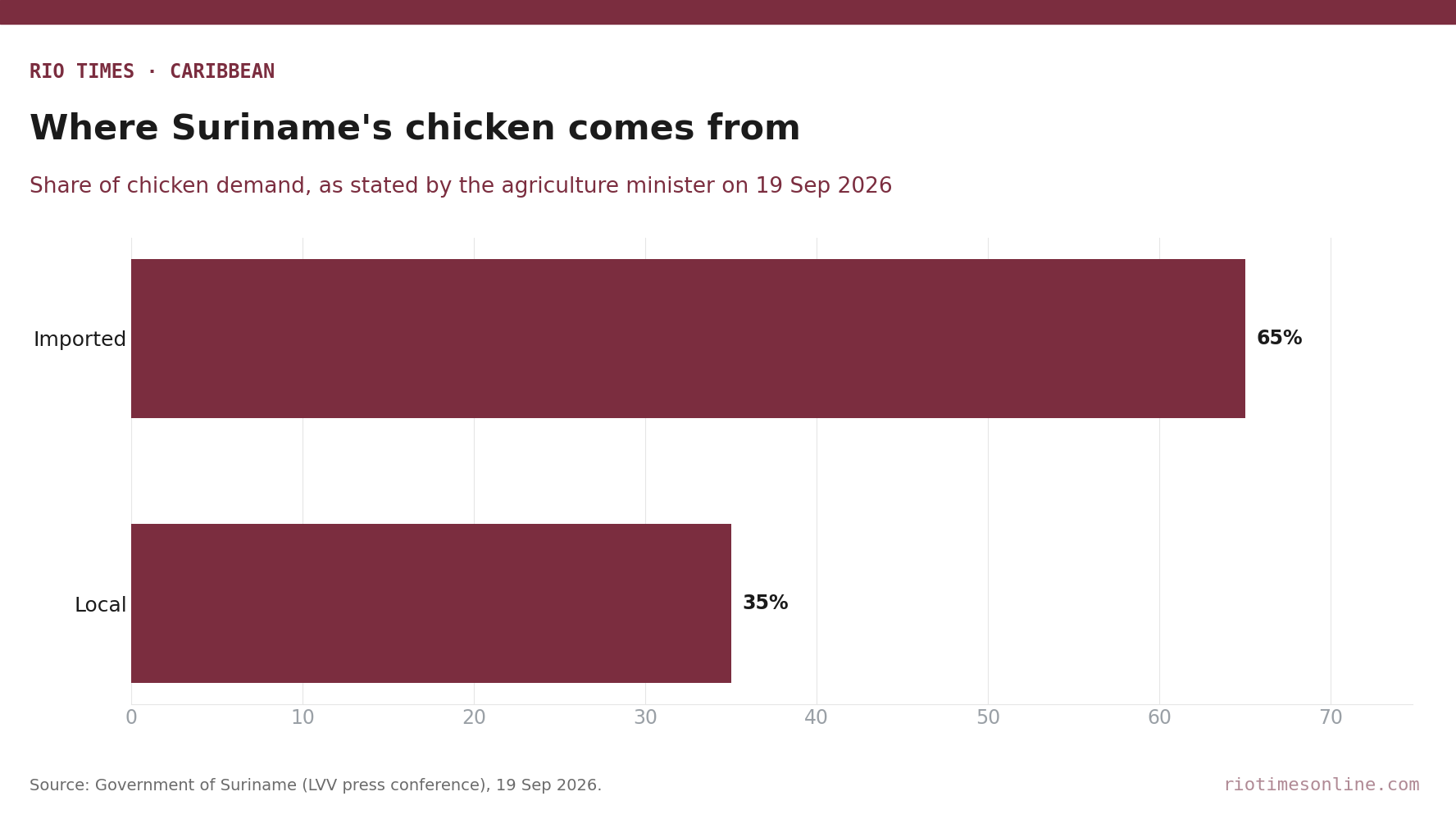
Suriname covers about 35% of its chicken demand from local farms and imports the other 65%, the minister said on 19 September. The government wants to raise local output.
How Far the Outbreak Has Reached
On 22 September Dagblad Suriname reported a suspected case at a site in Sophia’s Lust. Three slaughterhouses and a processing plant were closed as a precaution, and their birds and products destroyed.
By 29 September the national disaster coordination centre (NCCR) had worked at four to five locations, some outside Paramaribo, Suriname Herald reported. It helps with culling, cleaning and disinfection.
Risk to People and Farms
Everyone tested in Suriname has been negative so far and remains under watch, the public health office said on 24 September. Officials say infection comes from handling sick birds, not from eating properly cooked chicken.
Trotman said the real risk for Barbados is to farms and food security, not to consumers of imported meat. He urged farmers to keep footbaths, change clothes before entering coops and report sudden illness.
The Suriname bird flu outbreak was discussed at a recent meeting of CARICOM chief veterinary officers, which offered Suriname assistance. Trotman said it did not raise widespread regional alarm.
Elsewhere in South America, in August, São Paulo confirmed its second wild bird flu case of 2026. Argentina also won back EU market access for its poultry.
What Is Not Yet Known
The exact Suriname bird flu strain, its pathogenicity and how the virus entered the country are still unknown. Officials said on 24 September that foreign laboratory results could take several weeks.
Suriname has not published a full count of affected farms or birds beyond the first site. Barbados has not said how many extra inspections it is running at its ports.
Is it safe to eat chicken in Barbados?
Barbados’s chief veterinary officer sees no immediate threat, as poultry and meat enter only from approved countries. Suriname’s health office says infection comes from handling sick birds, not eating cooked chicken.
Has Barbados banned imports from Suriname?
No ban or emergency restriction applied as of 2 October. Instead, Barbados has stepped up surveillance at its ports for poultry smuggled in informally or carried in baggage.
Has anyone caught bird flu in Suriname?
No human case has been reported. Suriname’s public health office said on 24 September that everyone tested so far was negative, and those exposed remain under monitoring.
Sources: Barbados Today, interview with Chief Veterinary Officer Mark Trotman, 2 October 2026; Government of Suriname, releases of 20, 23 and 24 September 2026; Dagblad Suriname, 22 September 2026; Suriname Herald, 29 September 2026.
Editorial responsibility: Matthias Camenzind, Editor-in-Chief · Editorial standards · Report an error