Zinc Falls on Soft China Demand; Nexa and Buenaventura Slide
Key Facts
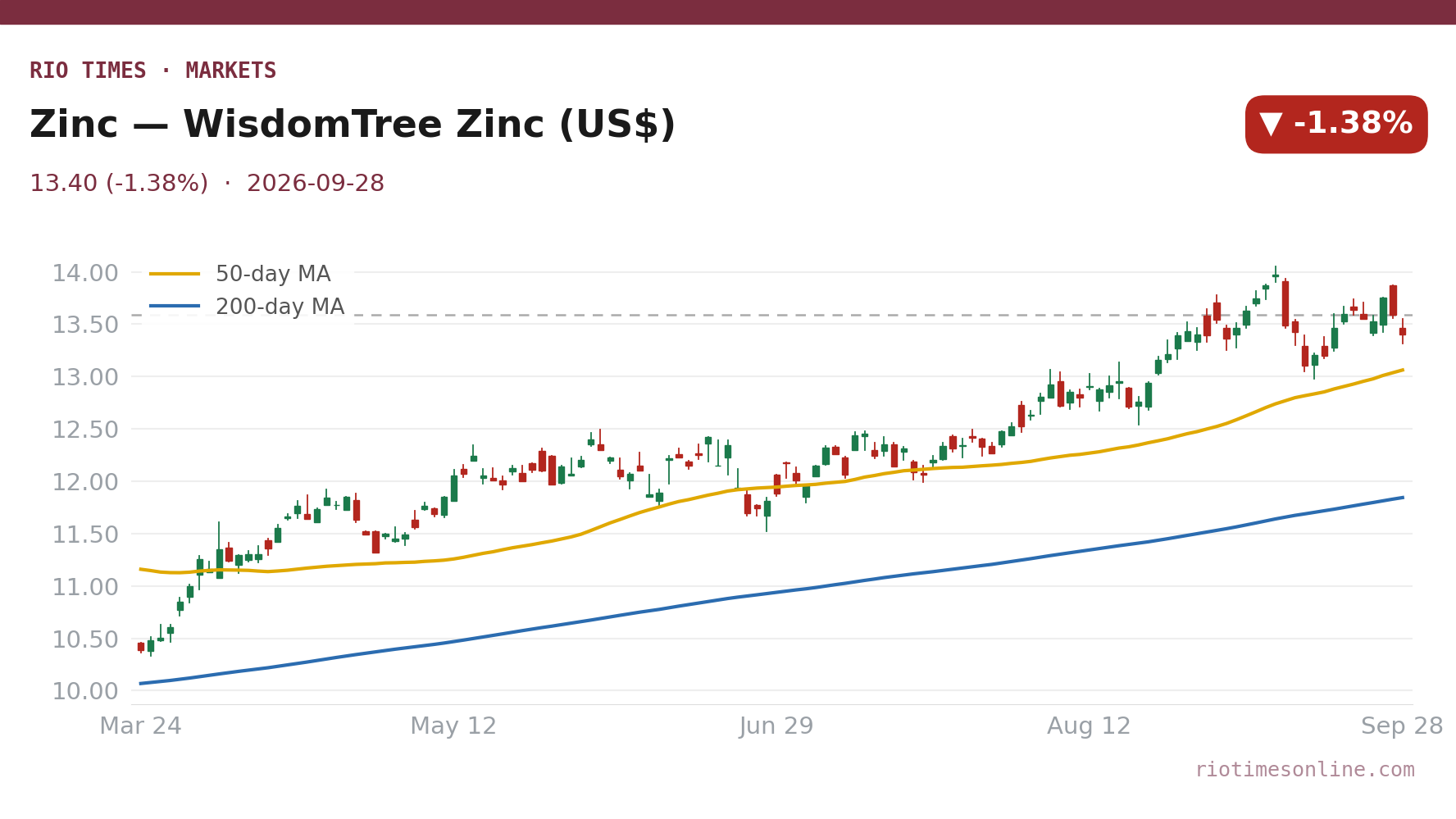
- China demand soft London three-month zinc closed at US$3,851 a tonne on Monday, September 28, 2026, down 1.09 percent.
- Shanghai reopen Shanghai November zinc was near 26,500 yuan (about US$3,950) a tonne, about 0.9 percent lower after Friday’s Mid-Autumn Festival closure.
- Nexa drops Nexa Resources fell 1.69 percent to US$12.23 in New York, the more direct Latin American listed proxy for zinc.
- Buenaventura diverges Buenaventura fell 3.38 percent to US$32.05, dragged by precious metals rather than tracking zinc.
- Galvanising link Zinc protects steel from corrosion through galvanising, tying it to construction and infrastructure demand.
- Producing region Peru, Bolivia and Mexico are major zinc producers, with Nexa running mines and smelters in Peru and Brazil.
Today’s Focus
Zinc slipped on Monday, September 28, 2026, as Chinese demand stayed soft and Shanghai prices reopened lower after the Mid-Autumn Festival. London three-month zinc traded around US$3,875 a tonne in Asian hours, below the late-Friday level near US$3,900, and closed at US$3,851, down 1.09 percent. A firmer dollar and hawkish Federal Reserve signals added to the pressure.
The move filtered into Latin American miners unevenly. Nexa Resources, the Peru and Brazil zinc miner and smelter, fell 1.69 percent to US$12.23 in New York. Buenaventura, the Peruvian polymetallic miner, dropped for other reasons, losing 3.38 percent to US$32.05 as gold and silver weighed on its shares.
For investors, the split shows that Nexa is the cleaner Latin American proxy for zinc. Buenaventura’s broader precious-metals portfolio can override the industrial metal’s daily move. Both remain exposed to construction and infrastructure demand through galvanised steel, but the metals mix decides which one leads.
What matters today. Zinc fell because Shanghai reopened to soft Chinese demand and the dollar firmed. Nexa caught the industrial chill while Buenaventura was swept down by precious metals.
01 The session in one read
Zinc weakened on Monday, September 28, 2026, as Chinese demand stayed soft and Shanghai prices reopened lower after the Mid-Autumn Festival closure. London three-month zinc closed at US$3,851 a tonne, down 1.09 percent.
That pullback pulled Latin American zinc proxies lower, but not evenly. Nexa Resources fell 1.69 percent to US$12.23, while Buenaventura dropped 3.38 percent to US$32.05, caught up in a precious metals decline rather than zinc itself.
Zinc’s Monday decline is a demand and macro story, not a supply shock. Shanghai resumed trading after the Mid-Autumn Festival holiday with November zinc around 26,500 yuan (about US$3,950) a tonne, roughly 0.9 percent below its previous settlement, confirming that Chinese buyers were not chasing the metal. London three-month zinc hovered near US$3,875 a tonne in Asian hours, under the late-Friday level near US$3,900, and closed at US$3,851 as a firmer dollar added pressure. Nexa’s 1.69 percent slide to US$12.23 reflects direct zinc exposure, while Buenaventura’s 3.38 percent fall to US$32.05 was driven more by gold and silver weakness. Watch Shanghai zinc’s next session: if it fails to regain ground, London may test lower levels and Nexa could follow.
02 The board
Nexa Resources, the Peru and Brazil miner and smelter, closed at US$12.23 in New York, losing 1.69 percent. Buenaventura, the Peruvian polymetallic miner, ended at US$32.05, down 3.38 percent.
The two moves tell different stories. Nexa’s decline tracks zinc’s industrial demand, while Buenaventura’s slide is being driven by the gold and silver sell-off that dominated broader metals markets on Monday.
| Asset | Level | Change |
|---|---|---|
| Nexa Resources | US$12.23 | -1.69% |
| Buenaventura | US$32.05 | -3.38% |
Source: RT close, 2026-09-28. Where a commodity has no spot feed, an exchange-traded tracker or leading producer is shown as a labelled proxy.
Live Market IntelligenceThe live market board
Rio Times · Live Market Intelligence
Latin America — Cross-Market Board
| Instrument | Last | Change | YoY | Prev. | High | Low | Volume |
|---|---|---|---|---|---|---|---|
| IBOV | 182,991.13 | -0.26% | +21.85% | 183,476.86 | 168,310 | 167,142 | — |
| IPSA | 11,137.59 | -1.06% | — | 11,256.80 | 11,210 | 10,984 | 1,513,213,483 |
| IPC MEX | 64,737.82 | -0.39% | +12.17% | 64,992.23 | 66,121 | 65,405 | 108,886,187 |
| MERVAL | 2,798,925 | -3.28% | +30.51% | 3,022,485 | 3,042,365 | 2,991,150 | — |
| COLCAP | 2,579.33 | -0.21% | — | 9.04 | 9.05 | 9.02 | 4,133 |
| BVL PERÚ | 60,698.35 | -0.79% | — | — | — | — | — |
| USD/BRL | 5.16 | +0.01% | -5.13% | 5.16 | 5.18 | 5.14 | — |
| EUR/BRL | 5.95 | +1.01% | -5.83% | 5.89 | 5.98 | 5.94 | — |
| USD/MXN | 17.06 | -0.24% | -8.58% | 17.10 | 17.08 | 17.01 | — |
| USD/CLP | 913.98 | +0.04% | -5.67% | 913.65 | 915.11 | 906.68 | — |
| USD/COP | 3,140 | +0.03% | -22.04% | 3,139 | 3,141 | 3,105 | — |
| USD/PEN | 3.36 | -0.66% | -4.82% | 3.38 | 3.38 | 3.35 | — |
| USD/ARS | 1,493 | +0.10% | +12.96% | 1,491 | 1,494 | 1,480 | — |
| USD/UYU | 40.27 | +1.24% | +1.80% | 39.77 | 40.27 | 40.23 | — |
| USD/PYG | 5,939 | +1.68% | -19.54% | 5,841 | 5,939 | 5,925 | — |
| USD/BOB | 11.64 | -0.76% | +72.04% | 11.73 | 11.72 | 11.64 | — |
| USD/DOP | 58.34 | +1.25% | -3.44% | 57.62 | 58.34 | 58.04 | — |
| USD/CRC | 445.92 | +0.89% | -9.71% | 441.97 | 448.50 | 445.92 | — |
03 What moved it
The key driver was China. Shanghai November zinc was near 26,500 yuan (about US$3,950) a tonne, about 0.9 percent lower than its previous settlement, after Shanghai markets reopened following Friday’s Mid-Autumn Festival holiday.
London three-month zinc traded around US$3,875 a tonne in Asian hours, below the previous late-Friday level near US$3,900. The softer tone carried into the London close at US$3,851 a tonne, down 1.09 percent, as Chinese buyers stayed away. Higher oil prices revived inflation worries, and hawkish Federal Reserve comments kept the dollar firm, adding macro pressure.
04 The Latin American read
Peru, Bolivia and Mexico are major zinc producers, and the metal’s main use is protecting steel from corrosion through galvanising. That makes construction and infrastructure activity the key demand channels for zinc from the region.
Nexa operates zinc mines and smelters in Peru and Brazil, giving it greater sensitivity to industrial zinc demand. Buenaventura offers more diversified Peruvian exposure to zinc, precious metals and other base metals, which can cushion or override the metal’s daily move.
05 The names to watch
Nexa Resources is the most direct Latin American listed proxy for zinc. Its 1.69 percent decline to US$12.23 reflects the soft Chinese demand that pulled the metal lower.
Buenaventura’s 3.38 percent drop to US$32.05 was driven more by gold and silver, which fell sharply across the board. For zinc-specific exposure, Nexa remains the cleaner instrument.
06 The outlook
The zinc market’s near-term direction hinges on whether Shanghai demand picks up after the holiday. If November zinc holds near 26,500 yuan (about US$3,950) a tonne, London prices may stabilise around current levels; if Chinese buyers stay away, the setback could extend. Latin American miners will follow the metal, with Nexa more exposed and Buenaventura more insulated by its precious metals mix.
07 What to watch
- Shanghai zinc demand: whether November zinc recovers from 26,500 yuan (about US$3,950) a tonne after the Mid-Autumn Festival reopening
- London three-month zinc: whether prices recover towards US$3,900 a tonne or extend Monday’s fall to US$3,851
- Nexa Resources: how the Peru and Brazil miner responds to zinc’s demand signal from China
- Buenaventura: whether the Peruvian miner’s precious metals mix keeps diverging from zinc’s daily move
Frequently Asked Questions
Why did zinc fall on Monday?
London three-month zinc closed at US$3,851 a tonne, down 1.09 percent, as Chinese demand stayed soft, Shanghai reopened lower after the Mid-Autumn Festival and a firmer dollar weighed.
Which Latin American company tracks zinc most closely?
Nexa Resources, the Peru and Brazil zinc miner and smelter, fell 1.69 percent to US$12.23 and is the more direct listed proxy for zinc.
Why did Buenaventura fall more than zinc?
Buenaventura dropped 3.38 percent to US$32.05, mostly dragged by falling gold and silver prices rather than zinc itself.
What is zinc used for?
Zinc is used mainly to protect steel from corrosion through galvanising, making construction and infrastructure key demand channels.
Source: RT live market data, close of Monday 28 September 2026.
This article was produced by The Rio Times’ automated newsroom system. How we use AI · Report an error
LatAm Markets: Live Signals → — real-time movers, turnover leaders and FX across Latin America.
Read More from The Rio Times