Hichilema Is Sworn In With the Election Petition Still Unresolved

ZAMBIA · POLITICS
Key Facts
A public holiday for the ceremony: The government declared Tuesday 1 September a public holiday for the swearing-in of President Hakainde Hichilema and Vice-President Mutale Nalumango. The ceremony was held at the National Heroes Stadium in Lusaka.
The margin: The Electoral Commission of Zambia declared Hichilema re-elected on 18 August with 60.49% of the vote. Brian Mundubile, who stood for the NRPUP as the Tonse Pamodzi alliance candidate took 37.87%.
Petition unresolved: The Secretary to the Cabinet said the seven-day window for filing an election petition had expired, clearing the way for the inauguration. The Constitutional Court confirmed it had received no challenge.
Why that is contested: The opposition has said it was unable to lodge a challenge after authorities sealed off the courts on the final filing day, citing security. No petition was therefore ever heard.
The economic record he is running on: The government points to inflation falling from about 24% at his 2021 inauguration to 6.5% in June 2026. It also cites roughly US$12bn of fresh mining investment.
Debt was the first-term project: Hichilema’s first term was dominated by restructuring Zambia’s defaulted external debt, alongside energy shortages and weak investor confidence. That work framed the country’s return to market access.
The unresolved case: Mundubile was charged with treason in late August, after surrendering to police following two weeks in hiding. Eleven opposition officials were detained in a raid on election night.
A Hichilema second term formally began on 1 September, when Zambia swore in the president and Vice-President Mutale Nalumango at Lusaka’s National Heroes Stadium. He returns with 60.49% of the vote and, unusually, with an emailed election petition still sitting before the Constitutional Court.
What happened on the day
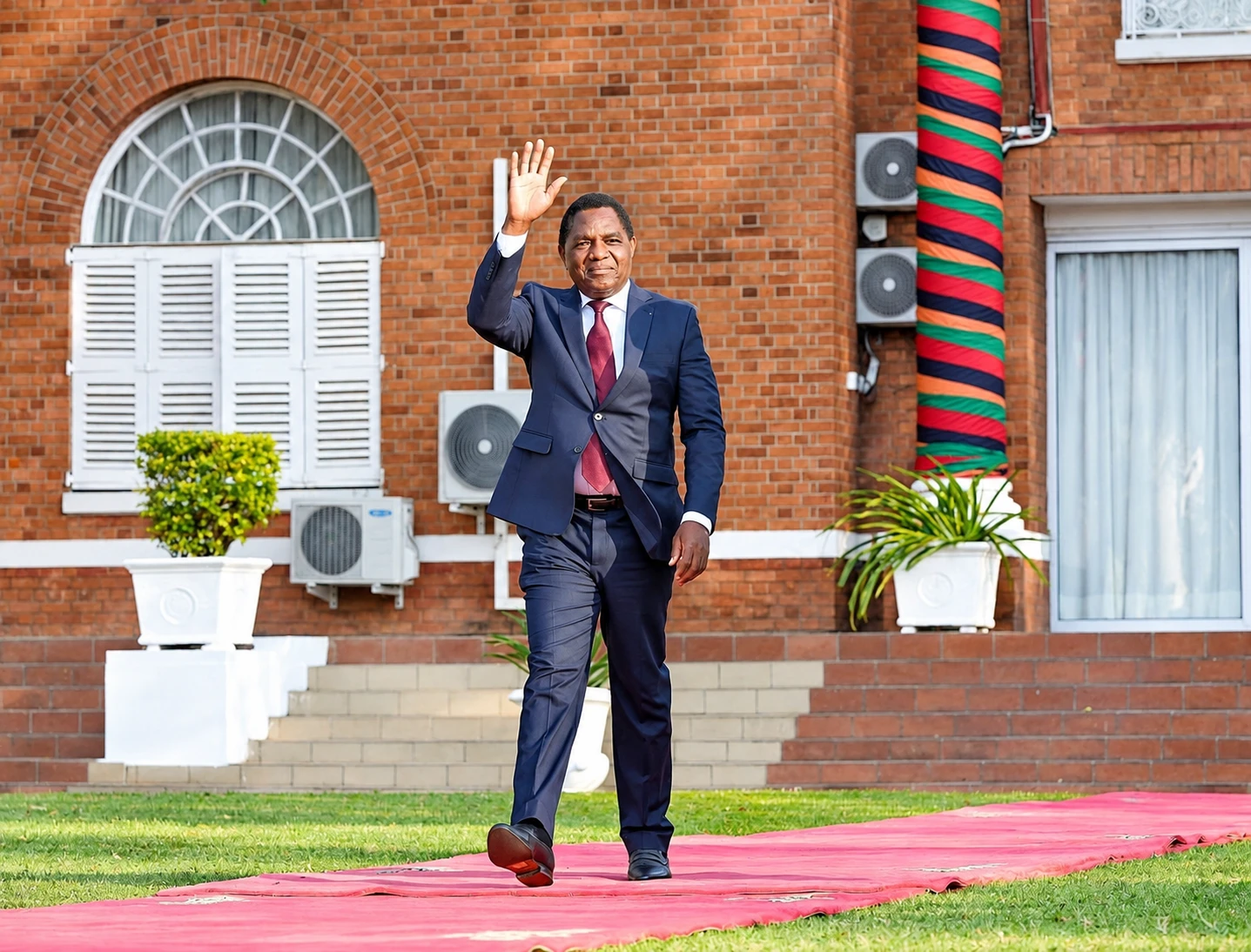
The government declared 1 September a public holiday so Zambians could watch the ceremony, which was held at the National Heroes Stadium in Lusaka. It marks the start of a second five-year term.
Preparations were confirmed in the days before by the Zambian press, which reported the venue ready and the schedule fixed. Hichilema was declared re-elected by the Electoral Commission of Zambia on 18 August.
The margin was wide. He took 60.49% against 37.87% for Brian Mundubile of the Tonse Pamodzi alliance.
The petition nobody could file
Zambian law gives seven days for an election petition. The Secretary to the Cabinet confirmed that the window had expired and that the swearing-in would go ahead.
The Constitutional Court said it had received no challenge to the result. On the face of it, that is a clean legal path to inauguration.
The opposition’s account is different. It has said it could not lodge a petition because authorities sealed off the courts on the final filing day, citing security concerns, so no challenge was ever heard on its merits.
Both statements can be true at once, and that is the difficulty. The absence of a petition is not by itself evidence that the result was uncontested.
The economy behind the Hichilema second term
The government’s own account of the first term rests on stabilisation. It points to inflation falling from about 24% at the 2021 inauguration to 6.5% in June 2026, and to roughly US$12bn of fresh mining investment.
Debt was the defining work. Zambia defaulted in 2020 and spent most of the first term negotiating a restructuring with official and private creditors, a process that shaped everything from the exchange rate to the budget.
Energy shortages and weak investor confidence ran alongside it. Both are the kind of problem that eases slowly and returns quickly.
Copper is the whole argument
Zambia is Africa’s second-largest copper producer, and the metal is the country’s principal source of foreign exchange. The investment figure the government cites is essentially a copper figure.
That gives the second term a clear commercial test. Whether the announced capital converts into produced tonnes, and on what terms for the treasury, is the question investors will judge.
It also ties Zambia directly into the wider contest over the minerals needed for the energy transition. The Copperbelt is one of the places where that competition is most visible.
The politics that did not go away
Mundubile was charged with treason in late August, after two weeks in hiding and a surrender to police. Eleven opposition officials were detained in a raid on election night.
Those cases will run into the new term. They are the reason the inauguration reads differently at home than it does in a press release.
For a government that has built its external credibility on predictability, the handling of the opposition is now part of the risk picture. Creditors and miners tend to price political stability alongside geology.
What to watch in the new term
The first marker is the treason case and how it is conducted. The second is whether the mining investment pipeline produces commissioned capacity rather than announcements.
The third is fiscal. Restructuring bought Zambia room, and the question is whether the second term uses it for capital spending or for consumption.
None of this is a prediction. It is simply the short list of things that will tell readers, over the next year, which version of the first term the second one intends to continue.
Frequently Asked Questions
When did Hichilema’s second term begin?
He was sworn in on 1 September 2026 at the National Heroes Stadium in Lusaka, alongside Vice-President Mutale Nalumango. The government declared the day a public holiday.
What was the election result?
The Electoral Commission of Zambia declared Hichilema re-elected on 18 August with 60.49% of the vote. Brian Mundubile of the Tonse Pamodzi alliance took 37.87%.
Was the result challenged in court?
None was filed by the deadline, and the opposition says it could not lodge one because the courts were sealed off on the final filing day. The Chief Justice then received a petition by email on 25 August and referred it to the Constitutional Court, which has not ruled.
What does the government claim for the first term?
It points to inflation falling from about 24% in 2021 to 6.5% in June 2026, and to roughly US$12bn of fresh mining investment. Debt restructuring was the defining task.
What happened to the main opposition candidate?
Mundubile was charged with treason in late August after surrendering to police following two weeks in hiding. Eleven opposition officials were detained on election night.
Connected Coverage
Follow the story on our Southern Africa page and in the wider Africa: The New Scramble. We covered the treason charge against Brian Mundubile, and earlier reported when Zambia suspended its vote count after election violence.
This article was produced by The Rio Times’ automated newsroom system. How we use AI · Report an error · Editorial responsibility: Matthias Camenzind, Editor-in-Chief
In depth
LatAm Markets: Live Signals → — real-time movers, turnover leaders and FX across Latin America.