West Africa’s Busiest Transshipment Port Belongs to One of Its Smallest States
TOGO · ECONOMY
Key Facts
- —The traffic Port of Lomé handled 2.06 million containers in 2024, up 8 percent.
- —The growth Real GDP rose 6.3 percent in 2025 to 5,649.2 billion CFA francs (about US$10 billion).
- —The programme Togo has an IMF loan of about US$390 million over 42 months, approved in March 2024.
- —Why the port matters fiscally Rising transshipment revenue improves the budget, as customs and port fees are easier to collect.
- —The inflation line Inflation fell to about 0.4 percent in 2025, below the region’s 3 percent ceiling.
- —The catch Faure Gnassingbé left the presidency in May 2025 for a new post with no term limit.
The Port of Lomé handled 2.06 million containers in 2024. Lloyd’s List, the shipping industry’s reference ranking, calls it the busiest transshipment hub in West Africa.
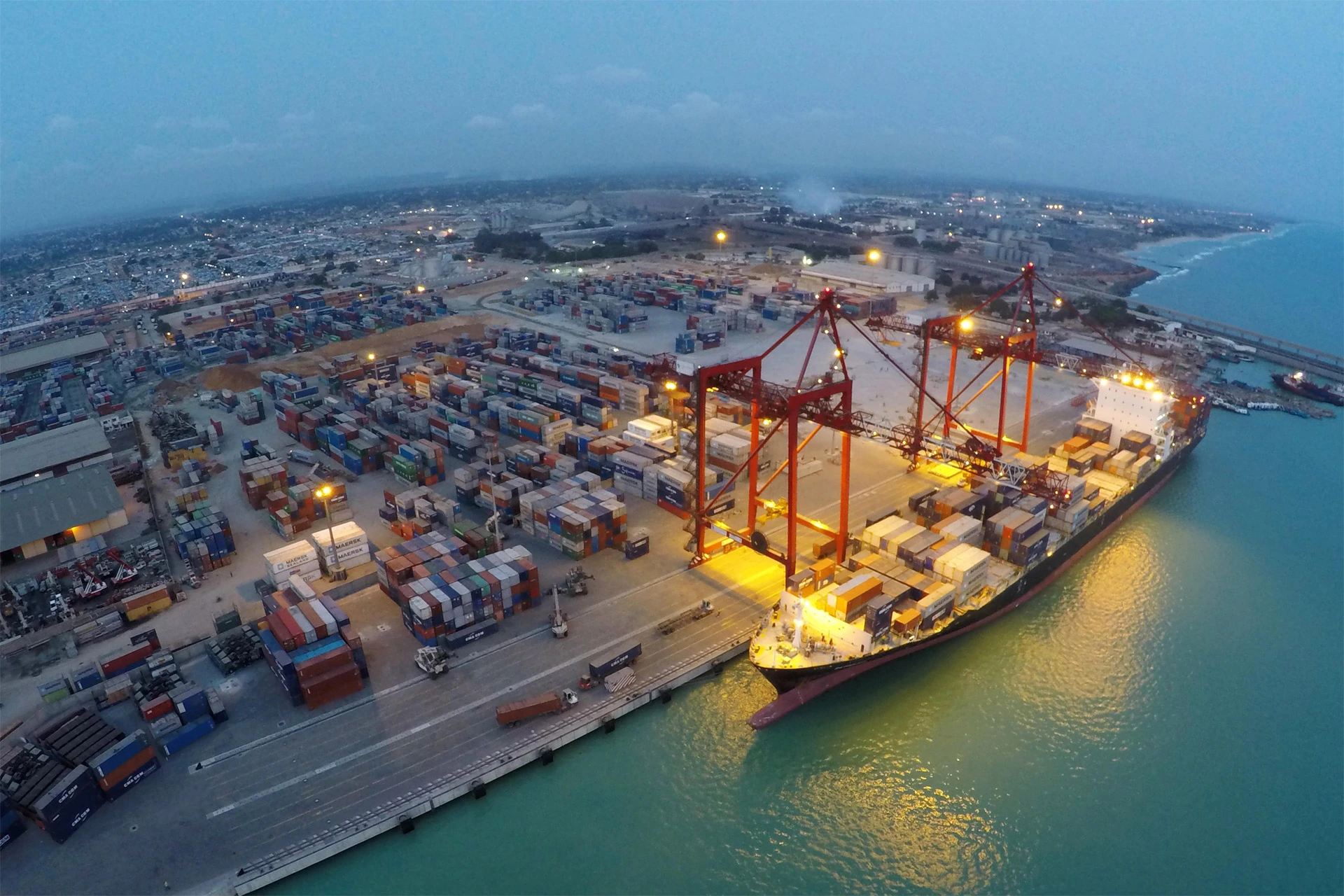
A country of about nine million people grew 6.3 percent last year. One deep-water port complex carries an outsized share of the national budget.
What the Port of Lomé actually does
Transshipment is a different business from importing. Containers arrive on large ocean-going vessels, get transferred to smaller feeder ships, and leave again for ports up and down the coast.
That requires deep water, fast cranes and reliable customs. It also means the cargo never enters Togo’s own economy.
Togo earns a fee instead, on goods bound for Nigeria, Ghana, Bénin and the landlocked Sahel countries.
Volumes reached 2.06 million twenty-foot equivalent containers (TEUs) in 2024, up 8 percent from 1.9 million the year before. Lloyd’s List ranked Lomé 92nd among the world’s ports in its 2025 list.
Within Africa, only Tanger Med, Port Said, Durban and Damietta ranked higher. None of those four is in West Africa, which is why Lomé leads its own region by a clear margin.
Depth is the reason it works. Lomé can take the largest vessels calling in the region, something few other West African berths can manage.
The main container terminal is a joint venture. France’s Bolloré Ports and Switzerland’s Mediterranean Shipping Company (MSC) built it, opening in 2014 and expanding it several times since.
How one asset changes a national budget
Real GDP rose 6.3 percent in 2025, reaching 5,649.2 billion CFA francs. At the CFA franc’s fixed peg to the euro, and the euro-dollar rate on 4 September 2026, that is roughly US$10 billion.
Growth is projected to average around 6 percent through 2026 and 2027, according to the African Development Bank. Private investment and low inflation are the main supports.
Port and customs revenue is unusually valuable to a small state because it is collectible. Taxing an informal domestic economy is difficult, while taxing a container gantry is not.
Togo has been running an IMF Extended Credit Facility since March 2024, worth roughly US$390 million over 42 months. Fiscal consolidation, meaning bringing spending closer to revenue, is the core condition.
Rising transshipment receipts have helped Togo meet those targets. Part of the programme is effectively being financed by other countries’ imports passing through the port.
Low inflation has also helped. Togo’s rate was about 0.4 percent in 2025, far below the 3 percent ceiling set by its regional monetary union.
The Sahel changed the map
Lomé’s position has become more valuable as the political geography of West Africa has fractured. Mali, Burkina Faso and Niger have distanced themselves from the Economic Community of West African States (ECOWAS) and from some coastal neighbours.
Landlocked states still need a coast. Corridors that were once routine have become political choices, and Togo has positioned itself as the least contentious option.
That is a delicate business. Serving governments that other capitals have sanctioned or suspended requires careful, deliberate neutrality.
Lomé has practised that neutrality for years. The city hosts regional negotiations and signings more often than its size would suggest.
The commercial payoff is measurable. Corridor traffic towards Ouagadougou and Niamey has grown as other routes became politically awkward.
The politics behind the throughput
The Gnassingbé family has governed Togo since 1967. Faure Gnassingbé became president in 2005 and held that office until May 2025.
A 2024 constitutional change replaced Togo’s presidential system with a parliamentary one. Gnassingbé then moved out of the presidency and into a new post.
That post, President of the Council of Ministers, carries the real executive power and no term limit.
A separate figure, Jean-Lucien Savi de Tové, was elected by parliament to the now-ceremonial presidency. Critics call the whole rearrangement a way for Gnassingbé to govern indefinitely under a different title.
Supporters counter that a parliamentary system spreads power more widely than a strong presidency does. Either way, the family that has run Togo since 1967 still runs it.
Protests against the change were held in Lomé in June 2025, shortly after Gnassingbé took the new post. The ruling UNIR party holds 108 of the National Assembly’s 113 seats, following the 2024 legislative election.
For investors this is the standard frontier trade-off. Political continuity delivers predictable port policy, but it concentrates risk in a single family’s succession.
Neighbouring countries have seen abrupt political transitions upend commercial terms overnight. That risk is not merely theoretical in this part of West Africa.
A model with obvious limits
Transshipment income is rent on geography and capital equipment. It employs relatively few people directly and creates limited links to the wider economy.
Competition is also growing. Lekki in Nigeria, Abidjan in Côte d’Ivoire and Tema in Ghana have all expanded their own container capacity.
Shipping lines move their hub of choice when the economics change elsewhere. Nigeria’s Lekki Port alone was designed to handle up to 2.5 million TEUs a year.
Its actual volumes have grown slowly since it opened in 2023, but the design capacity shows the scale of the coming competition.
The task for Togo is to convert throughput into industry: warehousing, assembly, processing. That is the step almost every transshipment hub finds hardest.
Togo has begun with logistics zones and free-zone incentives around the port. Whether manufacturers follow the containers is still an open question.
What to watch next
The first thing is 2026 container volumes, and whether the 8 percent growth rate holds against expanding regional competition.
The second is the IMF programme’s remaining reviews. They will show whether fiscal consolidation survives without a further revenue windfall from the port.
The third is whether Sahelian cargo keeps routing through Lomé as regional politics continue to shift.
Latest developments
- South Africa Court Shields Bank Files in Tycoon Iqbal Survé’s War on Banks — 25 September 2026
- South Africa’s Woolworths Exits Top 40 Stock Index as Shoppers Cut Back — 25 September 2026
- US Firm Wins US$700 Million-Plus Deal to Service Guinea’s Iron-Ore Trains — 25 September 2026
- IMF and World Bank Rewrite Debt Rules for 70 Poor Countries, Most in Africa — 25 September 2026
Frequently Asked Questions
How large is the Port of Lomé?
The port handled 2.06 million twenty-foot equivalent containers in 2024, an 8 percent increase on 2023. Lloyd’s List ranks it as West Africa’s busiest transshipment port.
How fast is Togo’s economy growing?
Real GDP rose 6.3 percent in 2025 to 5,649.2 billion CFA francs, about US$10 billion. Growth is projected to average around 6 percent through 2027.
Does Togo have an IMF programme?
Yes. An Extended Credit Facility worth about US$390 million was approved in March 2024, running 42 months, with fiscal consolidation as the condition.
What is transshipment?
It is the transfer of containers from large ocean-going vessels to smaller feeder ships for onward delivery. The cargo never enters the domestic economy.
Is Faure Gnassingbé still Togo’s president?
No. He left the presidency in May 2025 for a new post, President of the Council of Ministers. That office now holds real executive power, with no term limit.
Connected Coverage
- We covered the competitive stakes in our earlier look at the battle for Lomé. We also covered the corridor play in the inland port next door in Bénin.
- Both belong to the wider contest in Africa: The New Scramble.
This article was produced by The Rio Times’ automated newsroom system. How we use AI · Report an error · Editorial responsibility: Matthias Camenzind, Editor-in-Chief
LatAm Markets: Live Signals → — real-time movers, turnover leaders and FX across Latin America.