As Pantanal Fires Burn, Pressure Grows on Brazil’s Environmental Officials
RIO DE JANEIRO, BRAZIL – The odor of burning brush penetrated the home of Zulmira Maria Lucia, 67, a resident of Mata Cavalo, a community settlement located in the Pantanal in Mato Grosso, western Brazil.
“The fire emerged very quickly and cleared the whole pasture. We lost everything, the banana fields, and other plantations”, says Zulmira, about her community and the other 28 neighboring ones, where 40,000 settlers live. One of the most affected homes is of Maria da Paz’s family, who lost all the pasture and sugar cane in the fire and will need to buy food to feed the small flock of ten animals.
From the porch door, Maria da Paz holds her newborn grandson in her arms. Tania, the baby’s mother, is hospitalized with Covid-19. Maria raises her teary eyes and signals that we must not come close because of the baby. She points to the burnt area and says laconically: “We also lost everything, the fire has come this far,” she shows, pointing to the fire tracks left near her home.

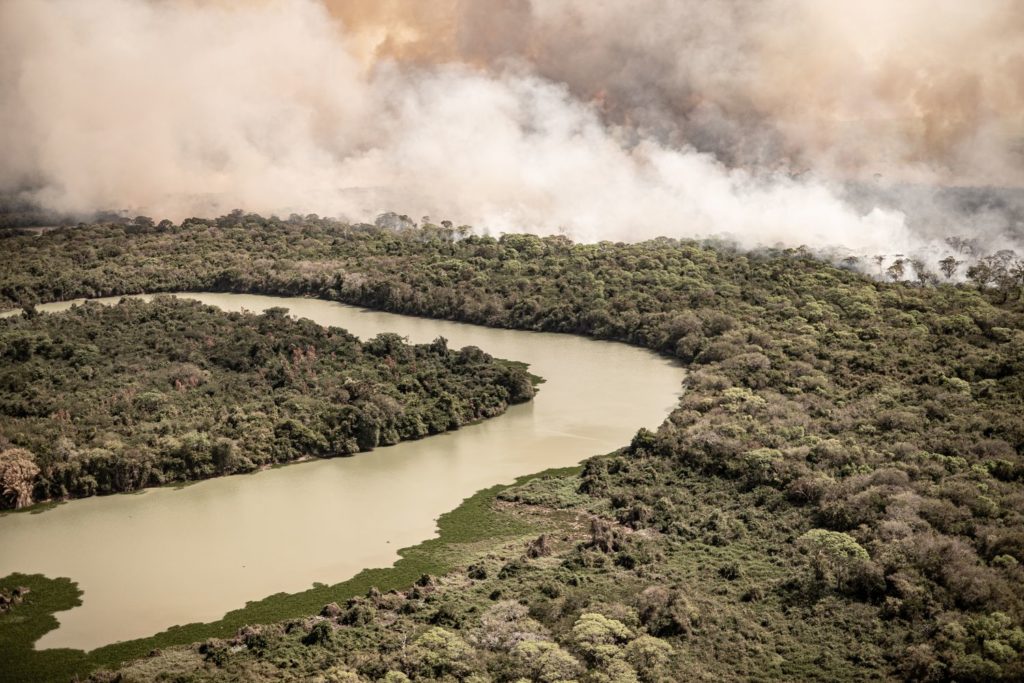
The fire came with intensity this year in the Pantanal, a 156,000 km² wetland biome in the far west of Brazil, between Mato Grosso and Mato Grosso do Sul, that borders Bolivia and Paraguay. Despite preserving 83 percent of its forests, the region is currently burning.
In July alone there were over 1,601 hotspots, the highest in the Pantanal’s history since the National Institute for Space Research (INPE) began monitoring the region. In the month of August, the problem worsened. There have been 2,170 hotspots in only 10 days.
“This figure is now 28 percent higher than in the whole month of August 2019,” explains Vincíus Silgueiro, a researcher at the Center for Life Institute (ICV), which has been working in the biome for twenty years. “Over 55 percent of hotspots are on registered rural properties. The source of hotspots comes from these areas with a strong human presence.”
The emergency situation led the Minister of the Environment, Ricardo Salles, to visit Mato Grosso earlier this week. From the aircraft window that flew him there, he could witness what the fire alerts were depicting. “Throughout the flight, we can see hundreds of fire hotspots, but now we can detect the origin and we will punish all those responsible,” warned the Minister on Tuesday afternoon after flying over fire hotspots in the region.
The Bolsonaro government is increasingly pressured by claims of poor environmental management in the Amazon, and there is a consensus that the necessary organization and competence to deal with the biome have also been lacking. On Friday, the Federal Gazette published the exoneration of Col. Homero Siqueira, who was in charge of the Chico Mendes Institute for Biodiversity Conservation (ICMBio), one of the bodies involved in surveillance and inspection of the forests.
The decision was made by Minister Salles because of the uncontrolled burning in the Pantanal. Siqueira followed the common formula in Bolsonaro’s management of exchanging experts for military personnel in the institute’s posts that oversees national reserves, his critics say.
Those who know the Pantanal say they have failed to foresee these events. “Actions need to start earlier. They were only taken late in 2020 when the numbers [of burnings] were already high. It’s a fatal delay for the biome,” says Júlio Sampaio, who coordinates the Cerrado Pantanal program for the WWF-Brazil environmental group. He mentions the federal decree that banned the use of fire in property management, published only this year.
Firefighters surrounded by fire
Fire fighting has been a complex challenge given the features of the Pantanal, as Salles acknowledged on Tuesday. “We’re relocating personnel, but the Pantanal environment is very dry, hot and windy,” he said. A day earlier, on Monday, August 17th, local teams faced moments of terror.
Six men from the Mato Grosso Military Fire Department were surprised by the speed and intensity of the fire lines in Poconé, adjacent to Mata Cavalo, and found themselves surrounded by the flames. The Brazilian Air Force Black Hawk H-60 helicopter had to be deployed for emergency rescue. Luckily, no one was injured.
The fire has already fully engulfed forest animals. A jaguar had 70 percent of its body burned and had to be flown in the army helicopter to Cuiabá on Monday, August 16th. The female jaguar was admitted to the federal university veterinary hospital. In distress because of the fire, the animal invaded the backyards of the Poconé community, causing panic among the population. Almost 500 bird species and 132 mammals inhabit the Pantanal.
The situation worries Mato Grosso, which lives off tourism in the region, and has a natural reserve that is vital for the global climate balance. “The fires have already consumed six percent of the Pantanal,” said governor Mauro Mendes, along with Minister Ricardo Salles, who is being increasingly called upon to act for the preservation of Brazil’s forests.
The fires in the Pantanal changed the scenery even in the capital of Mato Grosso, 200 kilometers from the reserve, with the traditional blue sky of Cuiabá stained ash gray. The accumulated smoke forces the planes to land aided by instruments due to the lack of visibility at the state’s main airport, named for the renowned Amazon explorer Marshal Rondon.
Mato Grosso lives off the glories of being the world’s largest producer of soybeans while leading in the number the fires in 2020. According to INPE, there are 769 reports, one third of all those currently burning in Brazil. Through Wednesday, August 19th, the fire ravaged out of control, mainly in the SESC Pantanal Private Natural Heritage Reserve (RPPN).
The São Francisco do Perigara farm, next to the reserve, was among the hardest hit by the fires. The area hosts the largest concentration of natural blue macaw nests in the world. The place is the research center of the Blue Macaw Institute. “There are 700 animals and over 77 nests monitored, so we will only know the extent of the damage caused by fire when the fight is over. But many of the nests had chicks and the animals have lost their main food source – Bacuri palm trees – to the fires,” says Neiva Guedes, director of the Blue Macaw Institute.
Amazon and Pantanal
The Mato Grosso reserve has an umbilical relationship with the Amazon. The two biomes have most of their springs located in the same mountain range, the Chapada dos Parecis, in Mato Grosso.
It is there that 70 percent of the waters that will form the Pantanal plain are found, in Mato Grosso do Sul. “But we are recording increasingly less rainfall there,” laments Felipe Dias, executive director of the SOS Pantanal Institute, an institution that monitors deforestation in the region.
The projection is that the droughts will be increasingly severe from now on. “We have to prepare ourselves not to lose the Pantanal,” Dias explains. “The current scenario is favorable for the tripod base for fires: a hot winter, low humidity, and strong winds,” he concludes.
One of the causes for so many fires is drought. The Régua de Ladário, in Mato Grosso do Sul, established by the Brazilian Navy in 1900 to assess the floods of the Paraguay River, had not reached such low levels for 47 years. “This drought and rains system is natural to the Pantanal. The old people always said that alternating periods last up to ten years. That means we have to prepare ourselves,” Dias alerts.
The fire in the Pantanal is a problem for the world. The fires and changes in land use are accountable for 80 percent of Brazil’s greenhouse gas emissions that heat the planet and cause climate change. Brazil has been ranked fourth in the world for greenhouse gas emissions during years of uncontrolled fires and deforestation, as was the case in 2005.
The country was removed from the list of the ten largest emitters in 2019, after controlling deforestation in the Amazon. But in 2016 it was still ranked sixth, and if the situation gets out of control in other biomes, emissions will rise again. Emissions can also reduce the financial resources to control burning. Today, it is the state and national commitments to reduce deforestation in the Amazon that provide financial support for actions to fight the fires.
The agreement signed between the Mato Grosso Government and European countries during the World Climate Conference in Paris, Cop-21, ensures annual transfers to the state. The program known as Redd+ for Pioneers grants financial support to the great deforesters who control the loss of forests. Mato Grosso was ranked second in the loss of natural areas in the Amazon, but today it is in the seventh position, according to INPE. This control has ensured an investment of R$22 million (US$4.4 million) passed on by German and British banks to fight the burning.
According to the State Secretariat for the Environment (SEMA), this resource was applied in the joint actions of the Committee on Fire, comprising civil and public bodies and non-governmental organizations. SEMA provides equipment and daily allowances to conduct the operations. Since March, R$680,000 in daily allowances have been transferred to the official firemen and other professionals who work directly in the fight against fires.
Last year had already been critical in terms of drought. “We had temperature peaks and humidity drops all over the Pantanal”, says Júlio Sampaio da Silva, from WWF-Brazil. “Fire is something we’ve seen since the start of 2020. And the fires have human origin. Fire starts with the hand of men, through cleaning areas and renewing pastures,” he explains. “It’s very irresponsible to burn in critical drought periods. Even in the rain, fires have occurred and signaled that we would have had an atypical year.”
The fires will leave deep scars. “This time of fires implies a very serious loss for insects because these animals lack long-range mobility, many of them are pollinators, crucial for plant development,” explains Cristina Cuiabalia, biologist and manager of Research and Environment at the SESC Pantanal Socio-Environmental Center. They are not the only ones: reptiles also end up being consumed by the fires.
“The birds can migrate between one environment and another, but nests and dormitories are lost, which represents the loss of a generation, since we are well into the blue macaw’s breeding season, and of the tuiuiú (Jabiru stork)”, adds Cuiabalia.
Covid-19 and fires
Authorities in Cuiabá and Várzea Grande, the largest cities in Mato Grosso, need to reconcile the impact of the fires on health in the midst of the novel coronavirus pandemic. In July, the Oswaldo Cruz Foundation (Fiocruz) considered the state one of the epicenters of Covid-19 in Brazil. With a steep curve in the number of cases and insufficient hospital beds, there are almost 80,000 cases, for 450 beds in public Intensive Care Units.
The Health Secretariat states that the occupancy rate remains under control, with just over 20 percent of beds available, but the Mato Grosso Prosecutor’s Office has decreed restrictive emergency quarantine twice in the state between June and July for lack of beds.
In the Community of Mata Cavalo the population is still debating what to do after the loss of vegetable gardens. “People say we are close to cities, but for the settlement community to leave its home ten kilometers from the paved roadway and reach a market it incurs R$100 in travel costs. Because of the coronavirus pandemic, the bus that operated our line stopped running in April,” says Arlete Pereira, 54, president of the Mata Cavalo de Baixo Association.
For healthcare official Edson Batista, 51, the impact of the fires could worsen the pandemic. “With this drought, without vegetable gardens and the pandemic aid ending (in September), families will run out of food. We already have some cases of coronavirus here, and one death has been recorded. The respiratory disorders caused by the fires will also prompt families to seek treatment in hospitals in the capital. I don’t know what the next months will be like,” he says.
Source: El País
More: Brazil news in English, every day from The Rio Times.
This article was produced by The Rio Times’ automated newsroom system. How we use AI · Report an error · Editorial responsibility: Matthias Camenzind, Editor-in-Chief