LatAm Opens After Brazil Stocks Rise 0.5% | Pre-Open, Oct 19
Key Facts
- Asian tech shares fell again on Monday, with Japan’s Nikkei 225 and South Korea’s Kospi both lower after the Nasdaq dropped 2.1% on Friday.
- Wall Street ended Friday lower, with the S&P 500 down 1.09% and the VIX, the US fear gauge, up 21% to 19.99.
- Oil is still elevated, with Brent crude near US$106 a barrel on Monday after closing Friday at US$107.58, up 3.4%.
- The dollar eased, with the ICE dollar index down 0.2% to 101.84 on Friday, while dollar-yen sits near 158 and the offshore yuan near 6.68 per US$.
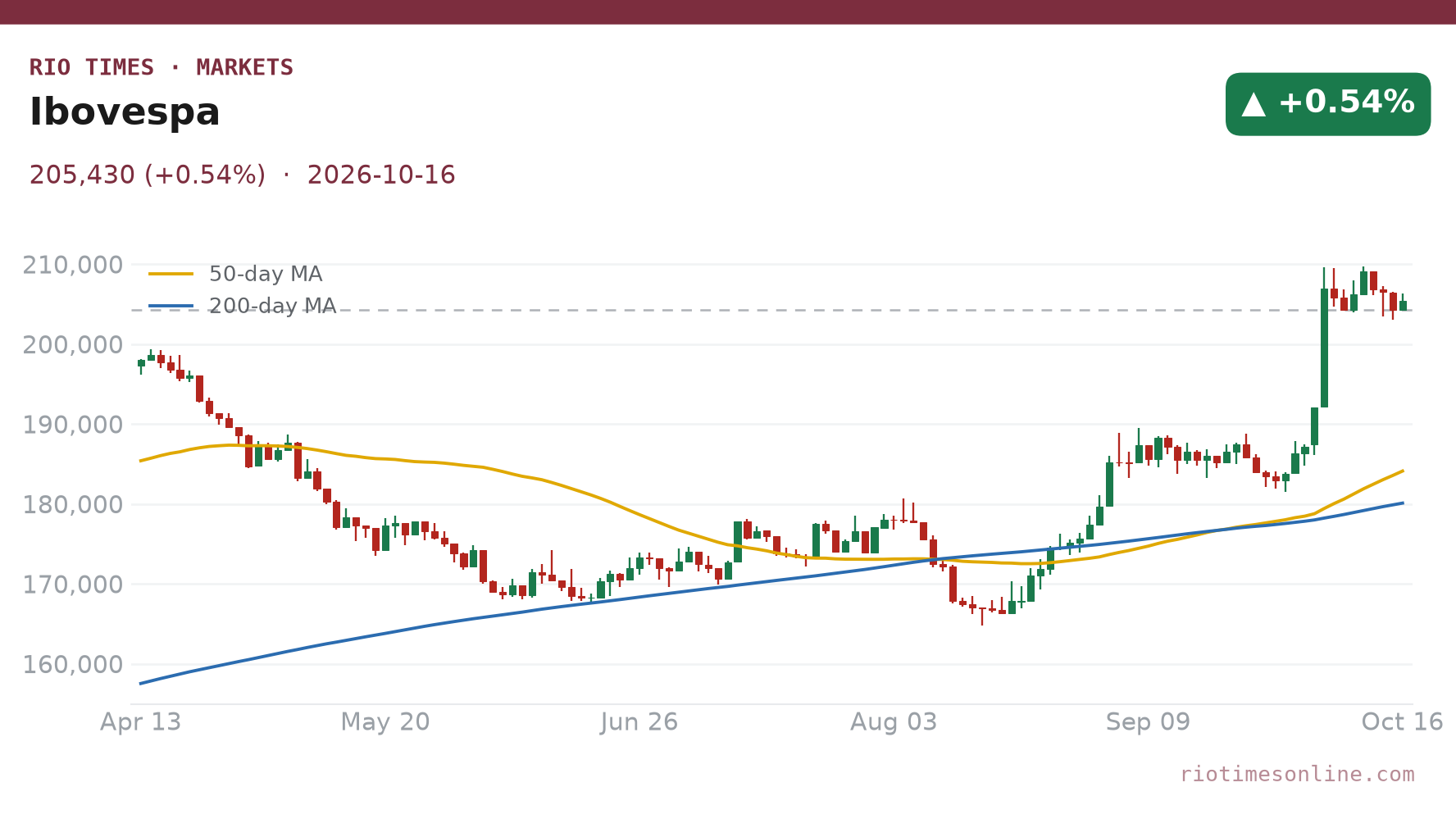
- Brazil’s Ibovespa decoupled on Friday, rising 0.54% while the S&P 500 fell 1.09%, ahead of today’s inflation data and central bank survey.
Today’s Focus
Today’s Latin American open is a tug-of-war between a global technology sell-off and a softer dollar. Asian markets fell again on doubts about the artificial-intelligence trade, while oil stays near US$106 a barrel.
For Brazil, the real and local assets may draw support from high interest rates and dollar weakness. But oil-driven inflation and global tech volatility argue for caution.
Mexico’s peso and Chile’s peso face the same divide, while Argentina and Colombia will watch commodity moves and today’s data closely.
What matters today. Whether the softer dollar can cushion Latin American assets against the global tech sell-off.
| Instrument | Level | Session |
|---|---|---|
| Ibovespa (Brazil) | 205,430 | +0.54% |
| S&P 500 (US) | 7,659 | -1.09% |
| USD/BRL | 5.0627 | -0.67% |
| USD/MXN | 18.493 | +0.43% |
| USD/CLP | 984.83 | +0.37% |
| USD/COP | 3,176 | -0.61% |
| USD/ARS | 1,518 | +0.31% |
Source: market close, 16 October 2026.
01 The overnight tape in one read
The weekend break did little to settle nerves in technology. Asian investors again questioned the artificial-intelligence trade, with Japan’s Nikkei 225 and South Korea’s Kospi trading lower on Monday.
Wall Street set that tone on Friday, when the Nasdaq Composite fell 2.1% and the S&P 500 fell 1.09%. The euro held near US$1.12.
The oil market is the other big signal. Brent crude, the international benchmark, closed Friday at US$107.58 (up 3.4%) and traded near US$106 on Monday, as shipping disruption in the Middle East keeps supply tight.
The dollar is the quiet lifeline for emerging markets. The ICE dollar index fell 0.2% on Friday to 101.84, which generally supports currencies like the real, the Mexican peso and the Chilean peso.
The evidence points to a cautious open. The dollar’s slide is a genuine support for emerging-market currencies, but the Nasdaq’s 2.1% drop on Friday and a further slide in Asian tech show that risk appetite is fragile. The variable to watch is whether Wall Street stabilises in the New York session, because a further fall would likely drag Latin American equities lower despite the currency tailwind.
02 The board before the open
| Instrument | Level | Change | Read |
|---|---|---|---|
| Ibovespa | 205,430 | +0.54% | Brazil decoupled from Wall Street on Friday |
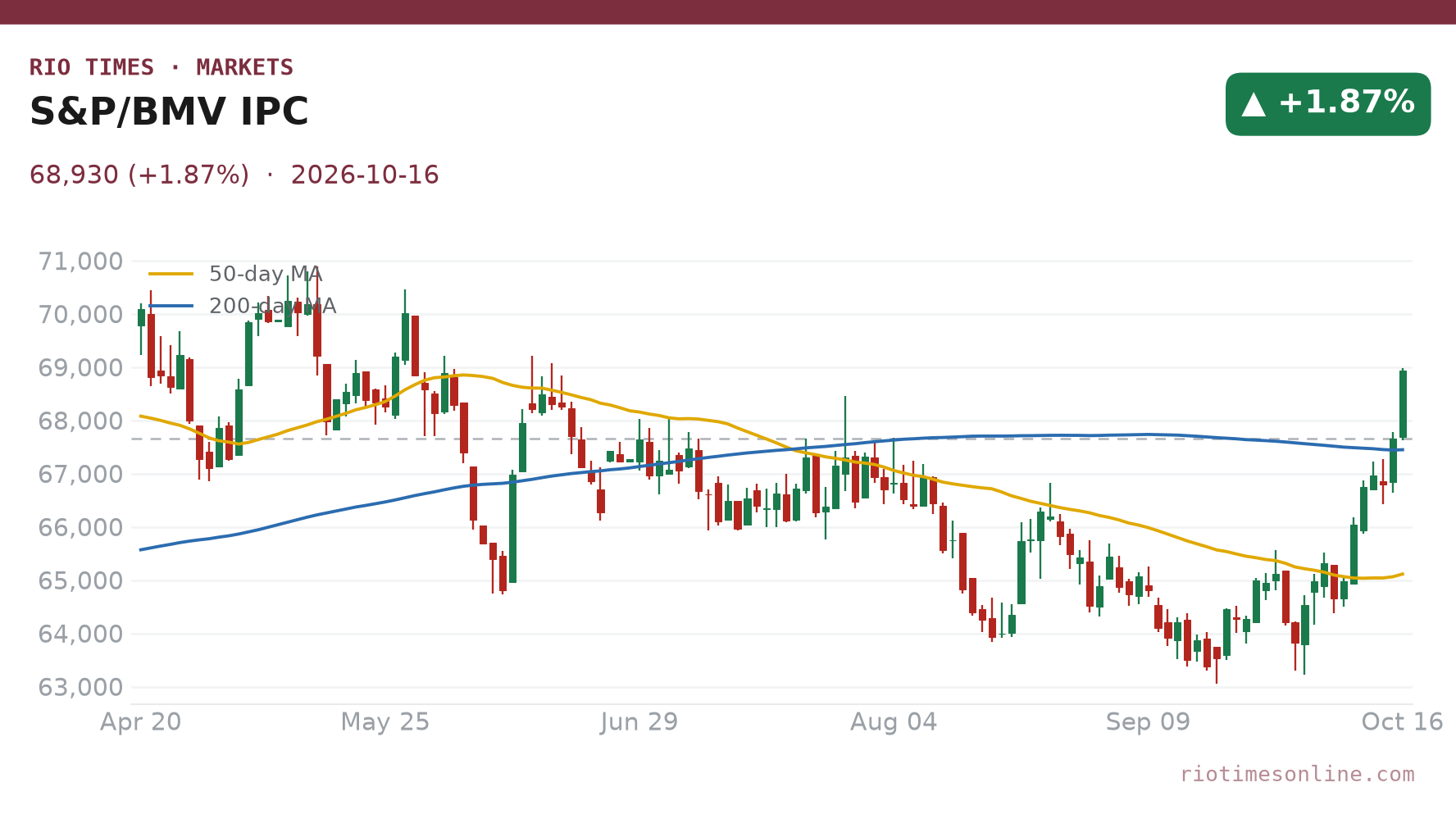
| IPC (Mexbol) | 68,930 | +1.87% | Mexico outperformed, climbing on local strength |
| IPSA | 10,970 | -0.01% | Chile was flat, waiting for direction |
| Merval | 2,848,945 | -0.35% | Argentina eased with commodity pressure |
| VIX | 19.99 | +21.45% | VIX, the US fear gauge, jumped as the S&P 500 fell 1.09% |
The board shows a region that was already trading on its own rhythms before today’s Asian sell-off. Brazil’s Ibovespa gained while US stocks fell sharply, a rare decoupling.
Mexico’s IPC stood out with a strong rise, while Chile and Argentina drifted lower. The Mexican peso, however, weakened 0.43% to 18.49 per US$. Rio Times · Live Market Intelligence
Live Market IntelligenceLatin America — Cross-Market Board
Latin America — Cross-Market Board
Instrument Last Change YoY Prev. High Low Volume
IBOV
205,430.33
+0.54%
+21.85%
204,324.26
168,310
167,142
—
IPSA
10,970.29
-0.01%
—
10,971.88
11,210
10,984
1,513,213,483
IPC MEX
68,929.72
+1.87%
+12.17%
67,663.29
66,121
65,405
108,886,187
MERVAL
2,848,945
-0.35%
+30.51%
3,022,485
3,042,365
2,991,150
—
COLCAP
2,566.28
-0.55%
—
9.04
9.05
9.02
4,133
BVL PERÚ
60,210.69
-0.91%
—
—
—
—
—
USD/BRL
5.16
+0.01%
-5.13%
5.16
5.18
5.14
—
EUR/BRL
5.95
+1.01%
-5.83%
5.89
5.98
5.94
—
USD/MXN
17.06
-0.24%
-8.58%
17.10
17.08
17.01
—
USD/CLP
913.98
+0.04%
-5.67%
913.65
915.11
906.68
—
USD/COP
3,140
+0.03%
-22.04%
3,139
3,141
3,105
—
USD/PEN
3.36
-0.66%
-4.82%
3.38
3.38
3.35
—
USD/ARS
1,493
+0.10%
+12.96%
1,491
1,494
1,480
—
USD/UYU
40.27
+1.24%
+1.80%
39.77
40.27
40.23
—
USD/PYG
5,939
+1.68%
-19.54%
5,841
5,939
5,925
—
USD/BOB
11.64
-0.76%
+72.04%
11.73
11.72
11.64
—
USD/DOP
58.34
+1.25%
-3.44%
57.62
58.34
58.04
—
USD/CRC
445.92
+0.89%
-9.71%
441.97
448.50
445.92
—
03 What the data shows — Petrobras led a domestic rotation
| Stock | Move | Turnover | Note |
|---|---|---|---|
| PETR4 | +4.0% | about R$3.3bn | Petrobras preferred shares, the turnover leader |
| PETR3 | +3.5% | about R$0.6bn | Petrobras ordinary shares followed higher |
| MGLU3 | +6.9% | about R$0.64bn | Magazine Luiza rose on heavy trading |
| BRKM5 | -6.5% | about R$0.03bn | Braskem fell sharply |
The B3 scan shows money rotating toward energy and consumer names. Petrobras, the state-controlled oil giant, led trading with a strong gain, while retailer Magazine Luiza rose 6.9%.
Braskem’s 6.5% drop is a reminder that not every Brazilian story is rosy. Turnover figures are estimates from RT volume and closing prices.
04 Brazil and the currencies
The real’s setup is the clearest carry-trade test in the region. The currency strengthened 0.67% on Friday to 5.06 per US$, helped by a softer dollar and Brazil’s high interest rates.
But elevated oil is a double-edged sword. It adds to inflation worries, yet it supports Petrobras shares and export revenues.
Mexico’s peso weakened 0.43% on Friday, to 18.49 per US$, and Chile’s peso weakened 0.37% to 984.83. Chile’s peso is more exposed to copper and Chinese demand, which adds another variable to today’s open.
Brazil’s central bank publishes its weekly Focus survey today at 8:25 BRT, and FGV releases October IGP-10 inflation at 8:00 BRT. Brazil’s IBC-Br economic activity index rose 0.3% in August, in line with forecasts, after July was revised to a 0.4% fall.
05 The regional setup
| Index | Country | Change |
|---|---|---|
| Ibovespa | Brazil | +0.54% |
| IPC | Mexico | +1.87% |
| IPSA | Chile | -0.01% |
| Merval | Argentina | -0.35% |
Mexico is the region’s bright spot, with its IPC up 1.87% on Friday even as the peso slipped. The tech sell-off could hit Mexico’s manufacturing-linked stories, but a softer dollar offers an offset.
Argentina’s primary budget surplus for September was ARS 1,427.6 billion (about US$940 million at 1,517.75 pesos per US$), with a budget balance after interest of ARS 977 billion, according to the Economy Ministry. Today’s September balance of trade is due at 16:00 BRT, with consensus at 2,500 and the previous reading at 2,187 (US$ million).
Colombia’s retail sales rose 7.3% in August, below the 8.5% forecast, while industrial production fell 3.7% against a forecast fall of 2.1% (DANE). Today’s ISE economic activity index for August (consensus 1% year on year, previous 1.11%) is due at 12:00 BRT.
Ecuador’s balance of trade for August is due at 11:00 BRT (consensus 300, previous 504.4, US$ million).
06 The technical picture
The Ibovespa’s Friday close of 205,430 left it about 1.7% below its one-year high close of 209,067 on 9 October. A failure to hold gains would signal that the decoupling from Wall Street was temporary.
The VIX jumped 21% to just under 20, which is elevated but not yet panic territory. For Latin American indices, that means volatility is rising.
The dollar’s 0.2% Friday decline is the key support for emerging currencies. If the ICE dollar index breaks lower, expect a fresh bid for the real and the peso, and if it reverses, carry trades could unwind quickly.
07 What to watch
- Wall Street’s tone: Whether US stocks stabilise after Friday’s tech-led drop will set the mood for all five Latin American exchanges at the open.
- Brazil’s IGP-10 and Focus survey: FGV’s inflation gauge (8:00 BRT) and the central bank’s survey (8:25 BRT) will show if inflation expectations are shifting.
- Oil’s next move: Brent near US$106 is a pivot; a fall would ease inflation worries but hurt energy-heavy markets like Colombia and parts of Brazil.
- Dollar index direction: A break below recent dollar support would boost the real, peso and other emerging currencies across the region.
Background: LatAm Opens After Brazil Stocks Fall 1.06%.
Background: LatAm Opens After Asia Sell-Off as Nasdaq Falls 2.1%.
Frequently Asked Questions
Why did Brazil’s Ibovespa rise while US stocks fell on Friday?
Brazil’s market moved against Wall Street, with Petrobras and retail shares leading gains, while high interest rates keep carry trades attractive.
What does the AI sell-off mean for Latin America?
It signals lower global risk appetite, which can pressure Latin American equities. The region has few pure AI plays, so the impact runs mostly through sentiment and currencies.
Is expensive oil good or bad for the region?
It is mixed. Oil exporters such as Colombia’s Ecopetrol, Mexico’s Pemex and Brazil’s Petrobras gain revenue, while importers such as Chile face higher inflation pressure.
Why does the dollar matter for Latin American markets?
A softer dollar makes local currencies more attractive and supports carry trades, which bring foreign money into Brazilian, Mexican and Chilean assets.
Market data: RT
This article was produced by The Rio Times’ automated newsroom system. How we use AI · Report an error · Editorial responsibility: Matthias Camenzind, Editor-in-Chief
LatAm Markets: Live Signals → — real-time movers, turnover leaders and FX across Latin America.