SpaceX launches first satellite developed by Brazilian startup into space
RIO DE JANEIRO, BRAZIL – The Falcon 9 rocket of the private company SpaceX launched Thursday from Cape Canaveral (U.S.), carrying a small satellite developed by the Brazilian startup Pion Labs into orbit.
“This is a milestone for Brazil. It is the first startup in the country to put a satellite into space,” Paulo Barros, director of portfolio management at the Brazilian Space Agency (AEB), was quoted as saying in a statement from the agency.
“It is a pocket satellite that we call PocketSat (Picosatellite), and it was developed entirely in Brazil. It is essential for the country to have a startup already capable of launching one of these satellites,” Barros added.

Pion-Br1, a picosatellite designed to explore remote transmission capabilities during its two-year lifespan, was one of 105 small satellites from private and government customers launched Thursday into heliosynchronous orbit as part of SpaceX’s Transporter 3 mission.
Among the satellites that were part of the Falcon 9 rocket’s payload were six of the 80 satellites that Spanish company Fossa Systems plans to launch by 2023 to enable Internet of Things (IoT) connectivity, as well as the miniature General San Martín satellite that the Argentine government intends to use to provide Internet access to agricultural producers in rural areas across the country.
The Pion-Br1, with a volume of just 125 cubic centimeters, was developed and assembled in the laboratory of the small Brazilian technology company in Sao Caetano do Sul, a town in the metropolitan region of São Paulo.
“On behalf of the Brazilian Space Agency, I would like to congratulate the young entrepreneurs of the Pion Labs startup for their achievement,” AEB’s Satellite and Applications Coordinator Rodrigo Leonardi said in the same statement.
Pion, named after Brazilian physicist César Lattes, who is co-responsible for discovering the subatomic particle Meson Pi (Pion), was founded in 2017 to develop rockets to be presented at the Spaceport American Cup (SAC), an annual event held in the United States.
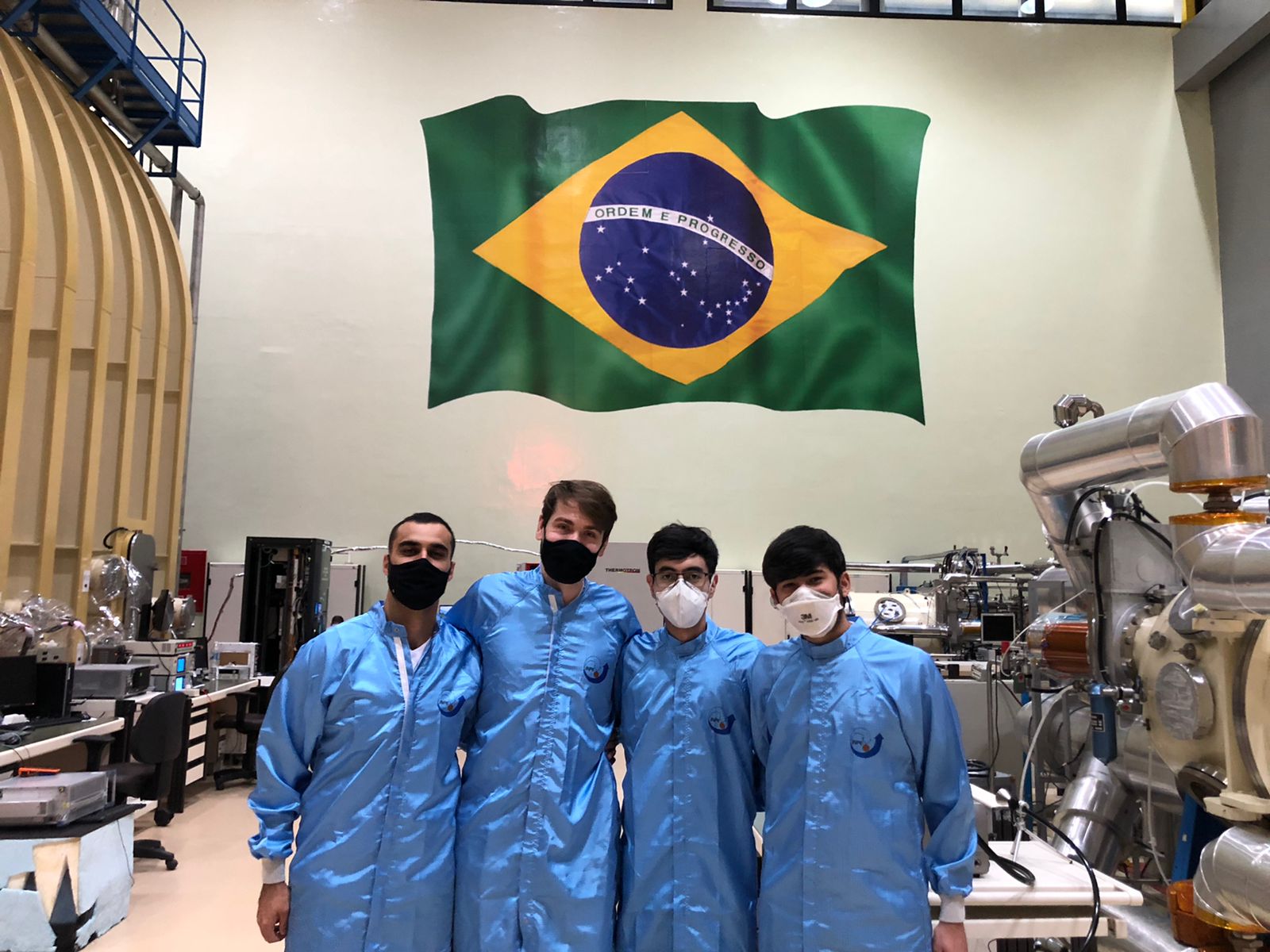
In 2020, the small company won a bid from Brazil’s Ministry of Science and Technology, which provided funding to develop and launch its satellite.
Developed in just seven months by the company’s founders Calvin Trubiene, Bruno Pinto Costa, Gabriel Yamato, and Joao Pedro Vilas Boas, the device is designed to explore the capacity of remote communications for future development of a new era in this segment in Brazil.
The technology will allow it to collect and analyze data on long-distance communication capacity and study this type of transmission.
“In the long term, we want to perfect these findings and translate them into solutions for sustainability and security monitoring, as demanded by many players in the agribusiness and for the protection of the Amazon,” Trubiene explains. “At a later stage, we are also thinking about expanding our activities to other Latin American countries,” he added.
SpaceX’s transporter missions are split trips, with private and public entities covering the approximate cost of more than US$50 million to put cargo into orbit.
Thursday’s launch is the second this year, following last week’s launch from Kennedy Space Center, also at Cape Canaveral, of another series of nearly 50 Starlink satellites for SpaceX’s Internet satellite network.
More: Brazil news in English, every day from The Rio Times.
This article was produced by The Rio Times’ automated newsroom system. How we use AI · Report an error · Editorial responsibility: Matthias Camenzind, Editor-in-Chief
LatAm Markets: Live Signals → — real-time movers, turnover leaders and FX across Latin America.