Best Brazil Stocks on B3 for Foreign Investors in 2026
Key Facts
—Ibovespa P/E (mid-2026):. ~7–9x — deep discount to S&P 500 (20x+) and MSCI EM (11–13x).
—Dividend yields on B3:. 5–8% index-wide in BRL; individual names (PETR4, VALE3, BBAS3) can reach 8–20% in commodity upcycles.
—Index weighting:. Petrobras + Vale + major banks = ~40–55% of the Ibovespa — understanding these names means understanding the index.
—US-accessible tickers:. PBR/PBR.A (Petrobras), VALE (Vale), ITUB (Itaú), BBD (Bradesco), NU (Nubank), EBR (Eletrobras), ERJ (Embraer).
—B3-only names:. BTG Pactual (BPAC11), Magazine Luiza (MGLU3), Lojas Renner (LREN3), JBS (JBSS3), Sabesp (SBSP3).
Brazil’s best stocks are not software platforms or luxury conglomerates — they are iron ore mines, oil wells, banks with margins that would seem extraordinary in developed markets, and meat-processing plants feeding protein to China. That is not a flaw. It is a structural feature of a resource-rich, demographically young, financially deepening economy, and it creates opportunities genuinely absent from the indices investors know best. This sector-by-sector guide covers every major name on B3: tickers, investment cases, dividend profiles, US-accessibility, and the specific risks that go with each.

How the Ibovespa Works — and Why It Looks Nothing Like the S&P 500
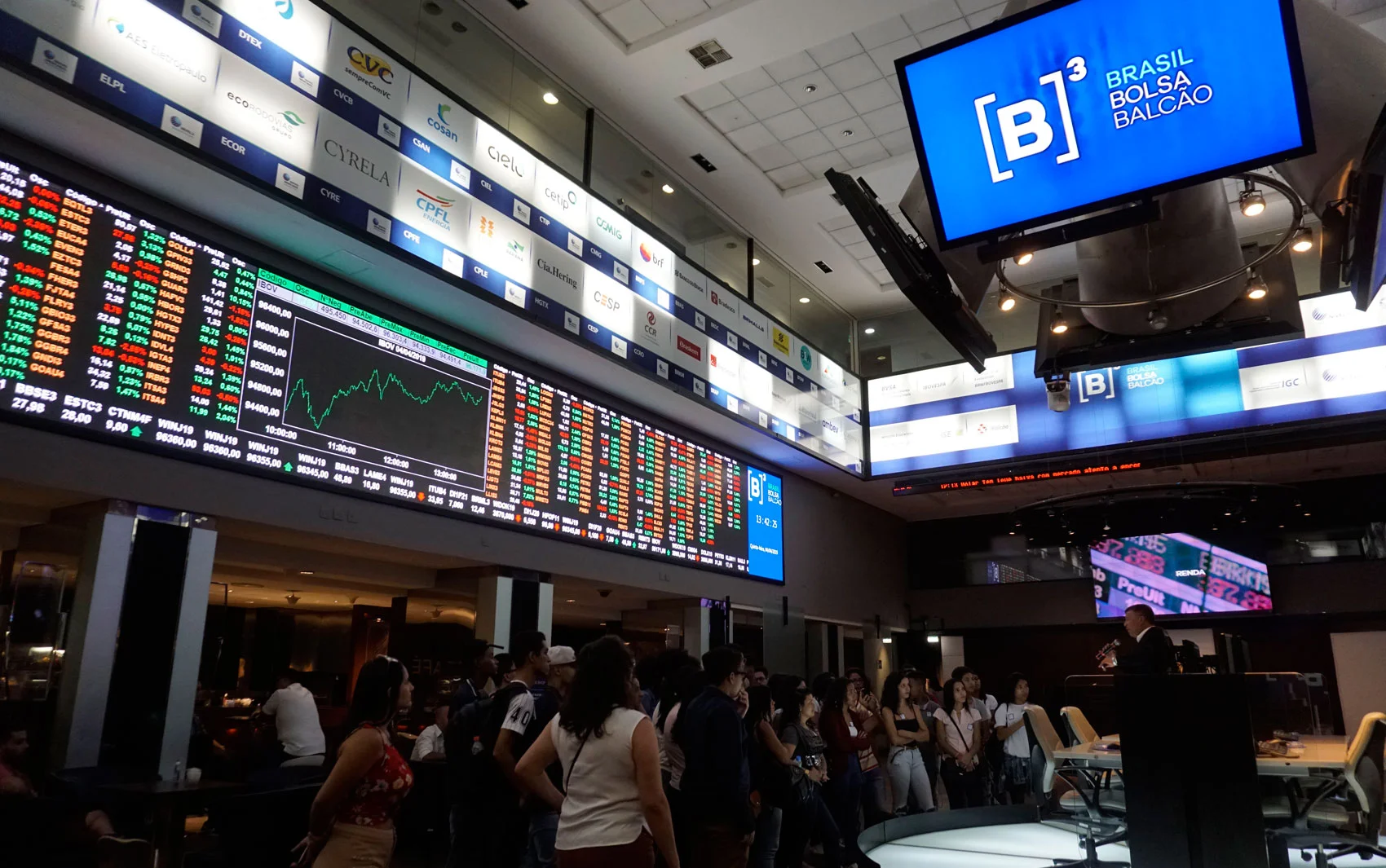
The Ibovespa (IBOV) is B3’s flagship benchmark. Unlike the S&P 500, which is market-capitalization-weighted, the Ibovespa uses a liquidity-based methodology: weights reflect each stock’s share of B3’s total trading volume over the preceding twelve months.
It is reviewed four times per year (January, May, July, September). Stocks must have traded in at least 95% of sessions, represent at least 0.1% of total volume, and trade above R$1.00. As of mid-2026, approximately 87–130 stocks qualify, covering over 80% of B3’s total trading value.
The critical structural difference from developed-market indices: technology is nearly absent. Petrobras, Vale, and the major banks — six to eight names — account for 40–55% of the entire index.
Live Market IntelligenceBrazil — Live Market Board
Rio Times · Live Market Intelligence
Brazil — Live Market Board
+0.54%
205,430.33
+0.54%
68,929.72
+1.87%
10,970.29
-0.01%
2,848,945
-0.35%
2,566.28
-0.55%
60,210.69
-0.91%
| Instrument | Last | Change | YoY | Prev. | High | Low | Volume |
|---|---|---|---|---|---|---|---|
| IBOV | 205,430.33 | +0.54% | +21.85% | 204,324.26 | 168,310 | 167,142 | — |
| USD/BRL | 5.16 | +0.01% | -5.13% | 5.16 | 5.18 | 5.14 | — |
| SELIC | 14.00% | — | — | — | — | — | |
| PETR4 | 41.64 | -0.05% | +35.19% | 41.66 | 41.97 | 41.15 | 41,499,400 |
| VALE3 | 72.97 | +0.83% | +30.75% | 72.37 | 73.54 | 72.66 | 17,658,000 |
| ITUB4 | 38.60 | -1.03% | +4.57% | 39.00 | 39.34 | 38.39 | 29,487,800 |
| BBDC4 | 16.85 | +0.36% | +3.50% | 16.79 | 16.90 | 16.67 | 19,416,900 |
| BBAS3 | 19.37 | +0.47% | +0.73% | 19.28 | 19.44 | 19.16 | 11,069,200 |
| B3SA3 | 14.26 | -0.21% | +12.73% | 14.29 | 14.47 | 14.11 | 33,037,800 |
| ABEV3 | 14.89 | -0.80% | +21.91% | 15.01 | 15.07 | 14.81 | 16,453,100 |
| WEGE3 | 47.59 | +0.49% | +29.99% | 47.36 | 48.08 | 47.36 | 3,364,600 |
| PRIO3 | 59.14 | -0.19% | +50.67% | 59.25 | 59.81 | 58.74 | 3,325,600 |
| SUZB3 | 41.33 | +2.35% | -23.55% | 40.38 | 41.48 | 40.35 | 3,914,900 |
| RENT3 | 34.68 | -0.09% | +0.84% | 34.71 | 34.96 | 34.35 | 7,979,100 |
| AZZA3 | 15.89 | -2.63% | -53.76% | 16.32 | 16.42 | 15.82 | 1,330,300 |
| CSNA3 | 4.30 | +0.47% | -42.65% | 4.28 | 4.41 | 4.26 | 10,076,100 |
| GGBR4 | 24.69 | +2.19% | +51.38% | 24.16 | 24.85 | 24.18 | 7,047,600 |
| ENEV3 | 24.21 | -1.38% | +70.49% | 24.55 | 24.64 | 23.99 | 9,297,000 |
Energy & Oil: Petrobras (PETR4 / PBR.A)
No Brazilian equity analysis starts anywhere except Petrobras. The company’s pre-salt basin off Brazil’s southeastern coast holds some of the world’s most productive oil reserves, with lifting costs below $5/barrel at peak efficiency. It generates substantial free cash flow at virtually any oil price above $50/barrel.
Two share classes: PETR3 (common, voting, less liquid) and PETR4 (preferred, no vote, priority dividend, more liquid). On the NYSE: PBR = PETR3, PBR.A = PETR4 (each ADR = 2 underlying shares).
The federal government owns ~36.6% of total capital and directly influences dividend policy — a real, recurring governance risk.
Petrobras dividend yields of 15–25% in BRL have occurred at high oil prices; the Lula government revised the dividend formula downward in 2023 and the share price fell sharply. Typical valuation: P/E 4–7x, EV/EBITDA 3–5x — a 50–70% discount to international oil majors. Whether that discount is compensation for risk or deep value depends on your reading of Brazil’s political cycle.
Mining & Commodities: Vale (VALE3 / NYSE: VALE)
Vale is the world’s largest iron ore producer and a major nickel, copper, cobalt, and manganese producer. B3 ticker: VALE3.
NYSE ADR: VALE (1:1 ratio). Its Carajás ore — among the world’s highest grade — ships primarily to China, creating a direct correlation between Vale’s earnings and Chinese steel demand.
When China’s property sector booms, Vale’s margins are extraordinary; when China slows (as it has since 2021), margins compress and dividends are reduced.
Brumadinho context: Vale’s January 2019 tailings dam collapse killed 270 people and resulted in over R$47 billion in fines and remediation. Investors should treat this as a permanent feature of the risk profile — demonstrating that Brazil’s mining sector carries real safety and regulatory liability risk.
Dividend yields have ranged from 6–18% depending on the iron ore cycle; policy links payments to free cash flow generation.
Banking: Itaú, Bradesco, Banco do Brasil, BTG Pactual
Brazil’s banking sector is among the most profitable and concentrated in any major emerging market. Five institutions control ~80% of bank assets.
Itaú Unibanco (ITUB4 / NYSE: ITUB): Latin America’s largest private bank; ROE consistently 20–25%; P/BV 1.5–2.5x; dividend yield 4–7%. Quarterly JCP + dividend payments. Heavy digital investment through iti app.
Bradesco (BBDC4 / NYSE: BBD): Second-largest private bank; larger SME and insurance exposure; ROE 15–20%; P/BV 0.8–1.4x; elevated NPLs in 2023–2024.
Banco do Brasil (BBAS3 / OTC: BDORY): Largest bank by assets; ~66% government-owned; trades at persistent discount but ROE approaching 20%; highest dividend yield of the group at 7–12% — often the best income-yield bank in the cohort.
BTG Pactual (BPAC11): Brazil’s largest investment bank; corporate banking, capital markets, asset management, BTG+ digital retail; ROE 22–28%; P/BV 2.0–3.5x; no major US listing — B3 account required.
Fintech & Digital: Nubank (NYSE: NU / B3 BDR: NUBR33)
Nubank (Nu Holdings Ltd.) is the world’s largest digital bank by customer count outside China — over 100 million customers in Brazil, Mexico, and Colombia as of 2026. Its primary listing is on the NYSE as NU; any international investor with a standard brokerage account can buy it directly without a Brazilian account or CPF. Brazilian investors access it via the NUBR33 BDR on B3.
The company launched in 2013 as a no-fee credit card challenger, turned net-income positive in 2023, and has since expanded margins as revenue per customer grows through cross-selling of loans, savings, and investment products.
Key metrics: average revenue per active customer (ARPAC), net interest margin on credit products, and expansion velocity in Mexico and Colombia — where Nubank is replicating its Brazilian playbook against similarly concentrated incumbent banking sectors.
Agriculture & Food: JBS (JBSS3) and SLC Agrícola (SLCE3)
JBS (JBSS3): The world’s largest meat-processing company by revenue; brands include Friboi, Swift, Pilgrim’s Pride; operations span beef, pork, poultry, lamb across the US, Brazil, Australia, Europe. The majority of revenue is USD-denominated — a natural currency hedge for USD-based investors when BRL weakens.
Governance note: J&F Investimentos (Batista family) paid Brazil’s largest-ever leniency fine following a 2017 corruption investigation; management has been overhauled but the ownership structure warrants monitoring. No full US listing (JBS US IPO was blocked by US regulators); Pilgrim’s Pride (PPC, Nasdaq) is a JBS subsidiary but tracks poultry only.
SLC Agrícola (SLCE3): One of Brazil’s largest and most professionally managed grain and cotton farming companies, operating in the cerrado. A pure-play on Brazilian agricultural productivity and global grain prices (soybeans, corn, cotton) — cleaner commodity exposure than a vertically integrated processor like JBS.
Utilities: Eletrobras, Cemig, Sabesp
Eletrobras (ELET3 / ELET6 / NYSE: EBR): Brazil’s largest electric utility; privatized in June 2022 in the country’s largest-ever privatization (~R$33 billion capital raise). The investment thesis rests on operational efficiency improvements post-privatization and the value of its enormous hydropower and transmission asset base.
Regulated under ANEEL; complex concession agreements.
Cemig (CMIG4): Minas Gerais state electric utility; consistent dividend payer; state government retains controlling stake creating governance discount.
Sabesp (SBSP3): São Paulo state water and sewage utility; partially privatized in 2024 following the Eletrobras model. Post-privatization investment thesis centers on Brazil’s chronic underinvestment in sanitation infrastructure — the new private management expected to deploy capital more efficiently than the state.
Telecom: TIM Brasil (TIMS3) and Vivo / Telefonica Brasil (VIVT3)
TIM Brasil (TIMS3 / NYSE: TIMB): Brazilian subsidiary of Telecom Italia; one of three major mobile operators after post-2022 market consolidation. Aggressive 5G buildout; dividend yield 4–7%. NYSE ADR ratio: 1 TIMB = 5 TIMS3.
Vivo / Telefonica Brasil (VIVT3): Largest Brazilian telecom by revenue; Telefonica Spain subsidiary; operates both mobile and fiber-to-the-home broadband (VIVO Fibra); consistent dividend yield 5–8%; well-positioned for the copper-to-fiber infrastructure shift. Both names are relatively defensive vs. commodity stocks — less correlated with oil and iron ore cycles, more predictable revenue streams.
Top Dividend Payers on B3
Brazil’s structural bias toward high dividend payments reflects high SELIC rates (investors demand income), the cash-generative nature of commodity and banking oligopolies, and historically dividend-friendly tax treatment (under periodic legislative review).
Approximate yields under normal operating conditions: PETR4 (Petrobras preferred) 8–20%; VALE3 (Vale) 6–18%; BBAS3 (Banco do Brasil) 7–12%; CMIG4 (Cemig) 7–11%; ITUB4 (Itaú) 4–7%; BBDC4 (Bradesco) 5–8%; ELET6 (Eletrobras preferred) 4–8%; VIVT3 (Vivo) 5–8%; TIMS3 (TIM) 4–7%.
Note: Brazilian banks pay both dividends and JCP (Juros sobre Capital Próprio — Interest on Net Equity), a unique Brazilian mechanism treated as a financial expense for the company and subject to 15% withholding at shareholder level. From an investment income standpoint, dividends and JCP are functionally equivalent for foreign investors.
Valuation Context: Is the Ibovespa Actually Cheap?
The Ibovespa trades at trailing P/E of approximately 7–9x as of mid-2026, vs. 20x+ for the S&P 500 and 11–13x for the MSCI EM index. Price-to-book: ~1.5–2.0x (vs. 4–5x for S&P 500). Dividend yield: 5–8% in BRL (vs. 1.3–1.5% for S&P 500 in USD).
The discount is real — and so are the reasons: BRL has depreciated significantly against USD over most multi-year periods; state-controlled companies command lower multiples; SELIC at 14.75% means investors demand high equity earnings yields to justify owning stocks over risk-free government bonds; and the Americanas scandal raised questions about Brazilian accounting quality in mid-cap retail.
The bull case: single-digit P/E multiples provide a valuation floor against multiple compression; commodity-linked dividends at 8–20% can generate outstanding total returns if you time the entry to the cycle; a BRL appreciation period plus SELIC normalization plus commodity upcycle is a powerful combination for USD-based investors who get the macro thesis right.
US-listed access points: PBR.A (Petrobras preferred ADR), VALE (Vale ADR), ITUB (Itaú ADR), NU (Nubank NYSE) — available on any US brokerage.Brazil ETFs (no Brazilian account needed): EWZ (iShares MSCI Brazil ETF) and FLBR (Franklin FTSE Brazil ETF) trade on NYSE Arca.B3 account required for: BTG Pactual (BPAC11), Magazine Luiza (MGLU3), Lojas Renner (LREN3), JBS (JBSS3), Cemig (CMIG4), Sabesp (SBSP3).Track COPOM decisions: Rate decisions at bcb.gov.br — rate cut cycles are historically positive for Ibovespa multiple expansion.Further reading on this site: How to Invest in B3/Bovespa as a Foreigner · BRL to USD Exchange Rate Guide 2026
This article is for informational and educational purposes only and does not constitute investment, tax, or financial advice. Brazilian equity markets carry significant volatility, currency, political, and regulatory risk. All valuations and yields are approximate mid-2026 estimates — verify current figures before investing. Consult qualified financial advisors before making investment decisions. Last updated: August 2026.
Frequently Asked Questions
Is Petrobras a good investment for foreigners?
Compelling asset, real governance risks. The pre-salt basin is world-class with some of the lowest production costs globally. The risk is government ownership: dividend policy, fuel pricing, and capital allocation can be redirected by any Brazilian administration, as demonstrated by Lula’s 2023 dividend formula revision. Most investors hold PETR4/PBR.A and treat it as a high-yield, higher-volatility position rather than a defensive core holding.
How do I buy Nubank on B3?
You do not need to use B3. Nubank (Nu Holdings Ltd.) is incorporated in the Cayman Islands with its primary listing on the NYSE under ticker NU. Buy it through any standard US or international brokerage — no Brazilian account, CPF, or special setup required. Brazilian investors who prefer BRL-denominated exposure can use the NUBR33 BDR on B3.
What is JCP and how does it affect dividend yields?
JCP (Juros sobre Capital Próprio) is a uniquely Brazilian mechanism for returning capital to shareholders. It is treated as a financial expense for the paying company (reducing its taxable income) and is subject to 15% withholding at the shareholder level. Brazilian bank statements show dividends and JCP as separate line items, but for investment income purposes they are functionally equivalent. The combined dividend + JCP yield is what investors should compare when evaluating income-oriented Brazilian bank stocks.
Are Brazilian dividends taxed for foreign investors?
Yes. Brazil imposes 15% withholding tax on dividends and JCP paid to non-residents, deducted at source before crediting your account. For US investors, this can generally be claimed as a foreign tax credit on your federal return. Brazil’s dividend tax policy has been under legislative review; verify the current regime with a Brazilian tax professional at the time of investment.
→ How to Invest in the Brazilian Stock Market (B3/Bovespa) as a Foreigner
→ Brazil’s Tesouro Direto: Can Foreigners Invest in Government Bonds?
→ BRL to USD: Understanding the Brazilian Real Exchange Rate (2026 Guide)
→ Argentina’s Economic Crisis: What It Means for Brazil and Investors (2026)
This article was produced by The Rio Times’ automated newsroom system. How we use AI · Report an error · Editorial responsibility: Matthias Camenzind, Editor-in-Chief
LatAm Markets: Live Signals → — real-time movers, turnover leaders and FX across Latin America.
Expat Guide to Brazil
What The Rio Times publishes for foreigners who live in or move to Brazil.
Start here
- Do US Citizens Need a Visa for Brazil? Yes, US$80.90 E-Visa
- Brazil Education and Healthcare Explained
- Brazil Security and Crime Explained 2026
- Brazil Rent and Power Bills After 4.58% Inflation
City guides
Rio de Janeiro, São Paulo, Florianópolis, Salvador, Belo Horizonte, Curitiba, Porto Alegre, Brasília
Coming up in Brazil
- Copa Sudamericana Semi-Final Return Legs: Times and US TV 20 Oct
- Pussycat Dolls in São Paulo, Brazil: Reunion Show at Nubank Parque on October 20, 2026 20 Oct
- What to Do in Porto Alegre in October 2026 21 Oct
- Brazil Runoff Date and Results Time: 25 October, 4 p.m. ET 25 Oct
Understand Brazil