Peru El Niño Emergency: 893 Districts in 22 Regions Now Under Formal Decree
PERU · EL NIÑO
Key Facts
Now formal: Supreme Decree 124-2026-PCM, published in the official gazette El Peruano on 1 September 2026, declares a state of emergency in 893 districts of 154 provinces across 22 regions, plus the constitutional province of Callao.
Duration: 60 calendar days, for immediate exception measures against the imminent danger of intense rains linked to El Niño 2026–2027.
An update: The cabinet was still weighing the draft on 31 August, as we reported this morning. Publication in the gazette makes it binding.
Fiscal squeeze: The decree is financed from existing institutional budgets — no new Treasury money — while the 2026 housing fund has already been cut by more than half.
The forecast: ENFEN keeps Peru on Coastal El Niño Alert and sees a roughly 62 percent probability of an extraordinary-magnitude event between September 2026 and January 2027.
Peru formally declared a 60-day El Niño emergency in 893 districts of 22 regions plus Callao on 1 September 2026, hours after the cabinet debated the draft — with no fresh money attached and housing budgets already halved.
Peru El Niño Emergency: From Draft to Decree in Hours
What was a proposal on Sunday night is law as of Tuesday. Peru’s government published Supreme Decree 124-2026-PCM in the official gazette El Peruano on 1 September 2026, formally declaring a state of emergency over the imminent danger of intense rainfall associated with the 2026–2027 El Niño, the gazette and daily La República reported.
The Peru El Niño emergency covers 893 districts in 154 provinces of 22 regions — Amazonas, Áncash, Apurímac, Arequipa, Ayacucho, Cajamarca, Huancavelica, Huánuco, Ica, Junín, La Libertad, Lambayeque, Lima, Loreto, Madre de Dios, Moquegua, Pasco, Piura, San Martín, Tacna, Tumbes and Ucayali — plus the Constitutional Province of Callao. Eighteen districts of Metropolitan Lima are on the list, among them Comas, San Juan de Lurigancho, Ate, Rímac, Los Olivos, Lurín and Punta Hermosa.
As we reported this morning, the Council of Ministers had debated the draft in an extraordinary, non-in-person session on 31 August. At that point the document covered districts in 22 of Peru’s 25 regions plus Callao and had not yet been signed. The published decree confirms that scope and puts the number of districts at 893.
What the Decree Orders — and What It Does Not Fund
The decree instructs regional and local governments to execute “immediate and necessary” exception measures to reduce the existing very high risk, as well as response and rehabilitation work. The National Civil Defense Institute (INDECI) provides technical coordination and follow-up, with the participation of the ministries involved and other public and private institutions. Every action must have a direct causal link to the event and can be modified as needs evolve, provided competent technical bodies back the change.
Crucially, the financing clause states that implementation will be charged to the institutional budgets of the entities involved, “without demanding additional resources from the Public Treasury.” In plain terms: the emergency unlocks speed and extraordinary procedures, but not new money. Ministries, regional governments and municipalities must reshuffle what they already have.
A state of emergency also allows the state to fast-track procurement and, where ordered, deploy the armed forces in support of the police. It follows four supreme decrees of 23 August — three for 60 days each, plus a 120-day fishing emergency — and an earlier declaration of 2 July, Supreme Decree 097-2026-PCM, which placed 796 districts of 22 regions under emergency for 60 days. The new decree widens that net to 893 districts.
Halved Housing Budgets Meet a 25-Year Savings Low
The decree lands on an already strained fiscal position. Fiscal Council president Alonso Segura warned last week that El Niño “finds us with savings at their lowest point in almost 25 years.” The farming guilds grouped in AGAP have committed S/108 million (about US$32 million) of private money for prevention works and donations, at roughly 3.37 soles to the dollar according to Bloomberg Línea on 1 September 2026.
Housing is where the austerity is most visible. The approved 2026 budget for the Fondo Mi Vivienda stands at S/1,000 million (about US$297 million), down from S/2,200 million (about US$653 million) executed in 2025 — a cut of more than half. José Espantoso, president of the Confederation of Real Estate Developers, told Canal N the reduction could leave around 30,000 families without access to formal housing, hitting both the Techo Propio program and new-home buyers. El Comercio has separately warned that the near-50 percent cut in housing subsidies could stall social housing from April 2026.
The stakes are large: Peru’s housing deficit is estimated at 1.9 million units, and real estate is the country’s second-largest destination for private investment after mining, generating more than 280,000 jobs. Analysts note that 93 percent of urban growth over the past two decades has been informal — precisely the kind of settlement most exposed to flash floods and mudslides.
The Forecast Behind the Move
The ENFEN multisectoral commission, in its update of 28 August 2026, keeps the country on Coastal El Niño Alert. It assigns a roughly 62 percent probability to an extraordinary-magnitude event between September 2026 and January 2027, and expects strong-to-extraordinary conditions in February and March 2027. In the central Pacific (Niño 3.4 region), the probability of a very strong event for September to January is at least 58 percent.
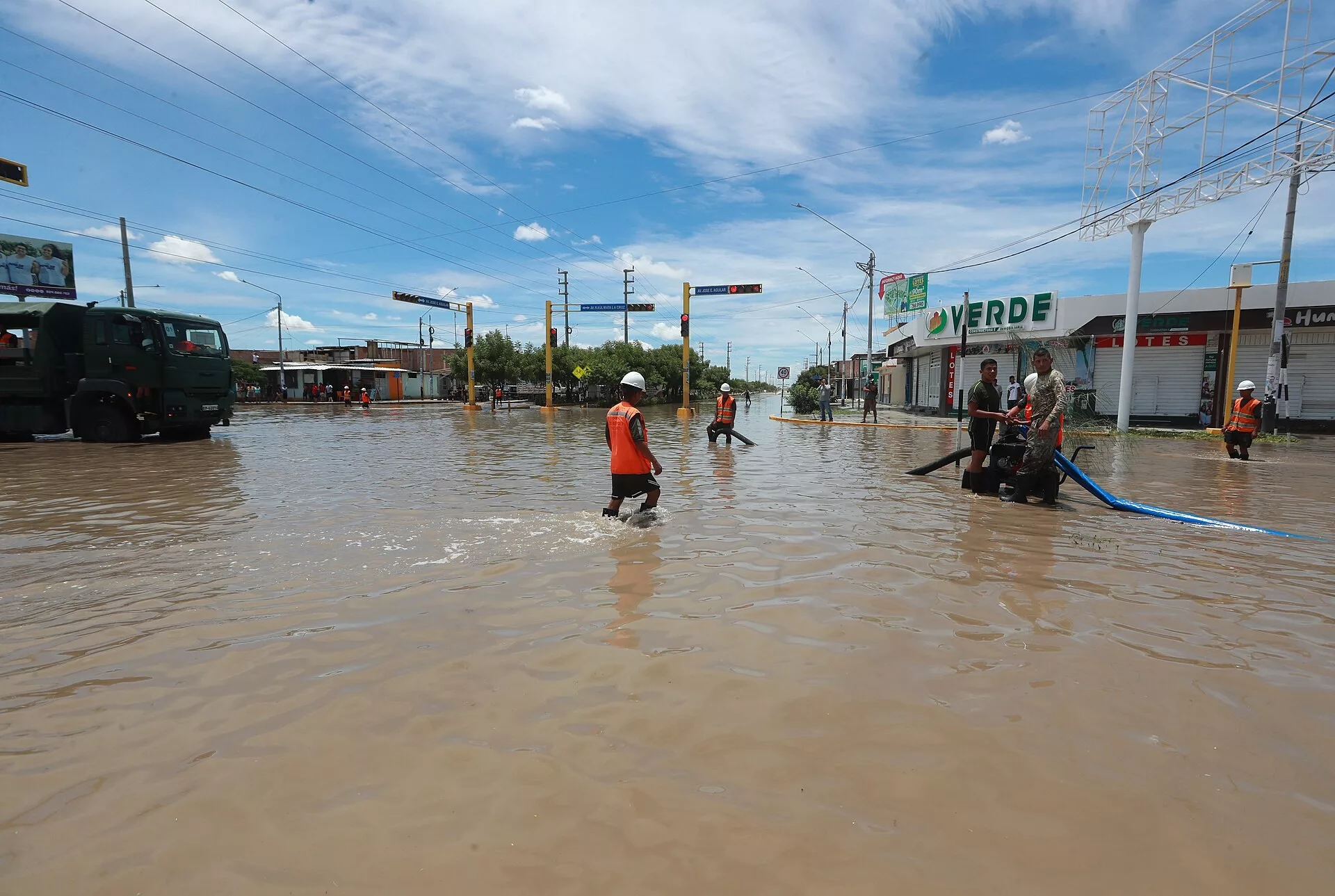
Peru has fresh reasons to take that seriously. Rains linked to the coastal El Niño between January and March this year killed at least 92 people and displaced more than 23,000 across Andean, Amazonian and northern coastal regions, according to UN OCHA figures cited by ECHO. Much of that destruction fell on districts that had no emergency declaration in force when the water arrived.
What It Means for Residents
For people in the 893 districts, the declaration means local authorities can skip ordinary procurement delays to buy machinery, clear riverbeds and shore up bridges before the heaviest rains arrive. It does not mean curfews or movement restrictions of the kind seen in Peru’s security emergencies; this is a disaster-risk instrument, not a policing one.
For foreigners living in Peru, the practical advice is unchanged: follow SENAMHI and INDECI bulletins, check whether your district is on the emergency list, and treat riverbed roads and ravine crossings with caution from November onward, when the north coast expects above-normal rainfall. The decree runs for 60 calendar days but can be extended, as July’s declaration now effectively has been — at a wider scale.
The open question is money. With the Treasury explicitly out of the financing clause, housing funds halved and national savings at a quarter-century low, Peru is asking its regions to prepare for a potentially extraordinary El Niño with the budgets they already have. Whether that is enough will be clear by the time the austral summer rains peak in February.
More: Peru news in English, every day from The Rio Times. See also what Guatemala’s fuel protests mean for travellers and expats.
More: Peru news in English, every day from The Rio Times.
This article was produced by The Rio Times’ automated newsroom system. How we use AI · Report an error · Editorial responsibility: Matthias Camenzind, Editor-in-Chief