Chilean Peso Hits 1,022 per Dollar | Chile Market Report, Nov 20
Key Facts
- The peso closed at 1,022 per US dollar, its weakest close in at least 12 months.
- The peso has lost a fifth of its value since 9 February, when the dollar cost 851.67 pesos.
- Wall Street’s fear gauge, the VIX, jumped 26.20% to 35.89 as the S&P 500 fell 3.70%.
- Chipmaker Nvidia fell 14.0% in New York and the gold fund GLD fell 3.67%.
- We could not confirm Santiago’s share-index close, so we do not print it.
- Prediction markets: Polymarket, a real-money prediction market, puts “no change” in the Central Bank of Chile’s December rate decision at 64.5% and a 0.25-point rise at 32.5% (US$30,000 traded, 9:25 p.m. ET, 20 November).
Today’s Focus
Chile’s currency took the hit on Friday while Wall Street fell apart. The peso closed at 1,022 per US dollar, the weakest close in at least 12 months (RT, Friday close).
The S&P 500 fell 3.70%, the Nasdaq fell 5.28%, and the VIX, which measures how nervous Wall Street is, jumped 26.20% to 35.89 (RT, Friday close).
The dollar now buys 20.0% more pesos than at its 9 February low of 851.67. Foreign investors who own Chilean assets also own the peso, so the slide eats into their returns.
We could not confirm the closing level of Santiago’s main share index, the S&P IPSA, from a second source, so this edition leaves it out.
What matters today. A peso at a 12-month low shows foreign money is stepping back from risk, whatever the share index did.
01 The session in one read
Chile’s peso, not its shares, carried the stress on Friday. It closed at 1,022 per US dollar, up 0.52% for the dollar on the day (RT, Friday close).
The trigger came from New York. The S&P 500 fell 3.70% and the Nasdaq 5.28%, and the VIX fear gauge reached 35.89.
Put simply, a weak peso eats into the returns of foreign investors in Chile even when share prices hold. We do not print the IPSA close because we could not confirm it from a second source.
For a traveller the arithmetic is kinder: a US dollar now buys 1,022 pesos, so hotels, wine and Patagonia tours cost less in dollar terms.
The evidence says the peso moved with global risk: the dollar index barely changed, yet the peso fell and the VIX jumped. Chile sells copper and lithium, so investors treat its currency as a risk asset when they flee. The variable to watch is the VIX: while it stays above 35, the peso is more likely to test new lows.
02 The day’s numbers
| Measure | Level | Change | Read |
|---|---|---|---|
| USD/CLP (pesos per US dollar) | 1,022 | +0.52% | Peso weaker; dollar at a 12-month high |
| Dollar vs 52-week range | 1,022 against a range of 851.67 to 1,022 | — | Sitting exactly on the top of the 12-month range |
| Key technical level | 1,000 per dollar | — | A return below 1,000 would show the peso recovering |
| S&P 500 (Wall Street) | 6,910 | −3.70% | The shock behind the peso move |
The table shows one clear story: the peso sits at the very top of its 12-month range, the worst place for anyone holding pesos.
We leave the IPSA out of the table because its Friday close is not confirmed from a second source. Rio Times · Live Market Intelligence
Live Market IntelligenceChile — Live Market Board
Chile — Live Market Board
Instrument Last Change YoY Prev. High Low Volume
IPSA
10,350.51
+0.16%
—
10,333.77
10,351
10,249
—
USD/CLP
1,022
+0.52%
+9.67%
1,017
1,023
1,012
—
COPPER
5.47
-2.84%
+10.19%
5.63
5.61
5.44
78,724
SQM-B
48,850
+0.10%
-13.92%
48,800
49,000
47,518
455,449
COPEC
6,324
+0.14%
-4.18%
6,315
6,348
6,260
729,567
BSANTANDER
78.36
+0.99%
+14.34%
77.59
78.36
76.40
77,523,879
FALABELLA
6,750
-0.30%
+16.00%
6,770
6,814
6,697
1,820,377
ENELAM
79.55
-0.31%
-10.97%
79.80
80.12
78.60
29,856,825
CENCOSUD
1,697
-0.18%
-38.96%
1,700
1,697
1,661
902,246
CMPC
939.00
+0.12%
-28.86%
937.90
940.00
930.10
2,534,864
BANCO CHILE
187.31
-1.00%
+10.18%
189.20
189.98
187.00
55,127,218
LATAM AIR
23.04
+0.39%
+4.73%
22.95
23.27
22.70
756,016,770
SOUTHERN COPPER
134.04
-5.25%
+12.75%
141.46
140.48
132.73
1,779,475
03 Why it moved — a global sell-off hits the peso
The first cause, with high confidence, was a rout on Wall Street. Chipmaker Nvidia fell 14.0% to US$125.53, and the Nasdaq lost 5.28% (RT, Friday close).
The second cause, with medium confidence, is that the peso behaves like a risk currency. Chile earns its living selling copper, lithium and fruit, so when investors flee risk they sell the currencies of commodity exporters. The dollar index, a basket measure of the US currency, moved only −0.05% to 103.84, so this was a flight from risk rather than a broad dollar rally.
The third cause is what happened to safe havens. The gold fund GLD fell 3.67%, so investors sold winners to cover losses elsewhere.
The cross-asset check backs the risk-off story. Silver fell about 7%, while the US 10-year Treasury yield eased to about 4.9%, a sign some money sought the safety of bonds.
Oil was the odd one out. The US oil fund USO rose 1.12%, and the US government’s weekly energy report (eia.gov) showed commercial crude stocks of 417.8 million barrels, up 3.4 million on the week.
Consumer data gave no rescue. The University of Michigan survey put US sentiment at 51.5, in line with forecasts and up from 48, while its gauge of year-ahead inflation expectations eased to 3.7 from 4.7.
04 The day’s movers
| Driver | Level / Move | Change | Note |
|---|---|---|---|
| Mallplaza (mall operator) | — | +3.5% | Pesos earned at home, mall operator gained |
| Parque Arauco (mall developer) | — | +2.3% | Lifted with Mallplaza |
| Copec (fuel and forestry) | — | +1.7% | Best of the large industrials |
| Enel Chile (power utility) | — | +0.6% | Defensive utility |
| Banco Santander Chile | — | +0.5% | Bank edged up |
| Falabella (retail and banking) | — | −0.9% | Retail group slipped |
| BCI (bank) | — | −1.1% | Lender fell |
| Banco de Chile | — | −1.9% | Largest bank fell |
| Cencosud (supermarkets) | — | −2.8% | Retail fell hard |
| Salfacorp (construction) | — | −4.9% | Biggest loser of the group |
Malls led the gains. Mallplaza rose 3.5% and Parque Arauco rose 2.3%, which suggests investors favoured businesses that earn pesos at home.
Banks and retailers sold off. Banco de Chile fell 1.9%, Cencosud 2.8% and construction group Salfacorp 4.9% (final Santiago closing prices). These figures come from the final Santiago prices, not an index level, which we could not confirm.
05 The regional scoreboard
| Index | Country | Change |
|---|---|---|
| S&P IPSA | Chile | — |
| IPC | Mexico | −0.12% |
| Merval | Argentina | — |
| COLCAP | Colombia | — |
| BVL Perú | Peru | — |
Mexico’s IPC slipped 0.12% to 68,629, the one regional close we could confirm. The other closes are blank rather than guessed, and Brazil’s B3 exchange was shut for a public holiday.
Currencies told the same story across the region. The dollar rose 0.93% against the Argentine peso and 0.31% against the Mexican peso, so Chile’s 0.52% was in the middle of the pack. The Colombian peso also weakened.
For Latin America this cuts both ways. Weak currencies lift the peso value of dollar earnings for exporters and the tourist trade, but they raise the cost of imports, fuel and dollar debt for governments and companies.
06 The technical picture
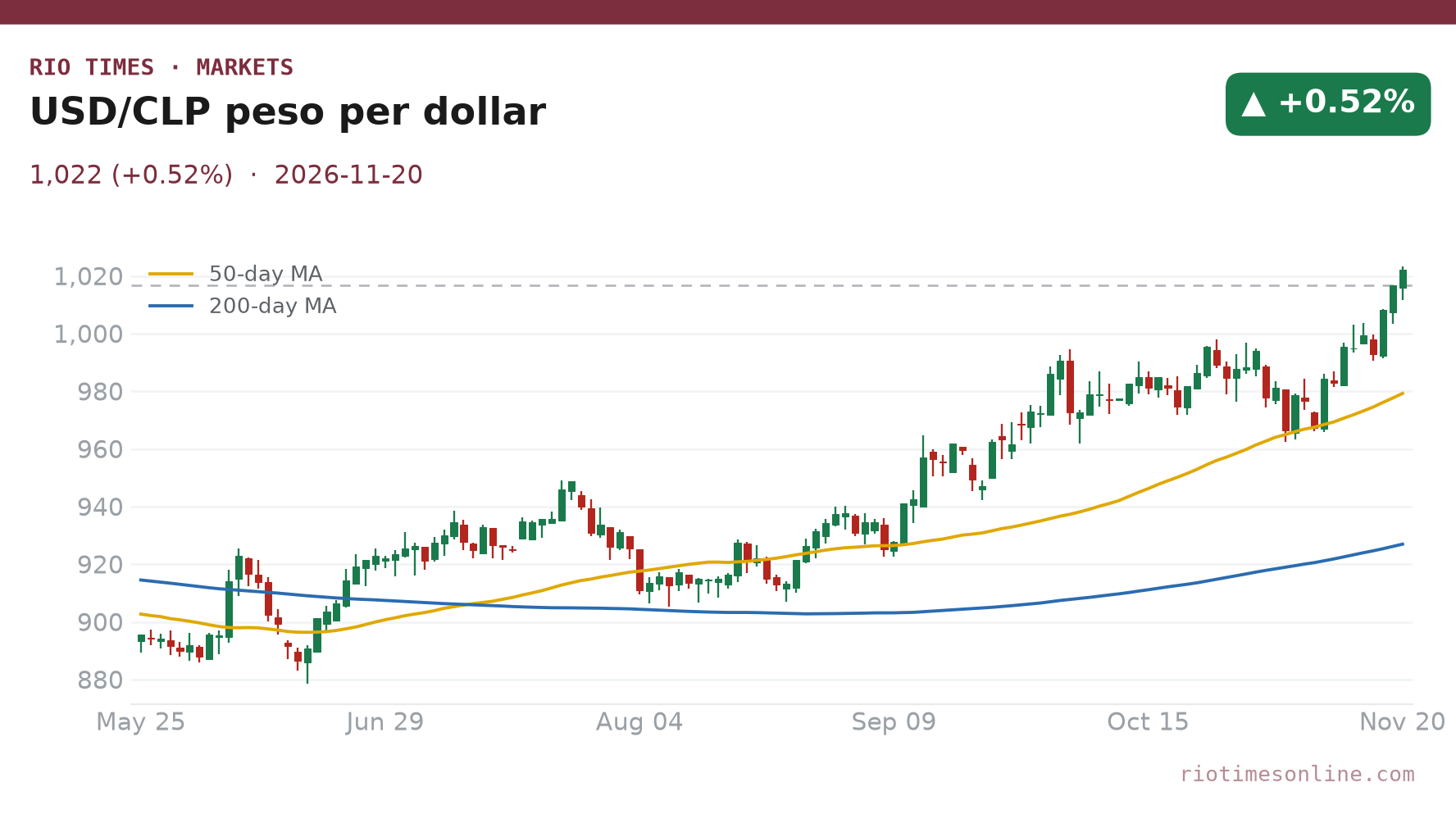
On the chart for the peso, 1,022 per dollar is the weakest close in at least 12 months. Because it is the extreme of the range, there is no chart level above it.
The round 1,000 is the first level that would show the peso recovering, and the dollar is 20.0% above its February low of 851.67.
For the currency, 1,022 is the highest dollar close in the past 12 months, so there is no chart ceiling overhead. The round number of 1,000 is the first level that would show the peso recovering.
What would end it: a VIX back below 30 and a dollar back under 1,000 pesos. The next test is Monday 23 November, when trading in Santiago resumes.
07 What to watch
- The VIX fear gauge: It jumped 26.20% to 35.89; a fall back would ease pressure on the peso, while another jump would keep Chilean assets under strain.
- Santiago’s share index: Watch Monday’s close of the S&P IPSA, the main index of Chile’s largest listed companies, to see whether shares follow the peso lower.
- USD/CLP at 1,022: This is the 12-month high for the dollar; watch whether 1,000 pesos per dollar comes back into view.
- Copper and lithium prices: Chile’s economy and its biggest stocks, from SQM to Copec, depend on both; a rebound would help the peso.
Background: Chile Stocks Slip 0.3% as Peso Weakens.
Background: Chile Stocks Slip 0.5% as Copper Fund Falls.
What Prediction Markets Say
Polymarket, where users bet real money, lists a market on the Central Bank of Chile’s December decision, with US$30,000 traded as of 9:25 p.m. ET, 20 November 2026. It prices “no change” at 64.5%, a 0.25-point rise at 32.5% and a 0.5-point or larger rise at 3.2%.
The same site prices a 0.25-point US Federal Reserve rise in December at 89.5% (US$47.6 million traded). These prices are bets, not polls.
Why we show this: prediction markets turn real-money bets into a live probability that moves within minutes of the news, which is why investors, campaigns and newsrooms in the United States now follow them closely. We show them next to polls and official results, never instead of them.
More: Chile news in English, every day from The Rio Times.
Frequently Asked Questions
Why did the Chilean peso weaken on Friday?
Mainly a global sell-off: the S&P 500 fell 3.70% and the VIX fear gauge jumped 26.20% to 35.89. Chile earns its living from copper and lithium, so the peso trades as a risk currency.
What does USD/CLP at 1,022 mean?
It means one US dollar buys 1,022 Chilean pesos, the weakest the peso has closed in at least 12 months. It helps visitors and exporters but makes imports more expensive.
How far is the dollar from its low against the peso?
It is 20.0% above its 9 February low of 851.67 pesos, and 1,022 is the highest dollar close in at least 12 months.
Is the peso weakening only because of Chile?
No. The dollar rose 0.93% against Argentina’s peso and 0.31% against Mexico’s, so the move is shared across the region.
Market data: The Rio Times; exchange figures from Bolsa de Santiago
This article was produced by The Rio Times’ automated AI newsroom. Editorial responsibility: Matthias Camenzind, Publisher and Editor-in-Chief. The Rio Times also runs Ask Rio Times, which answers from 100,000+ of our own articles, the daily Latin America Power Map, and prediction-market odds on elections and markets.. How we use AI · Report an error
LatAm Markets: Live Signals → — real-time movers, turnover leaders and FX across Latin America.
Get The Rio Times delivered to your inbox — market intelligence, daily briefs, and breaking analysis across Latin America.
Start for US$1