Brazil’s Right Wins 276 of 513 Chamber Seats

ELECTIONS 2026 · BRAZIL
Runoff · Sunday, 25 October
Flávio Bolsonaro vs Lula: what happens next
First-round results, how the runoff works, the key dates and who backs whom, in one guide.
Key Facts
- —The country Brazil, Latin America’s largest economy, elected all 513 members of its Chamber of Deputies, the lower house, on Sunday 4 October.
- —Why it matters Congress writes Brazil’s taxes, budgets and trade rules. Its balance decides how much any president can change, including policy towards Washington.
- —Why now Flávio Bolsonaro and President Lula meet in a runoff on Sunday 25 October. Both would face this lower house from February.
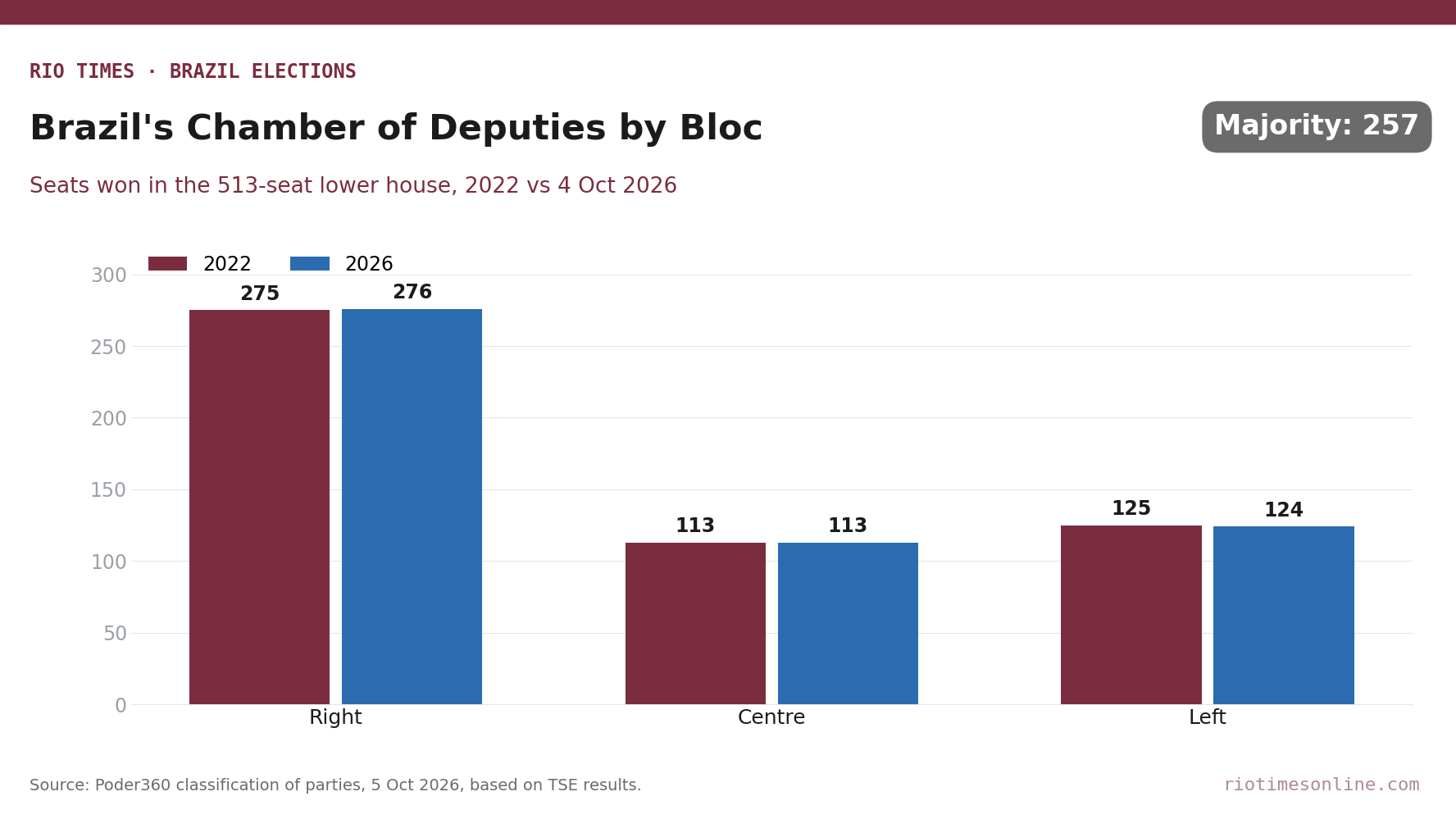
- —What happened Parties on the right won 276 of 513 seats, Poder360 counted on Monday 5 October. That is one more than in 2022 and above the 257-seat majority.
- —The numbers The left won 124 seats and the centre 113. In all, 301 sitting deputies were re-elected, 58.6% of current members, the Chamber’s news agency said.
- —What it means for you A right-leaning majority exists on paper, but it is short of the 308 votes needed to amend the constitution.
- —Still open Whether the right votes as one bloc. Its parties range from Bolsonaro loyalists to deal-making centre-right groups that also serve Lula.
- —Prediction markets Polymarket puts Flávio Bolsonaro’s chance of winning at 84% and Kalshi at 85% (Lula: 17% and 16%), as of 6 October, 3:20 am ET; prices are bets, not polls. Polymarket gives Flávio Bolsonaro an 84% chance of winning the presidency and facing this Chamber (6 October, 2:37 a.m. ET).
Parties on the right won 276 of the 513 seats in Brazil’s Chamber of Deputies on Sunday 4 October. That is the count of the news site Poder360. That gives them a majority of the lower house on paper, 19 seats above the 257 needed.
For American readers, this is the Congress that will set Brazil’s tax, budget and trade rules from 2027. Whoever wins the 25 October presidential runoff must work with it.
The headline number hides a story of stability. In 2022, Poder360 counted 275 right-wing deputies. The left moved from 125 to 124, and the centre held at 113.
Who Counts as the Right
Poder360, a Brasília political news site, sorted the parties by ideology. It used a classification by political scientists at the universities of Paraná (UFPR) and Maringá (UEM). It said it adjusted the labels for recent party moves.
Its right-wing list includes the Liberal Party (PL), the Progressistas (PP), União Brasil, Republicanos, the PSDB and Novo. Its centre includes the MDB, the PSD and Podemos.
The PL is the conservative party of former president Jair Bolsonaro, chaired by Valdemar Costa Neto. It won 121 seats, up from 99 in 2022, and is by far the largest party.
The other right-wing parties together hold 155 seats, Poder360 said. Several of them belong to the Centrão, a bloc of centre-right parties that trade votes for posts and budget funds.
The PP, chaired by Senator Ciro Nogueira, and União Brasil have both held ministries under Lula. Their deputies do not always vote with the PL.
On the left, President Luiz Inácio Lula da Silva’s Workers’ Party (PT), chaired by Edinho Silva, won 70 seats, up from 68. It is the second-largest party.
Other outlets draw the lines differently. CNN Brasil counted only the PL, Novo and Republicanos as a core right-wing group, which gives 172 deputies.
A Record Woman and Many Familiar Faces
The new house is not a clean sweep for incumbents or for newcomers. According to Agência Câmara, the Chamber’s own news agency, 301 sitting deputies won re-election, 58.6% of the total.
Another 183 deputies will serve a first term, a renewal rate of 35.67%, Agência Brasil reported from Chamber data. In 2022 the rate was 39.3%.
CNN Brasil, using a narrower method, found 296 of the 437 deputies who ran had won, a success rate of 67.7%. The Chamber’s figure also counts substitutes who took up seats during the current term.
The most-voted woman in the Chamber’s history comes from the left. Erika Hilton of PSOL, a socialist party to the left of the PT, won 1,596,472 votes in São Paulo.
That beats the previous record for a woman, 1,078,666 votes for Joice Hasselmann in 2018, according to G1 and Agência Câmara. Hilton became Brazil’s first Black trans federal deputy in 2022.
She led the push to end Brazil’s six-day working week. The most-voted deputy overall was Nikolas Ferreira of the PL, a conservative from Minas Gerais, with 3,119,318 votes, electoral court (TSE) results show.
The details of the earlier PL result are in our report Brazil’s Bolsonaro Party Wins 121 Seats in Lower House.
What It Means for You
For investors, a right-leaning lower house may make new taxes harder to pass. That would hold whoever wins the presidency.
Flávio Bolsonaro, a PL senator and the former president’s eldest son, would start with a friendlier house, but not a safe one. He would still need centrist votes for anything beyond a simple majority.
A fourth Lula term would face a hostile majority on paper. In practice, Lula has governed since 2023 by winning Centrão support with ministries and budget amendments.
The bigger hurdle is the constitution. Amendments need three fifths of each house in two rounds, which means 308 deputies. The right is 32 seats short.
For US companies, the takeaway is that Brazilian policy will move bill by bill. Sudden swings on tariffs or tax are less likely than slow bargaining.
What Is Not Known
It is not known how tightly the 276 right-wing deputies will vote together. Labels are a guide, not a whip, and Poder360 stresses that the centre will be decisive.
Court rulings on candidates whose votes are under appeal could still move individual seats. Final certification of winners comes before the new house sits on Monday 1 February 2027.
Who will lead the Chamber is also open. The house elects its Speaker in February; the current Speaker is Hugo Motta of Republicanos.
Read how the Centrão is choosing sides in Brazil’s Centrão Tilts to Flávio After 4 October Vote.
What Prediction Markets Say
The runoff decides which president will face this Chamber. Flávio Bolsonaro won 47.03% of first-round votes to Lula’s 45.16%, electoral court (TSE) results show.
On Polymarket, bets put Flávio’s chance of winning at 84% and Lula’s at 16.5% (6 October, 2:37 a.m. ET). Bettors see the race as tilted: Flávio’s price rose about 26 points in a week.
The market has traded about US$174 million in total. These are bets, not polls, and they move with the news.
Prediction markets · who wins the runoff
Implied chance of winning Brazil’s presidency on 25 October, from traders’ prices.
Polymarket
Flávio Bolsonaro 83.7% · Lula 16.5% (US$174 million traded)
Kalshi (regulated in the US by the CFTC)
Flávio Bolsonaro 85% · Lula 16%
As of 6 October, 3:20 am ET (08:20 Lisbon), updated every 20 minutes. Prices are bets, not polls, and can move fast.
Why we show this: prediction markets turn real-money bets into a live probability that moves within minutes of the news, which is why investors, campaigns and newsrooms in the United States now follow them closely. We show them next to polls and official results, never instead of them.
Why we show this: prediction markets turn real-money bets into a live probability that moves within minutes of the news, which is why investors, campaigns and newsrooms in the United States now follow them closely. We show them next to polls and official results, never instead of them.
How many seats did the right win in Brazil’s Chamber of Deputies?
Parties on the right won 276 of the 513 seats on 4 October, according to Poder360. That is above the 257 needed for a simple majority but short of the 308 for constitutional amendments.
Which party is the largest in the new Chamber?
Jair Bolsonaro’s Liberal Party (PL) won 121 seats, up from 99 in 2022. Lula’s Workers’ Party (PT) is second with 70.
When does the new Congress take office?
The deputies elected on 4 October take office on 1 February 2027 for a four-year term. The presidential runoff between Flávio Bolsonaro and Lula is on 25 October.
Sources: TSE results · Poder360 · Agência Câmara · Agência Câmara (Hilton) · Agência Brasil · CNN Brasil · G1 · Folha de S.Paulo
This article was produced by The Rio Times’ automated newsroom system. How we use AI · Report an error · Editorial responsibility: Matthias Camenzind, Editor-in-Chief