U.S. Warships Near Venezuela Raise Fears of Wider Tensions in Latin America
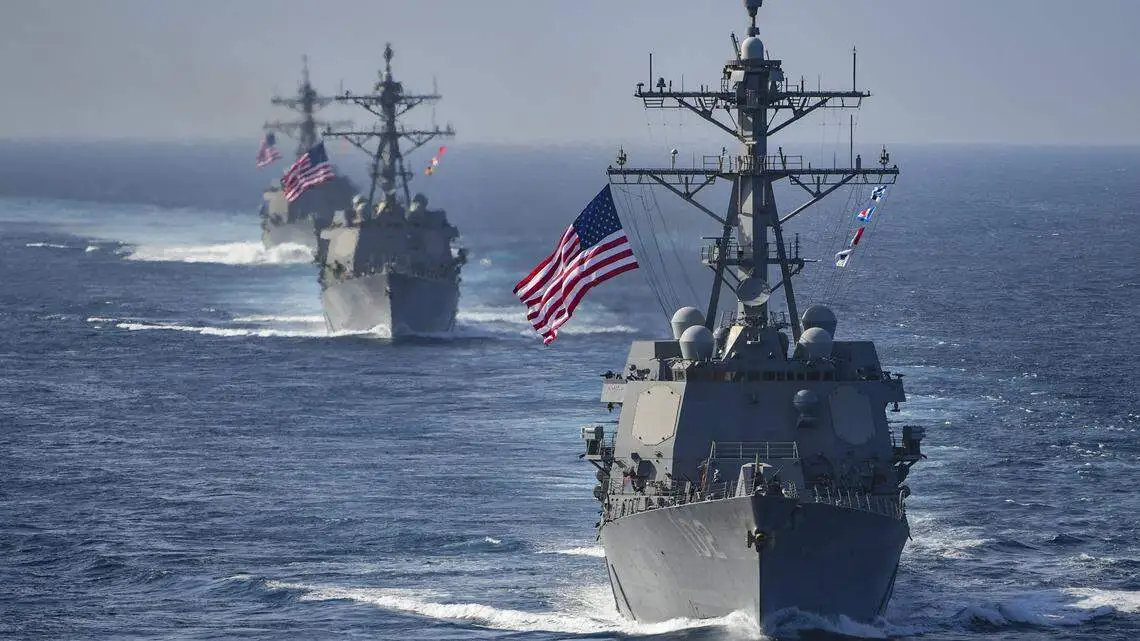
The United States has sent three guided-missile destroyers and about 4,000 personnel close to Venezuela in what Washington calls a counternarcotics mission.
At the same time, the State Department doubled its reward for information leading to the capture of President Nicolás Maduro to up to $50 million, saying it does not recognize him as Venezuela’s leader but as the head of a narcoterrorist cartel.
Venezuela rejected the accusations and mobilized millions of civilian militia members alongside its armed forces. Maduro declared that the country will defend its sovereignty and warned that U.S. actions threaten peace across the continent.
Caracas insists that drug-trafficking claims serve only as a pretext for intervention. Reactions in the region have been sharp.
In Brazil, presidential adviser Celso Amorim told Congress that non-intervention remains a foundation of foreign policy and warned against U.S. warships close to Venezuelan waters.
Mexico’s president Claudia Sheinbaum reaffirmed her country’s constitutional principle of non-intervention. Colombia’s president Gustavo Petro went further, warning that any invasion of Venezuela would be an aggression against Latin America and could destabilize his own country.
U.S. Military Buildup in Latin America Raises Regional Tensions
The logic behind the U.S. buildup is also questioned by data. A 2020 study based on U.S. government figures found that about 90 percent of cocaine reaching the United States travels through the Western Caribbean and Eastern Pacific, not Venezuela’s coast. Only a small share uses Venezuelan waters.
At home, anxiety is visible. A Genial/Quaest poll shows that five percent of Brazilians now rank war as their main concern, a marked rise in recent months. The increase reflects fears that a conflict could reach South America itself.
Russia, usually outspoken on U.S. military moves, has stayed silent on these deployments. Moscow’s recent official statements have focused on nuclear posture and broader disputes, with no sign of a deal over Latin America.
Behind the statements and maneuvers lies a deeper struggle. Washington insists it is fighting drugs, while Latin American leaders stress sovereignty.
For businesses, governments, and citizens, the risk is that military posturing narrows room for dialogue. Even a single misstep at sea could trigger political and economic turbulence across the hemisphere.
More: Colombia news in English, every day from The Rio Times.
This article was produced by The Rio Times’ automated newsroom system. How we use AI · Report an error · Editorial responsibility: Matthias Camenzind, Editor-in-Chief