U.S.-Japan Forge Warfighting Hub to Deter China in New Era
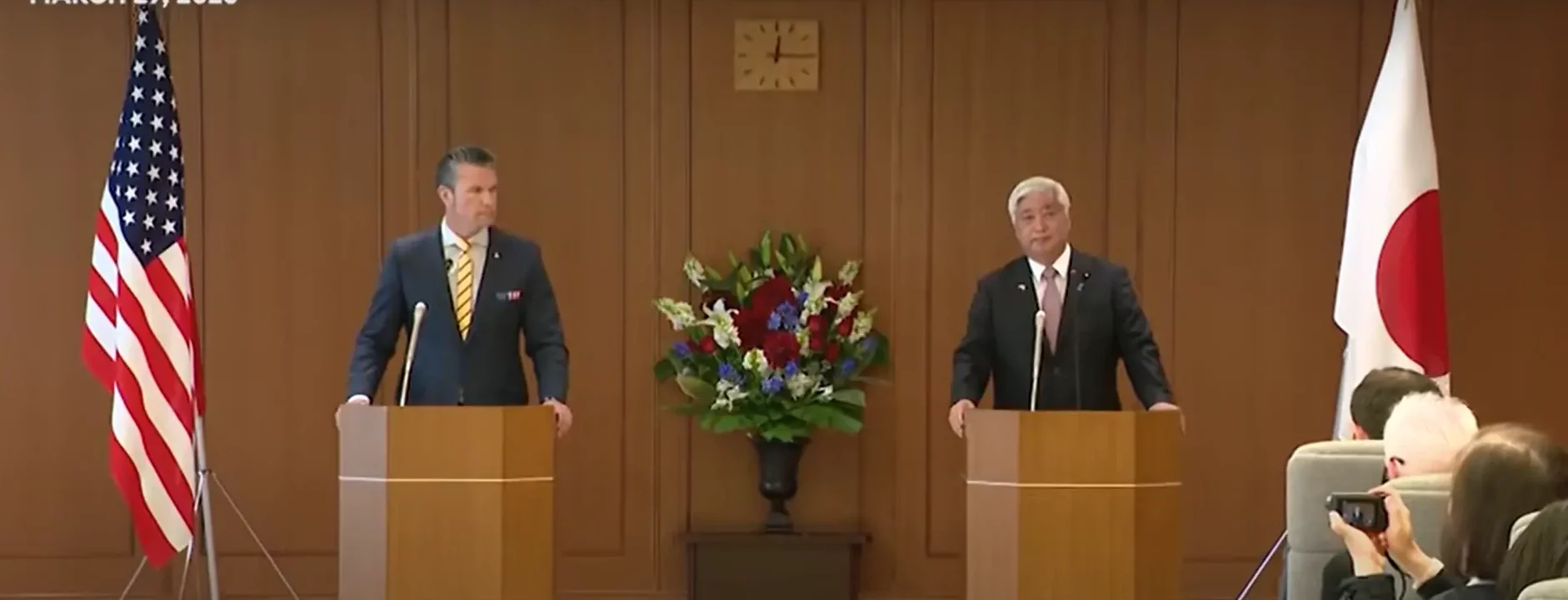
Tokyo delivers a stark message this weekend as U.S. Secretary of Defense Pete Hegseth and Japanese Defense Minister Gen Nakatani conclude an 85-minute meeting at Japan’s Ministry of Defense, unveiling a defense pact that jolts the Indo-Pacific balance.
They ignite “phase one” of transforming U.S. Forces Japan (USFJ) into a Joint Force Headquarters, a warfighting command armed with expanded staff and authority.
Nakatani deems it a stride toward unbreakable coordination, while Hegseth asserts it locks in readiness and unnerves adversaries.This bold stroke redefines the alliance’s edge.
The USFJ warfighting hub emerges as the pact’s linchpin. The U.S. fortifies its Tokyo base to mesh with Japan’s new Joint Operations Command, priming both for swift, decisive action.
With China targeting Taiwan by 2027, this overhaul aims to choke off aggression at its source. They intensify joint drills in Japan’s southwestern islands, fortifying a frontline against Beijing’s reach.
Missile production accelerates too—AMRAAM co-production speeds up, and SM-6 talks begin—securing arsenals for a tense horizon.
Hegseth anchors this in Trump’s “peace through strength” ethos, dismissing retreat. Nakatani underscores Japan’s awakening from pacifist slumber, compelled by the darkest security threats since the Cold War.
U.S.-Japan Forge Warfighting Hub to Deter China in New Era
They enlist Australia, South Korea, and the Philippines to curb regional coercion. Okinawa’s base realignment, including Futenma’s return, blends strategy with local support. Their infantry past drives a tough, unrelenting alliance.
Japan’s defense industry surges alongside this shift. Recent data show a 35% spike in arms sales for 2023, driven by firms like Mitsubishi Heavy Industries, matching Russia’s growth pace.
This boom, fueled by domestic demand rather than exports, reflects Tokyo’s massive military buildup—its largest since World War II.
The expansion signals Japan’s intent to wield advanced systems and reduce reliance on foreign suppliers, amplifying the alliance’s clout.
Analysis: A High-Stakes Pivot Reshapes Power
This move lays bare a world tilting toward confrontation. China’s relentless rise and Taiwan gambit force the U.S. and Japan to wield a sharper blade.
Turning USFJ into a warfighting nerve center ditches old playbook diplomacy for combat-ready unity.
Linking it with Japan’s command welds an alliance poised to strike back, not just hold ground, in the Taiwan Strait or beyond.
The southwestern buildup stares down China’s island-chain chokehold, where trade arteries hang in the balance.
The U.S. decision to deploy HIMARS rocket launchers to Japan’s southern islands marks a pivotal moment in East Asian security.
This move reshapes the military landscape and signals a new phase in U.S.-China relations. Businesses eye missile deals for profit, yet brace for chaos if deterrence falters.
Japan’s leap—hosting more U.S. muscle and footing bills—upends decades of caution, recasting it as a linchpin power.
Challenges accompany this bold shift. Precision remains critical to deter conflict rather than provoke it. Okinawa’s cooperation strengthens the alliance’s foundation.
Multilateral efforts require careful alignment with diverse partners. Building on past lessons—like Afghanistan—the U.S. and Japan aim to cement this strategy’s success.
The world takes notice. Allies gain confidence, adversaries reassess moves, and markets track the ripple effects.
With USFJ as its backbone, the U.S.-Japan alliance redefines Pacific security, challenging China to confront a united front
This article was produced by The Rio Times’ automated newsroom system. How we use AI · Report an error · Editorial responsibility: Matthias Camenzind, Editor-in-Chief
Read More from The Rio Times