Self-Employment in Brazil for Foreigners 2026: MEI, CNPJ and Autônomo Guide
Moving & Living: Brazil
Key Facts
—MEI cap. The Microempreendedor Individual (MEI) allows annual gross revenue up to R$81,000 in 2026 (roughly US$14,700). The fixed monthly DAS payment is R$82.05–87.05 (about US$15), covering INSS social security plus ICMS or ISS.
—CNPJ threshold. Businesses exceeding the MEI cap must migrate to Simples Nacional, where rates start around 4–6% depending on sector and rise with revenue.
—Self-employed count. Brazil had roughly 25.3 million self-employed workers in 2024, according to IBGE’s PNAD Contínua. That is 27% of the employed population, one of the highest rates in the world.
—Digital nomad visa. Introduced by Normative Resolution 45/2021, the visa requires proof of remote employment or self-employment with monthly income of at least US$1,500. It is valid for one year, renewable for another.
—Social security. MEI holders contribute to INSS and are entitled to retirement, sick pay, and maternity leave. Autônomos without formal registration have no social security coverage unless they make voluntary INSS contributions.
Brazil’s three-tier self-employment system — MEI, CNPJ, and informal autônomo — offers foreigners multiple paths to legalize their work, but each comes with distinct tax obligations, revenue limits, and social security trade-offs.
The Scale of Self-Employment in Brazil
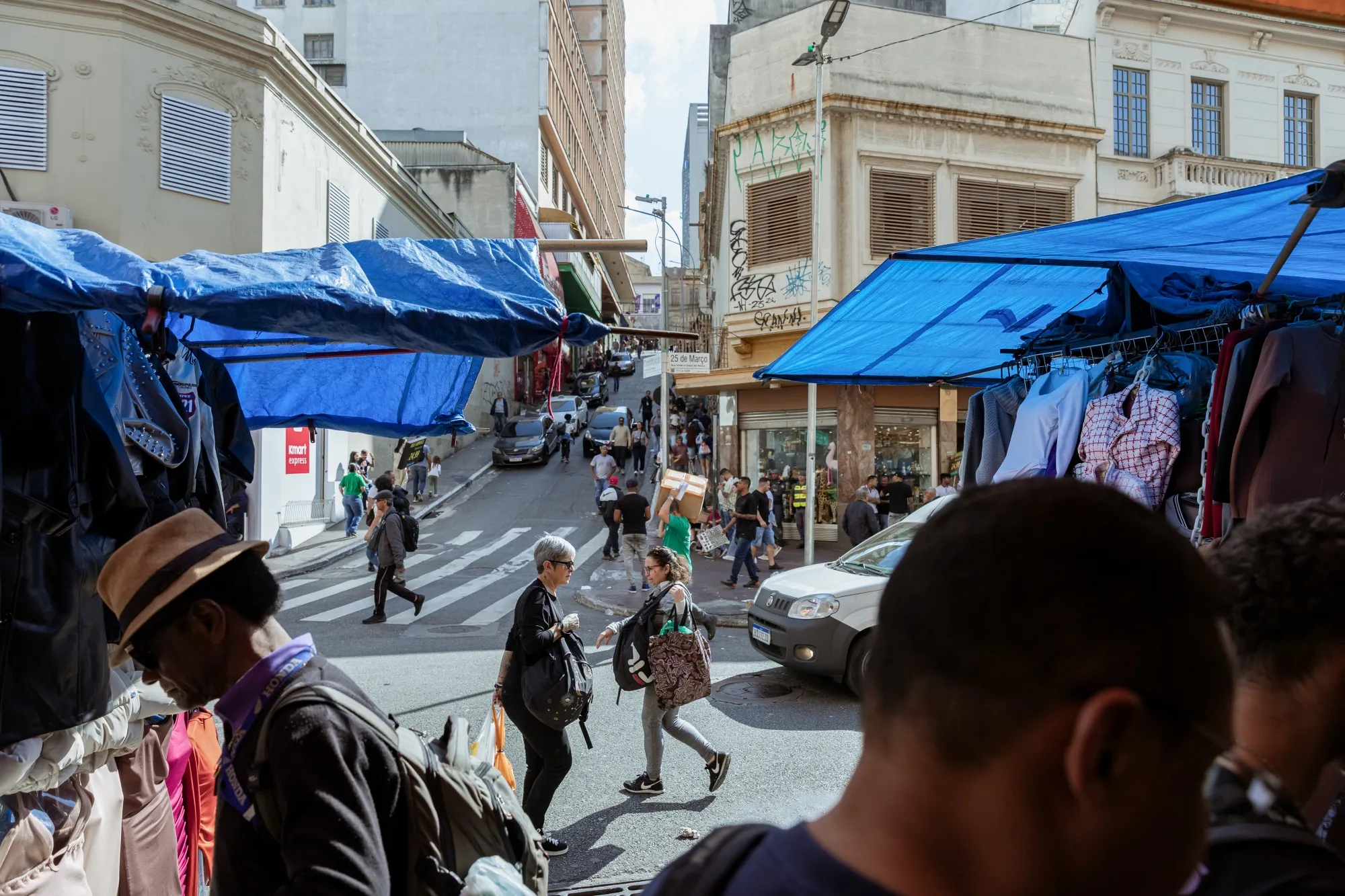
Brazil has one of the highest rates of self-employment in the world. The IBGE’s PNAD Contínua survey counted roughly 25.3 million self-employed workers in 2024, representing 27% of the employed population. That figure includes everyone from street vendors and freelance designers to lawyers and doctors operating as solo practitioners. The high rate reflects both the flexibility of informal work and the rigidity of Brazil’s formal labor market, where employer payroll taxes and severance obligations make full-time hiring expensive.
For foreigners, the self-employment landscape is both an opportunity and a maze. The Brazilian government has created multiple legal categories for independent workers, each with different tax rates, revenue limits, and social security benefits. The choice of category — MEI, CNPJ, or informal autônomo — has significant implications for how much tax you pay, what benefits you receive, and whether your work is legally protected.
The MEI: Entry-Level Formalization
The Microempreendedor Individual (MEI) was created in 2008 as a simplified legal framework for small self-employed businesses. It is the most popular choice for foreign freelancers and small-scale entrepreneurs because it is cheap, easy to register, and provides formal social security coverage.
In 2026, the MEI revenue cap is R$81,000 per year (roughly US$14,700). The monthly DAS payment is R$82.05 (about US$16, at the August 31, 2026 rate of R$5.18 per dollar) for commerce and industry, R$86.05 (about US$17) for services, and R$87.05 (about US$17) for both combined — that is 5% of the R$1,621 (about US$313) minimum wage for INSS social security, plus R$1 (less than US$1) of ICMS or R$5 (about US$1) of ISS. A bill to raise the cap to R$150,000 (about US$29,000) has passed the Chamber of Deputies but had not become law as of August 2026. MEI holders can issue formal invoices (notas fiscais) through the government’s free electronic invoice system and are entitled to retirement benefits, sick pay, and maternity leave.
The registration process is entirely online through the Portal do Empreendedor. Foreigners need a CPF and a valid visa. The main restriction is the revenue cap: if you exceed R$81,000 (US$14,700) in a calendar year, you must leave the MEI regime. An excess of up to 20% (R$97,200, about US$18,800) means a supplementary payment and migration the following January; a larger excess triggers retroactive reclassification, with back taxes, fines, and interest. There is also a list of permitted activities — the MEI is designed for small commerce, services, and industry, not for regulated professions like medicine, law, or engineering.
The CNPJ: Full Business Registration
When self-employed income exceeds the MEI cap, or when the activity requires a regulated license, the next step is a CNPJ — Brazil’s corporate taxpayer ID. The CNPJ opens access to full business banking, unlimited revenue, formal contracts with large companies, and the ability to hire employees.
Most small CNPJs opt for Simples Nacional, a consolidated tax regime that combines federal, state, and municipal taxes into a single monthly payment. Rates are progressive, starting around 4% for commerce and 6% for services in the lowest revenue bracket and rising toward 33% at the top. The Simples ceiling is R$4.8 million (about US$930,000) per year. The exact rate depends on the company’s sector and revenue bracket.
The downside is administrative complexity. A CNPJ requires monthly tax filings (DAS), annual corporate income tax returns, and formal accounting. Most foreigners hire an accountant (contador) to manage this, at a cost of R$300–800 per month (US$55–145). The CNPJ also exposes the owner to personal liability for certain tax debts, unlike the limited liability protection available to corporations (Sociedade Limitada, or LTDA).

The Autônomo: Informal and Unprotected
The “autônomo” category covers informal self-employment — work without any legal registration. It is common among foreign language teachers, tour guides, digital creatives, and consultants who work directly with individual clients. The appeal is simplicity: no registration fees, no monthly tax payments, no accounting requirements.
The disadvantages are severe. Autônomos have no access to social security unless they make voluntary INSS contributions, which few do. They cannot issue formal invoices, which limits their client base to individuals and small informal businesses. They have no legal protection in disputes with clients — a contract between an autônomo and a client is legally valid but difficult to enforce without a CNPJ and formal registration.
For foreigners, the autônomo path carries an additional risk: visa violation. Brazil’s digital nomad visa explicitly allows remote work for foreign employers, but it does not authorize work for Brazilian clients. A foreigner on a digital nomad visa who sells services to Brazilian companies as an autônomo is technically in violation of their visa conditions. Enforcement is patchy, but the risk exists.
Visa Pathways for Self-Employed Foreigners
Brazil does not have a dedicated “self-employed visa.” Most foreigners use one of three paths. The digital nomad visa (Normative Resolution 45/2021) is the most common for remote workers. It requires proof of remote employment or self-employment with a monthly income of at least US$1,500. The visa is valid for one year and renewable for another. It does not grant the right to work for Brazilian clients.
The investor visa (Normative Resolution 13/2017) requires an investment of at least R$500,000 (US$91,000) in a Brazilian business — or R$150,000 (about US$29,000) for qualifying innovation ventures. This is the path for foreigners who want to start a local company, open a restaurant, or launch a tech startup. The investment must be documented and registered with the Central Bank. Since a 2024 rule change (RN 49/2024), this route grants residency for an indefinite period from day one.
The retirement visa is available to foreigners with a monthly pension of at least US$2,000, with no minimum-age requirement. It grants residency and allows the holder to work or start a business without additional permits. This visa is popular among European retirees, particularly Portuguese and Italians, who benefit from Brazil’s bilateral agreements on pension recognition.
Social Security: The Hidden Cost of Informality
One of the most important differences between MEI, CNPJ, and autônomo is social security coverage. MEI holders automatically contribute to INSS through their monthly DAS payment. They are entitled to retirement at age 65 (men) or 62 (women), with a minimum benefit of one minimum wage (R$1,621 in 2026, roughly US$295). They also qualify for sick pay, maternity leave, and death benefits.
CNPJ owners under Simples Nacional also contribute to INSS, but the calculation is more complex. The contribution is embedded in the Simples tax rate and varies by revenue. CNPJ owners can opt for a higher contribution to increase their future retirement benefit, but most small businesses do not.
Autônomos have no automatic coverage. They can make voluntary INSS contributions (11% of a self-declared income base), but fewer than 15% of informal workers do so, according to IBGE data. The result is that most autônomos face old age without a pension, dependent on family support or informal savings.
Background: our doing business in brazil a complete guide for foreign entrepreneurs guide.
Background: our investing in brazil guide.
More: Brazil news, every day from The Rio Times.
Frequently Asked Questions
What is the MEI and who can use it?
The MEI is a simplified legal structure for small self-employed businesses. It allows annual revenue up to R$81,000 (US$14,700) and charges a fixed monthly DAS of R$82.05–87.05 (about US$15). Foreigners with a CPF and valid visa can register.
Can I work for Brazilian clients on a digital nomad visa?
Technically no. The digital nomad visa allows remote work for foreign employers only. Working for Brazilian clients requires a CNPJ and a visa that permits local employment, such as the investor visa.
What happens if I exceed the MEI revenue cap?
You must leave the MEI regime and migrate to Simples Nacional. If you exceed the cap by up to 20%, you pay a supplementary charge and migrate the following January. Above 20%, you lose MEI status retroactively to January, with back taxes, fines, and interest.
Connected Coverage
Brazil’s expat and nomad community continues to grow as remote work becomes permanent.
Sources: Portal do Empreendedor; IBGE; Ministério das Relações Exteriores; Receita Federal.
This article was produced by The Rio Times’ automated newsroom system. How we use AI · Report an error · Editorial responsibility: Matthias Camenzind, Editor-in-Chief
Expat Guide to Brazil
What The Rio Times publishes for foreigners who live in or move to Brazil.
Start here
- Brazil Visa for US Citizens 2026 With E-Visa Cost and Steps
- Brazil Education and Healthcare Explained
- Brazil Security and Crime Explained 2026
- Brazil Rent and Power Bills After 4.58% Inflation
City guides
Rio de Janeiro, São Paulo, Florianópolis, Salvador, Belo Horizonte, Curitiba, Brasília
Coming up in Brazil
- What to Do in Fortaleza in October 2026 15 Oct
- What to Do in Recife in October 2026 17 Oct
- Festival MADA Natal Sets 28th Edition for 16–17 October in Brazil 17 Oct
- Florianópolis Events 12 to 31 October 2026 18 Oct
Understand Brazil