Mexico Markets: IPC & the Peso — September 2, 2026
Key Facts
- The S&P/BMV IPC, Mexico’s main share index, fell 0.82% to 64,514 on a session where consumer-facing names lagged and banks proved the steadier pocket.
- The peso held its ground, closing at 16.9956 per dollar essentially flat on the day and still within sight of its strongest level in over a year.
- Grupo México was the biggest drag among actively traded names, falling 3.9% with roughly $35 million in turnover as mining and materials stocks took the heaviest blows.
- Walmex, the heavily traded retailer, slipped 0.8% on $47 million in volume, reflecting the soft tone across consumer staples.
- The IPC sits about 9.9% below its 52-week high of 71,601 having recovered from a trough of 60,216 during a volatile year for Mexican assets.
Today’s Focus
Mexico’s benchmark S&P/BMV IPC — the 35-company index that tracks the country’s largest, most liquid stocks — closed at 64,514 on Tuesday, down 0.82%. That left the market roughly 9.9% below its 52-week high of 71,601 and still within a broad range that has defined trading for months.
The peso, quoted as pesos needed to buy one US dollar, closed at 16.9956 — a move of just +0.01% on the day, showing almost no change and keeping the currency just under the psychologically important 17 level. A higher quote means a slightly weaker peso, and here the move was too small to mean much.
The session’s character was cautious rather than fearful. Mining and materials names such as Grupo México and Cemex led the declines, while banks and select consumer plays held up better, suggesting investors were trimming riskier industrial bets rather than rushing for the exits.
What matters today. The market’s decline was orderly and the peso stayed stable, suggesting investors are watchful but not alarmed.

01 The session in one read
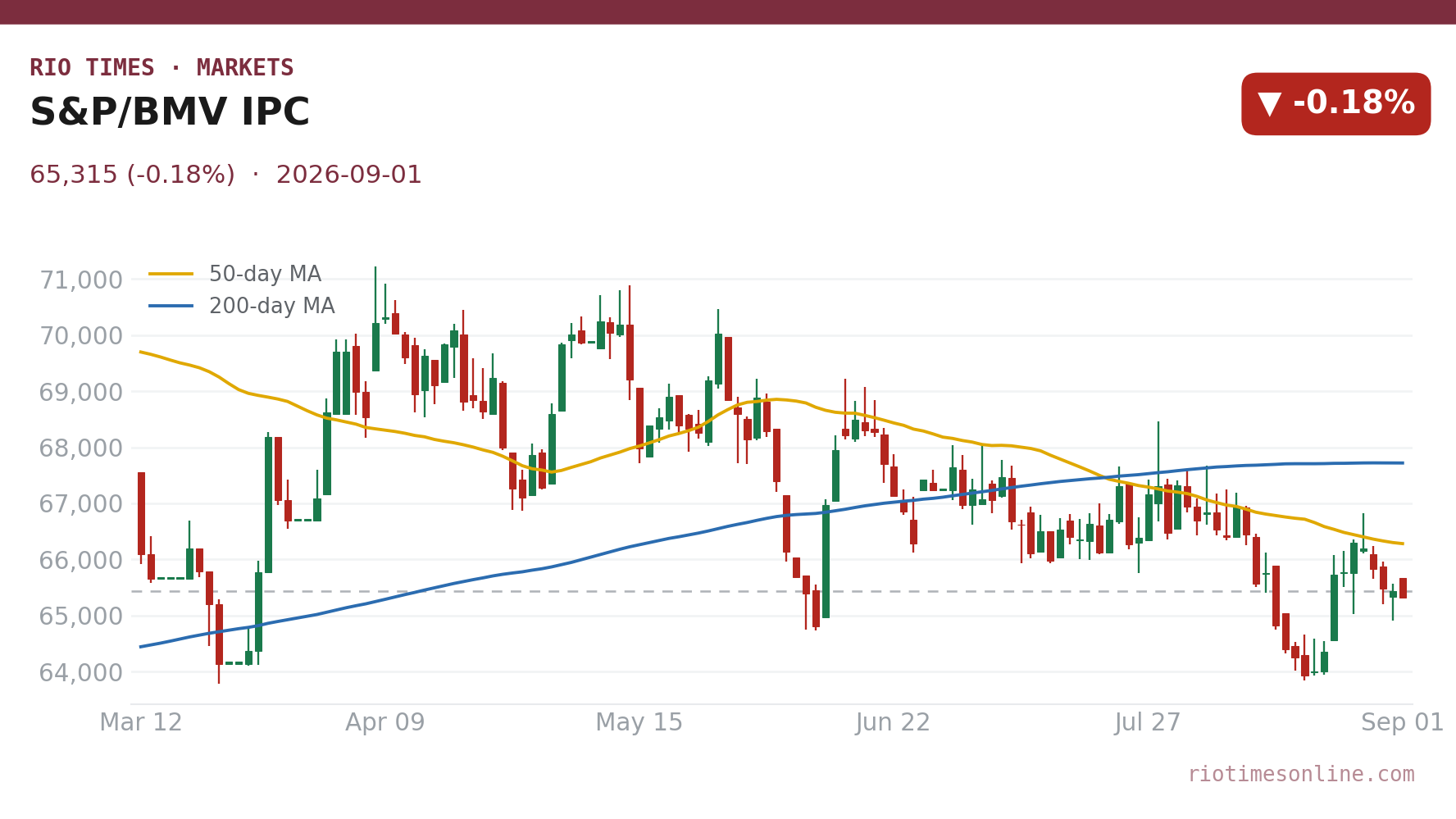
Mexico’s stock market finished Tuesday marginally lower, with the S&P/BMV IPC falling 0.82% to 64,514. The day’s tone was cautious rather than panicked, following a weak handoff from Wall Street where the S&P 500 dropped 0.71% and the Nasdaq lost 1.03%.
The peso, however, was a picture of calm. It closed at 16.9956 per dollar, a move of just +0.01% that kept the currency essentially unchanged under the 17 level.
Trading was selective. Industrial and materials names bore the brunt of selling, while banks like Banorte — one of Mexico’s largest financial groups — attracted modest interest, showing investors were repositioning within the market rather than abandoning it.
The pattern fits a session where global cues were mildly negative — US stocks fell and the VIX volatility gauge jumped 9.52% — but Mexico-specific drivers were largely absent. The IPC’s 0.82% decline is meaningful but not dramatic, and the peso’s flat close reinforces a view that investors are comfortable with Mexico’s near-term outlook even as they trim equity exposure in higher-risk sectors. The variable to watch is whether mining and materials weakness extends into another session, which would suggest a broader rotation out of cyclical names rather than a one-day wobble.
02 The day’s numbers
| Measure | Level | Change | Read |
|---|---|---|---|
| S&P/BMV IPC | 65,315 | −0.18% | Drifted lower in soft trade |
| USD/MXN (peso per dollar) | 16.9956 | +0.01% | Peso steady just under 17 |
| 52-week high | 71,601 | — | Index is 9.9% off that peak |
| 52-week low | 60,216 | — | Still a healthy distance above |
| S&P 500 (US) | 7,631 | −0.71% | Grim US handoff |
| VIX volatility gauge | 16.34 | +9.52% | Nerves picked up globally |
The headline numbers tell a story of a market treading water. The IPC’s 0.82% decline is a modest daily move by this index’s standards, and the peso’s flat close reinforces the sense of steadiness.
The 8.8% gap to the 52-week high of 71,601 is notable but not alarming — Mexican stocks have been rangebound for much of the year, with investors balancing supportive domestic consumption against global headwinds. Rio Times · Live Market Intelligence
Live Market IntelligenceMexico — Live Market Board
Mexico — Live Market Board
Instrument Last Change YoY Prev. High Low Volume
IPC MEX
68,929.72
+1.87%
+12.17%
67,663.29
66,121
65,405
108,886,187
USD/MXN
17.06
-0.24%
-8.58%
17.10
17.08
17.01
—
WALMEX
48.07
-0.62%
-14.38%
48.37
48.65
48.02
10,781,446
GMEXICO
223.28
+0.35%
+73.59%
222.50
226.18
222.17
1,325,556
FEMSA
201.19
-0.24%
+25.67%
201.67
206.71
199.56
750,706
CEMEX
19.32
+0.89%
+19.10%
19.15
19.35
19.04
14,327,054
GFNORTE
193.98
+1.18%
+14.36%
191.71
195.79
191.83
1,579,115
BIMBO
60.98
-0.96%
+11.89%
61.57
61.46
60.29
1,048,115
TELEVISA
9.71
+0.21%
+12.78%
9.69
9.75
9.60
577,851
AMX
19.80
-0.95%
+12.53%
19.99
20.05
19.70
58,058,525
GAP
366.23
+0.43%
-21.21%
364.68
370.85
362.82
226,946
ASUR
275.04
+1.25%
-15.28%
271.64
275.08
271.31
15,451
OMA
233.50
+0.62%
-6.48%
232.06
235.00
230.62
555,693
KOF
188.04
+0.86%
+18.94%
186.44
188.56
185.52
425,273
GRUMA
252.90
+0.11%
-21.85%
252.61
254.74
250.36
90,048
KIMBER
39.74
+0.43%
+8.85%
39.57
40.09
39.33
490,551
AMX ADR
23.38
-0.23%
+22.25%
23.43
23.49
23.06
1,347,445
03 Why it moved — global caution, local restraint
The clearest signal came from abroad. US stocks fell across the board, with the tech-heavy Nasdaq down 1.03% and the Dow Jones off 0.79%, while the VIX — a measure of expected US stock market volatility often called the fear gauge — jumped 9.52%.
That kind of global caution usually filters into emerging markets like Mexico, but it did so gently. Investors appeared to be trimming positions in sectors sensitive to global growth, such as mining and cement, while keeping faith in domestic-facing names and the peso.
The currency’s resilience is striking. Even as the dollar strengthened broadly — the DXY index rose 0.30% — the peso barely budged, reflecting confidence in Mexico’s carry appeal and its relatively contained fiscal picture.
04 The day’s movers
| Driver | Level / Move | Change | Note |
|---|---|---|---|
| Walmex | — | −0.8% | Heaviest trade, $47m; consumer staples soft |
| Grupo México | — | −3.9% | Mining drag, $35m; sector under pressure |
| Cemex | — | −2.8% | Cement maker hit, $15m in turnover |
| America Movil | — | −0.1% | Telecom giant flat on $31m |
| Banorte | — | 0.0% | Bank steady on $51m; financials firm |
The most-traded stock was Banorte, the big Mexican bank, which saw $51 million in turnover and finished unchanged — a sign of underlying stability in financials. Walmex followed with $47 million traded and slipped 0.8% as consumer staples lagged.
The biggest percentage blows landed in the materials sector. Grupo México, the mining and transport conglomerate, tumbled 3.9% on $35 million in volume, while cement maker Cemex lost 2.8%. Other notable casualties in the sector included Orbia, down 2.5%, and airport operator ASUR, off 2.4%.
05 The regional scoreboard
| Index | Country | Change |
|---|---|---|
| Colcap | Colombia | +1.86% |
| Ibovespa | Brazil | +1.30% |
| Merval | Argentina | +0.51% |
| S&P/BVL Perú | Peru | +0.11% |
| S&P/BMV IPC | Mexico | −0.18% |
Mexico’s dip stood out against a mostly positive regional day. Colombia’s Colcap rose a solid 1.86%, while Brazil’s Ibovespa — Latin America’s largest equity index — gained 1.30%.
The divergence underscores that Tuesday’s Mexico move was not driven by any local panic or country-specific shock. Instead, it reflected a modest bout of global caution that hit Mexico’s internationally exposed sectors hardest while leaving the currency and financial names steady.
06 The technical picture
The IPC closed at 64,514, in the lower half of a 52-week range that stretches from 60,216 on the downside to 71,601 on the upside. The index is about 9.9% below its high, which is close enough that a concerted rally could retest it within weeks, but far enough to leave room for further softness without triggering deeper technical damage.
The peso chart tells a similar story. At 16.9956, the currency is just off its 52-week best around 16.91 and far stronger than its weak point near 18.68, a sign that investors remain comfortable holding Mexican assets.
Key levels to watch: for the IPC, a move below 64,000 would suggest a retest of lower support, while a push back above 66,000 could signal renewed buying appetite. For the peso, a clear break under 16.90 would mark fresh 52-week territory and likely draw further inflows.
07 What to watch
- US services data: ISM services PMI due later this week could set the tone for global risk appetite and Mexico’s next move
- Mining and materials: Whether Grupo México and Cemex stabilise or extend losses will reveal if the rotation out of cyclicals has legs
- Peso under 17: A decisive break below 16.90 would be a milestone and could fuel further equity inflows
- Banorte and financials: Sustained steadiness in banks suggests domestic confidence remains intact despite global wobbles
Background: Mexican Peso August Rally Delivers Best Month Since April in Broad Market Gains.
Background: Mexico Stocks Dip as Central Bank Raises Growth Outlook.
More: Mexico news in English, every day from The Rio Times.
Frequently Asked Questions
What is the S&P/BMV IPC?
It is Mexico’s main stock-market index, tracking the 35 largest and most liquid companies listed on the Bolsa Mexicana de Valores.
Why did the peso barely move?
The peso closed at 16.9956 per dollar, essentially flat, reflecting investor confidence in Mexico’s carry appeal even as the US dollar strengthened broadly.
Which stocks fell hardest?
Mining and materials names led declines — Grupo México dropped 3.9%, Cemex lost 2.8%, and Orbia fell 2.5%.
Is this a sign of deeper trouble for Mexico?
Not on Tuesday’s evidence. The decline was contained, the peso held firm, and financials were stable — more a cautious trim than a broad rout.
Market data: RT; exchange figures from BMV
This article was produced by The Rio Times’ automated newsroom system. How we use AI · Report an error · Editorial responsibility: Matthias Camenzind, Editor-in-Chief
In depth
LatAm Markets: Live Signals → — real-time movers, turnover leaders and FX across Latin America.