Key Facts
- US futures are flat to marginally higher with the S&P 500 and Nasdaq contract barely above the prior close, giving Latin American dealers little directional nudge from New York.
- Crude oil is steady near $85 a barrel with Brent just under $88, keeping Mexico and Colombia’s oil exporters on an even footing while natural gas slips slightly.
- Brazil decoupled sharply on Monday with the Ibovespa rising even as the S&P 500 fell, so Tuesday’s GDP and industrial production numbers will test that local strength.
- The dollar is soft with the DXY index below 99.5 and the Mexican peso and Brazilian real firm against it, though Colombia’s peso weakened noticeably.
- Mexico and Chile printed mixed equity sessions with the Mexbol down and Chile’s IPSA lower, while Argentina’s Merval jumped again as local investors chase inflation hedges.
Today’s Focus
The overnight story is one of quiet stabilisation. US futures are barely moved, oil is holding $85, and Asia and Europe are drifting lower by fractions of a per cent.
That leaves Latin American markets to trade their own news. Brazil’s is the heaviest: second-quarter GDP and industrial production land before lunch, right after the Ibovespa notched its ninth straight daily gain.
Mexico brings business confidence and manufacturing data, Chile publishes monthly activity figures, and Argentina’s tax revenue is due — enough local catalysts to keep traders busy without a strong global wind.
The one genuine divergence remains Brazil. The real has been grinding stronger, the Ibovespa is overbought by most technical measures, and a soft GDP print could finally give local bulls a reason to book profits.
What matters today. Whether Brazil’s GDP and industry data sustain the local rally or break the nine-session winning streak.
| Instrument | Level | Session |
|---|---|---|
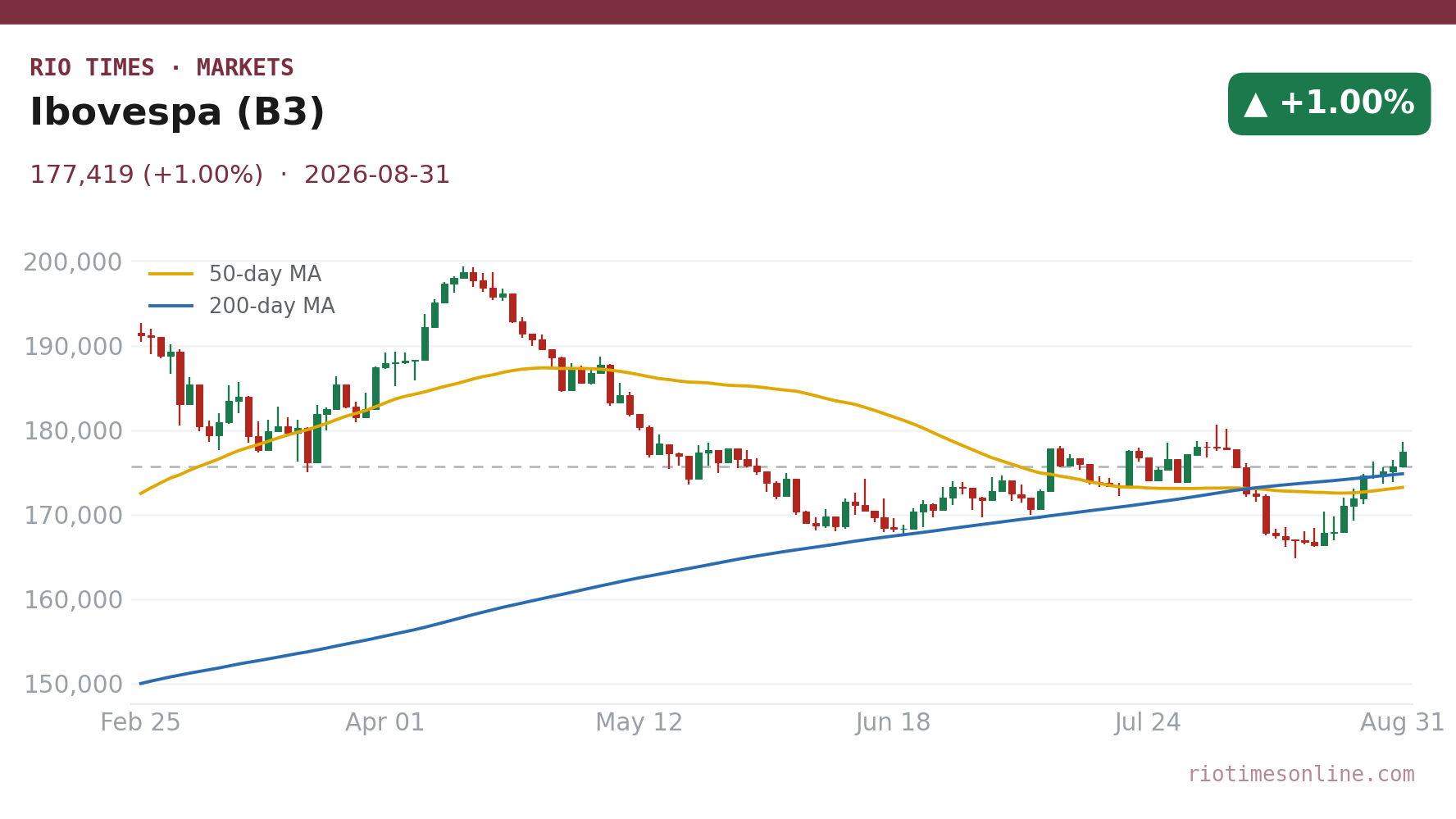
| Ibovespa (Brazil) | 177,419 | +1.00% |
| S&P 500 (US) | 7,686 | -0.33% |
| USD/BRL | 5.181 | -0.29% |
| USD/MXN | 17.032 | -0.02% |
| USD/CLP | 934.25 | +0.30% |
| USD/COP | 3,219 | +1.81% |
| USD/ARS | 1,509 | -0.26% |
Source: market close, 31 August 2026.
01 The overnight tape in one read
Global markets are catching their breath. Tokyo’s Nikkei and Hong Kong’s Hang Seng are both marginally lower, Europe’s STOXX 600 futures are flat to down, and the US contracts are all within a tenth of a per cent of the prior close.
The tone is one of consolidation after a mixed Monday on Wall Street. The Dow fell hardest, the S&P 500 slipped, and even the Nasdaq finished slightly lower while the VIX — the market’s fear gauge — ticked higher.
Bond traders were the more nervous set. The US 10-year Treasury yield rose again, sitting just above 4.75%, which keeps pressure on emerging-market assets that compete with dollar debt.
Oil is the stabilising force. West Texas Intermediate, the US benchmark, is holding just above $85 a barrel with Brent near $88, keeping energy-linked Latin American markets from slipping further.
The evidence points to a flat-to-slightly-positive open for most of the region, with oil stability supporting currencies like the Colombian peso and the real. But the Brazilian market has run hard — nine straight sessions up — and the data due today could force a breather. Watch Brazil’s GDP at 09:00 local time; a print below the 0.4% consensus is the trigger for a bout of selling.
02 The board before the open
| Instrument | Level | Change | Read |
|---|---|---|---|
| S&P 500 futures | 7,724.75 | +0.04% | Flat after Monday’s soft close |
| STOXX 600 futures | 655.60 | −0.11% | Europe consolidating |
| WTI crude | 85.40 | steady | Holding after Monday’s 3% jump |
| Brent crude | 88.29 | +0.22% | Slightly firmer than WTI |
| DXY dollar index | 99.41 | −0.29% | Dollar soft, helping LatAm FX |
The board is a study in mildness. US futures are essentially flat, European futures are barely lower, and oil is doing nothing dramatic.
The dollar’s softness is the most useful signal for Latin America. A DXY below 99.5 means the region’s currencies have room to strengthen, particularly the Brazilian real and Mexican peso, both of which firmed on Monday. Rio Times · Live Market Intelligence
Live Market IntelligenceLatin America — Cross-Market Board
Latin America — Cross-Market Board
Instrument Last Change YoY Prev. High Low Volume
IBOV
205,430.33
+0.54%
+21.85%
204,324.26
168,310
167,142
—
IPSA
10,969.16
-0.02%
—
10,971.88
11,210
10,984
1,513,213,483
IPC MEX
68,420.16
+1.12%
+12.17%
67,663.29
66,121
65,405
108,886,187
MERVAL
2,848,945
-0.35%
+30.51%
3,022,485
3,042,365
2,991,150
—
COLCAP
2,566.28
-0.55%
—
9.04
9.05
9.02
4,133
BVL PERÚ
60,210.69
-0.91%
—
—
—
—
—
USD/BRL
5.16
+0.01%
-5.13%
5.16
5.18
5.14
—
EUR/BRL
5.95
+1.01%
-5.83%
5.89
5.98
5.94
—
USD/MXN
17.06
-0.24%
-8.58%
17.10
17.08
17.01
—
USD/CLP
913.98
+0.04%
-5.67%
913.65
915.11
906.68
—
USD/COP
3,140
+0.03%
-22.04%
3,139
3,141
3,105
—
USD/PEN
3.36
-0.66%
-4.82%
3.38
3.38
3.35
—
USD/ARS
1,493
+0.10%
+12.96%
1,491
1,494
1,480
—
USD/UYU
40.27
+1.24%
+1.80%
39.77
40.27
40.23
—
USD/PYG
5,939
+1.68%
-19.54%
5,841
5,939
5,925
—
USD/BOB
11.64
-0.76%
+72.04%
11.73
11.72
11.64
—
USD/DOP
58.34
+1.25%
-3.44%
57.62
58.34
58.04
—
USD/CRC
445.92
+0.89%
-9.71%
441.97
448.50
445.92
—
03 What the data shows — Brazil decouples while Argentina keeps running
| Stock | Move | Turnover | Note |
|---|---|---|---|
| PETR4 | +1.00% (Ibovespa) | R$3.08bn | Oil major leads turnover again |
| VALE3 | +1.00% (Ibovespa) | R$2.17bn | Iron ore proxy follows index higher |
| ITUB4 | +1.00% (Ibovespa) | R$1.02bn | Banking giant tracks broader São Paulo rally |
| BBAS3 | +1.00% (Ibovespa) | R$933m | State lender joins the advance |
| ABEV3 | +1.00% (Ibovespa) | R$761m | Brewer mirrors main index move |
The São Paulo board shows the big five turnover leaders all rising with the Ibovespa’s 1% gain, led by Petrobras preferred shares — the oil giant’s most traded class — with over R$3 billion changing hands.
Vale, the mining heavyweight, and three of the country’s biggest financial and consumer names follow. The concentration of turnover in five names tells you this was an index-led move, not a broad stock-picker’s rally.
04 Brazil and the currencies
Brazil is the region’s headline act today. Second-quarter GDP is expected to grow 0.4% from the prior quarter, and industrial production is forecast to expand 1.2% from a month earlier — both are backwards-looking but crucial for the tone.
The real has been one of the better-performing emerging-market currencies, trading just above 5.18 to the dollar and off its 52-week high. That strength reflects sustained foreign interest in Brazilian assets.
A weak GDP print could snap the mood. The Ibovespa has risen for nine straight sessions, a stretch that leaves it technically stretched even though it remains more than 10% below its 52-week high.
The Selic, Brazil’s benchmark interest rate, remains high by global standards, which keeps carry-trade money flowing into the real. August inflation data and the next central bank decision are the next big domestic triggers.
05 The regional setup
| Index | Country | Change |
|---|---|---|
| Merval | Argentina | +1.83% |
| Ibovespa | Brazil | +1.00% |
| IPC | Mexico | −0.67% |
| IPSA | Chile | −1.14% |
| COLCAP | Colombia | −1.34% |
The regional board is split. Argentina’s Merval keeps climbing as savers treat equities as an inflation hedge, while Brazil’s Ibovespa held firm against a weaker Wall Street.
Mexico’s IPC, Chile’s IPSA and Colombia’s COLCAP all lost ground on Monday, with Colombia hit by a sharp fall in the peso that pressured local asset prices.
Today’s local catalysts could narrow the gap: Mexico’s business confidence and manufacturing PMI, Chile’s monthly activity index, and Colombia’s own manufacturing reading are all due.
Argentina’s tax revenue figure, due overnight, is a reminder that economic policy in Buenos Aires remains a wildcard for regional flows.
06 The technical picture
The Ibovespa is overbought on daily oscillators after nine straight gains, but the move has carried it only partway back to its 52-week high — meaning the trend is still constructive for dip-buyers.
The Brazilian real is testing the strong side of its range, with the dollar at 5.18 versus a 52-week high above 5.59. A break below 4.89 would open the door to a new leg of strength.
The S&P 500 remains within 2% of its own record high, so there is no technical damage in the US market to spill over into Latin America.
Gold’s drift around $4,460 an ounce after Monday’s 0% dip adds to the picture of consolidation rather than capitulation across global risk assets.
07 What to watch
- Brazil GDP and industrial production: The 09:00 local time release is the key test of whether the nine-session Ibovespa rally has fundamental legs.
- US ADP employment and factory orders: Both land before the close and could shift Fed expectations for the September meeting.
- Oil holding $85: A break below would pressure the Colombian peso, Mexican energy names, and Petrobras shares.
- DXY dollar index: A move back above 99.5 would reverse the tailwind now helping the Brazilian real and Mexican peso.
Frequently Asked Questions
Why did Brazil decouple from Wall Street?
The Ibovespa rose 1% on Monday while the S&P 500 fell, driven by local inflows, strong commodity names like Petrobras, and high real interest rates that attract foreign carry-trade money.
What is the Selic and why does it matter?
The Selic is Brazil’s benchmark interest rate. Higher rates support the real by making real-denominated assets pay more than dollar or euro equivalents, drawing foreign capital.
Why is Argentina’s Merval outperforming?
Argentine savers use the stock market as an inflation hedge. With consumer prices still running high, the Merval’s nominal rise often tracks the local currency’s loss of purchasing power.
What should I watch in Mexico today?
Mexico prints business confidence and S&P Global manufacturing PMI. The peso is firm near 17 to the dollar, and any data surprise could move the IPC index at the open.
Market data: RT
This article was produced by The Rio Times’ automated newsroom system. How we use AI · Report an error · Editorial responsibility: Matthias Camenzind, Editor-in-Chief
LatAm Markets: Live Signals → — real-time movers, turnover leaders and FX across Latin America.