Interview: “The qualification section of Brazil’s nuclear submarine is scheduled between 2022 and 2023”
RIO DE JANEIRO, BRAZIL – The Director-General of Nuclear and Technological Development of the Brazilian Navy (DGDNTM), Fleet Admiral Petrônio Augusto Siqueira de Aguiar, and the President of Itaguaí Construções Navais (ICN), André Portalis, received a group of media to provide details on the Navy’s main programs and activities and updates on Itaguai Construções Navais’ work in support of Brazil’s Prosub submarine program.
How many programs does the Navy currently carry out to defend the Blue Amazon?
Aguiar: The Brazilian Navy currently has 47 CT&I projects under development at the Navy Technology Center in Rio de Janeiro (CTMRJ). I cite as practical examples of products developed in this way the MAGE Defender, a piece of equipment to be produced in Brazil by Omnisys for installation on Tamandaré Class frigates; or Skua II, a situational awareness system that significantly enhances the capabilities of tactical systems onboard Navy ships and should become an essential link in the future of the Blue Amazon Management System. Another important program is the Radio Defence Software-Defined (RDS-D), a program coordinated by the Ministry of Defense and involving the Navy and other forces. There are many others, but it is important to highlight the technological duality that is characteristic of most of them, which ultimately benefits society as a whole. The model we intend to follow is that of the triple helix, which involves the Navy, faculties and research/study centers, the Ministry of Science and Technology, and the Brazilian Defense and Security Industrial Base.

How can we increase the technological maturity of these programs and thus attract more companies?
Aguiar: This is our great challenge, to make companies understand that they need to study the market, have a business plan, and see what the prospects of success are if they decide to act, whether in the Submarine Program or the Navy’s Nuclear Program in ARAMAR. The country’s technological independence requires the ability to manage significant risks such as nuclear power for propulsion and its myriad challenges. The synergies between the Brazilian Navy and ICN will benefit most from these developments.
Prosub is preparing the delivery of the S-40 Riachuelo, the first of the four S-BR diesel-electric submarines. Wasn’t this means scheduled for delivery by the end of 2021?
Aguiar: Delays in delivering the first series of complex weapon systems such as the S-BR are expected, mainly because we analyze all the data generated in the countless tests the Riachuelo has been subjected to. A few days ago, the S-40 returned from a sea trial. It fired a mock-up of the Exocet missile underwater, testing the entire procedure of flooding the bow tubes, opening the hatches, launching the capsule with the missile, and having it reach the surface as expected. The Riachuelo has already fired F-21 heavy torpedoes, satisfactorily fulfilling the expected performance for this advanced smart weapon. These are very complex tasks, but they are being carried out well and with the desired results. The second submarine should be launched in the second half of 2022, with delivery in 2023 to the operational sector, the third in 2024, and the last in 2025.
What facilities are being prepared at Itaguaí to support these submarines in service?
Aguiar: We are finalizing preparations to activate the maintenance shipyard, which was designed precisely to support the S-BRs throughout their service life, and this site is also capable of providing support to other means of the fleet, such as ships of different types and sizes. The Brazilian Navy and ICN are paying attention to this. We are currently doing all the electrical wiring of the shipyard facilities to prepare for activation by the end of 2022.
What is the development schedule for the Álvaro Alberto submarine?
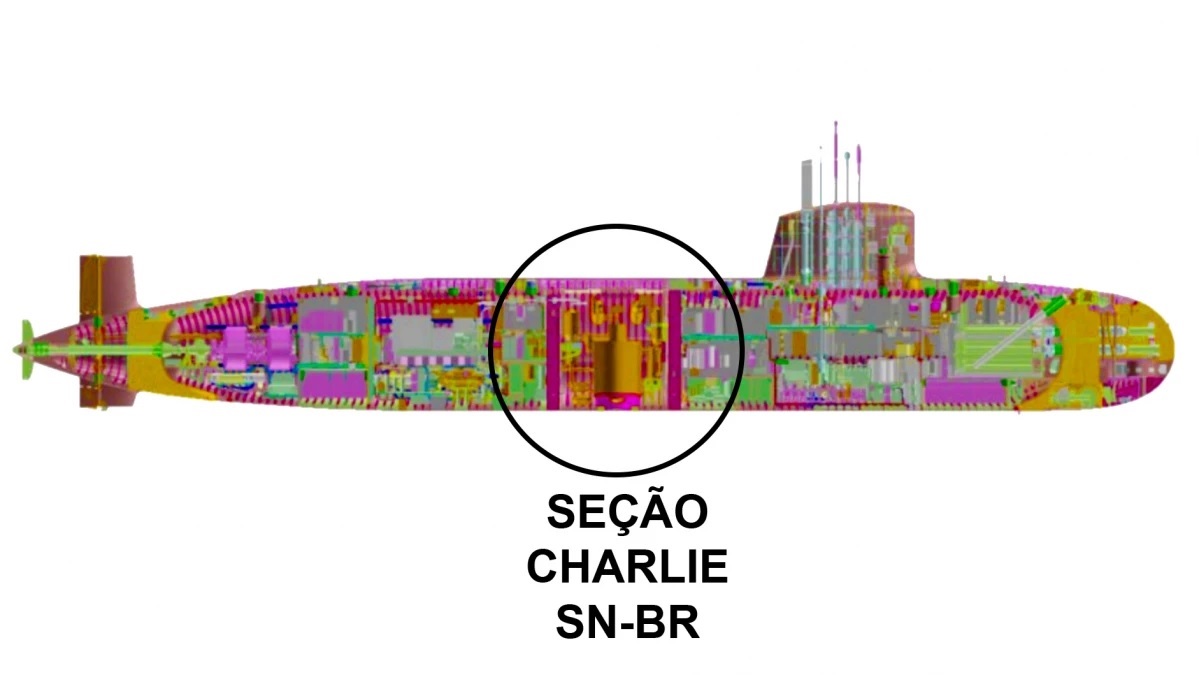
Aguiar: Regarding the schedule for the nuclear-powered submarine, we can say that, after many years of selfless effort, we have an integrated schedule that includes the construction of the submarine (hull), the nuclear facilities at Itaguaí (ICN/EBN), the effective activation of LABGENE, the shore test reactor, and the vital process of issuing the nuclear licenses. Those involving onshore work remain the National Nuclear Energy Commission’s (CNEM) responsibility. Everything related to the reactors of naval means becomes the responsibility of the Naval Agency for Nuclear Safety and Quality under the aegis of the Brazilian Navy. Therefore, the first naval means equipped with a nuclear reactor, authorized by the Navy, will be the nuclear propulsion submarine. The first partial construction license was granted at the end of 2021, which decisively influenced the progress of the project’s final design of this strategic means. Therefore, we can say that the nuclear-powered submarine has already started construction because we have signed the contract to construct the first hull qualification section of this nuclear-powered submarine.
Portalis: The two stages of the qualification section are planned for between 2022 and 2023. A first section will be made in common steel, to qualify and calibrate the construction tools of this hull. After this inaugural action, the qualification section will be made with imported special steel, which has already been procured in 2021 and will be delivered by the supplier at the end of 2022. Once the construction tools and procedures have been defined and qualified, the section itself will be built and, if it meets the specifications, it can be used in the submarine. This fundamental section of the hull, the Charlie, is the most complex because it will receive the nuclear reactor. The other sections are much less challenging because they will not be new to the Itaguaí teams. The great work demand is to satisfactorily qualify the Charlie section of the nuclear reactor, which requires greater preparation of workforce and equipment.
What about integrating the platform (submarine) control systems and the weapons, sensors, command, control, and communications systems?
Aguiar: Conventional submarines are expected to complete the material contract and the construction itself by the end of 2022. Combat and platform systems are fully upgraded to state-of-the-art. As construction and delivery of assets progress, modernizations and new capabilities are added and made available to the entire fleet. That is why the commissioning of the maintenance yard by 2023 is so important. To this must be added the technology transfer of conventional submarine combat systems. Extending ICN’s activities beyond submarines, as is being studied, will bring even more capabilities to the high-capacity shipyard.
Portalis: S-BR combat equipment, when mounted on submarines, follows a dynamic upgrade process. We qualify personnel for each new ICN stage in collaboration with the Brazilian Navy. The teams are trained and qualified, and the contract stipulates control methods that prevent obsolescence of any technology during the operational life of the submarines. It is a dynamic and continuous process of qualification and updating personnel and hardware/software upgrades.
With information from Info Defensa
More: Brazil news in English, every day from The Rio Times.
Editorial responsibility: Matthias Camenzind, Editor-in-Chief · Editorial standards · Report an error