Grains Dip as China Demand, Harvest Pressure Soy, Corn, Wheat

Key Facts
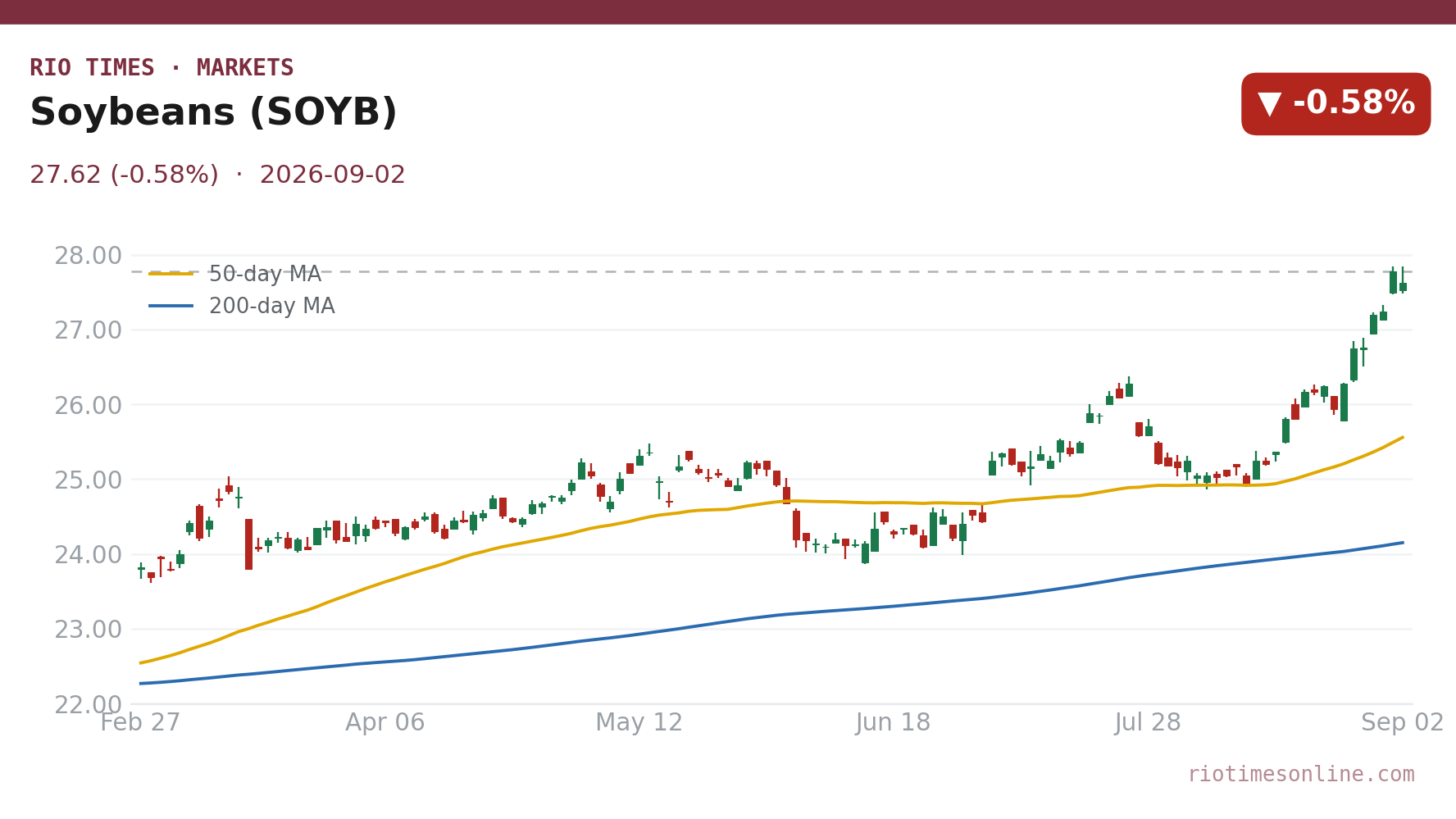
- Soybean tracker fell -0.58% to US$27.62, reflecting weak Chinese buying interest against a backdrop of huge South American supply.
- Corn tracker slipped -0.34% to US$20.22 as the northern Brazilian second-crop harvest neared 90% completion, keeping export pressure on prices.
- Wheat tracker eased -0.50% to US$27.86 after a run-up driven by Black Sea supply concerns lost momentum in thin trading.
- Argentina’s tax holiday The suspension of grain export taxes until October 31 is designed to accelerate shipments and bring in dollars, a policy that adds near-term supply.
- China’s footprint Chinese buyers had been in the market for roughly 8 million tonnes of previously committed corn, but fresh soybean demand remains the missing piece.
- Regional harvest Argentina’s corn harvest advanced to 88% complete, while Brazil’s second-crop corn in the north is just under 90% done, reinforcing the export flow.
Today’s Focus
Grain trackers closed lower on Wednesday, September 2, 2026, as the weight of South American harvest progress and uncertain Chinese demand offset earlier supply fears. The soybean, corn and wheat proxies all posted modest declines, with no single panic driver but a steady drift lower.
Brazil and Argentina remain the world’s export engine, but that very abundance is pressuring prices. The Brazilian second-crop corn harvest is nearly complete, Argentine corn is 88% done, and Argentina’s suspension of export taxes until October 31 is encouraging farmers to sell more aggressively.
China is the swing factor. While Chinese buyers held roughly 8 million tonnes of previously committed corn, fresh soybean purchasing has been cautious this season, leaving the market without a bullish demand anchor.
For foreign investors, the currency link matters: a weaker dollar can support grain exports from the region, but that dynamic is being overshadowed by the sheer volume of supply moving through ports.
What matters today. The session reflected a market caught between ample South American supply and a lack of fresh Chinese demand, not a structural break.
01 The session in one read
Grain trackers drifted lower on Wednesday, September 2, 2026, as South America’s harvest progress and a lack of fresh Chinese soybean buying outweighed the lingering Black Sea supply concerns that had supported wheat.
The soybean proxy closed down -0.58% at US$27.62, the corn tracker fell -0.34% to US$20.22, and the wheat tracker eased -0.50% to US$27.86, a modest but telling retreat across the complex.
The grains complex is likely to stay hemmed in by harvest progress and Argentina’s export tax holiday, which encourages near-term selling. The variable to watch is any fresh signal from Chinese state buyers returning for soybean cargoes.
02 The board
The three exchange-traded funds that track grains moved together, a sign that the session was driven by broad grain fundamentals rather than a single crop story.
The soybean-tracking fund settled at US$27.62 in US-dollar terms, while the corn-tracking fund closed at US$20.22 and the wheat-tracking fund at US$27.86.
| Asset | Level | Change |
|---|---|---|
| Soybeans (SOYB) | US$27.62 | -0.58% |
| Corn (CORN) | US$20.22 | -0.34% |
| Wheat (WEAT) | US$27.86 | -0.50% |
Source: RT close, 2026-09-02. Where a commodity has no spot feed, an exchange-traded tracker or leading producer is shown as a labelled proxy.
Live Market IntelligenceThe live market board
Rio Times · Live Market Intelligence
Latin America — Cross-Market Board
| Instrument | Last | Change | YoY | Prev. | High | Low | Volume |
|---|---|---|---|---|---|---|---|
| IBOV | 205,430.33 | +0.54% | +21.85% | 204,324.26 | 168,310 | 167,142 | — |
| IPSA | 10,970.29 | -0.01% | — | 10,971.88 | 11,210 | 10,984 | 1,513,213,483 |
| IPC MEX | 68,929.72 | +1.87% | +12.17% | 67,663.29 | 66,121 | 65,405 | 108,886,187 |
| MERVAL | 2,848,945 | -0.35% | +30.51% | 3,022,485 | 3,042,365 | 2,991,150 | — |
| COLCAP | 2,566.28 | -0.55% | — | 9.04 | 9.05 | 9.02 | 4,133 |
| BVL PERÚ | 60,210.69 | -0.91% | — | — | — | — | — |
| USD/BRL | 5.16 | +0.01% | -5.13% | 5.16 | 5.18 | 5.14 | — |
| EUR/BRL | 5.95 | +1.01% | -5.83% | 5.89 | 5.98 | 5.94 | — |
| USD/MXN | 17.06 | -0.24% | -8.58% | 17.10 | 17.08 | 17.01 | — |
| USD/CLP | 913.98 | +0.04% | -5.67% | 913.65 | 915.11 | 906.68 | — |
| USD/COP | 3,140 | +0.03% | -22.04% | 3,139 | 3,141 | 3,105 | — |
| USD/PEN | 3.36 | -0.66% | -4.82% | 3.38 | 3.38 | 3.35 | — |
| USD/ARS | 1,493 | +0.10% | +12.96% | 1,491 | 1,494 | 1,480 | — |
| USD/UYU | 40.27 | +1.24% | +1.80% | 39.77 | 40.27 | 40.23 | — |
| USD/PYG | 5,939 | +1.68% | -19.54% | 5,841 | 5,939 | 5,925 | — |
| USD/BOB | 11.64 | -0.76% | +72.04% | 11.73 | 11.72 | 11.64 | — |
| USD/DOP | 58.34 | +1.25% | -3.44% | 57.62 | 58.34 | 58.04 | — |
| USD/CRC | 445.92 | +0.89% | -9.71% | 441.97 | 448.50 | 445.92 | — |
03 What moved it
Supply is the central pressure point. Argentina’s corn harvest has advanced to 88% complete, and Brazil’s second-crop corn in the north is just under 90% done, meaning fresh exportable grain is hitting the market.
Argentina’s suspension of export taxes on grains until October 31 also incentivises farmers to sell now rather than wait, adding near-term supply and supporting the government’s need for dollar inflows.
On the demand side, Chinese buyers held roughly 8 million tonnes of previously committed corn, but that stock of commitments has not translated into aggressive new soybean purchases this season, leaving the complex without a fresh bullish spark.
04 The Latin American read
Brazil and Argentina are the world’s export engine for soybeans and corn, and their harvest pace is now translating directly into port loadings and price pressure.
For Argentina, the tax suspension until October 31 is a deliberate policy to speed up grain sales and bring dollars into a cash-strapped economy, which has the side effect of capping international prices.
Brazil’s role is more structural: its export record and steady shipments to China mean that even modest shifts in Chinese buying patterns move the global market.
05 The names to watch
The soybean-tracking fund is the clearest proxy for Chinese demand signals; any confirmation of fresh Chinese purchase tenders will likely lift it first.
The corn-tracking fund is tied to South American harvest completion and Argentina’s export policy, both of which are now firmly in the supply-bearish camp.
The wheat-tracking fund remains the most geopolitically sensitive of the three, with Black Sea supply disruptions still a latent risk even after Wednesday’s pullback.
06 The outlook
The path of least resistance appears lower for soybeans and corn while harvest selling accelerates and Chinese demand stays cautious.
Wheat is the outlier, with the potential for renewed Black Sea supply headlines to reverse the session’s softness quickly.
07 What to watch
- Chinese soybean tenders: Any fresh purchase announcement would signal that the demand void is filling and could lift the soybean tracker.
- Argentina export tax policy: The October 31 deadline matters; any extension or early reversal would change the pace of farmer selling.
- Black Sea shipments: New disruption headlines would likely support the wheat tracker and spill into broader grain sentiment.
- US dollar moves: A weaker dollar can support grain exports and cushion the complex, while dollar strength would add to the current pressure.
Frequently Asked Questions
Why did grains fall on Wednesday?
Ample South American harvest supply and cautious Chinese soybean demand outweighed earlier wheat supply fears.
What is Argentina’s export tax suspension?
It is a temporary measure until October 31 that removes taxes on grain exports to accelerate sales and bring in dollars.
How does China affect soybean prices?
China is the largest soybean buyer, and its shift toward Brazilian supply means its purchasing pace directly moves global prices.
Which instrument is most at risk from Black Sea headlines?
The wheat-tracking fund is the most sensitive to supply disruptions in that region.
Market data: RT
This article was produced by The Rio Times’ automated newsroom system. How we use AI · Report an error · Editorial responsibility: Matthias Camenzind, Editor-in-Chief
LatAm Markets: Live Signals → — real-time movers, turnover leaders and FX across Latin America.